
Instant-Retail Restaurant Alliance Network: A Six-Step SOP for Starting in One Commercial District
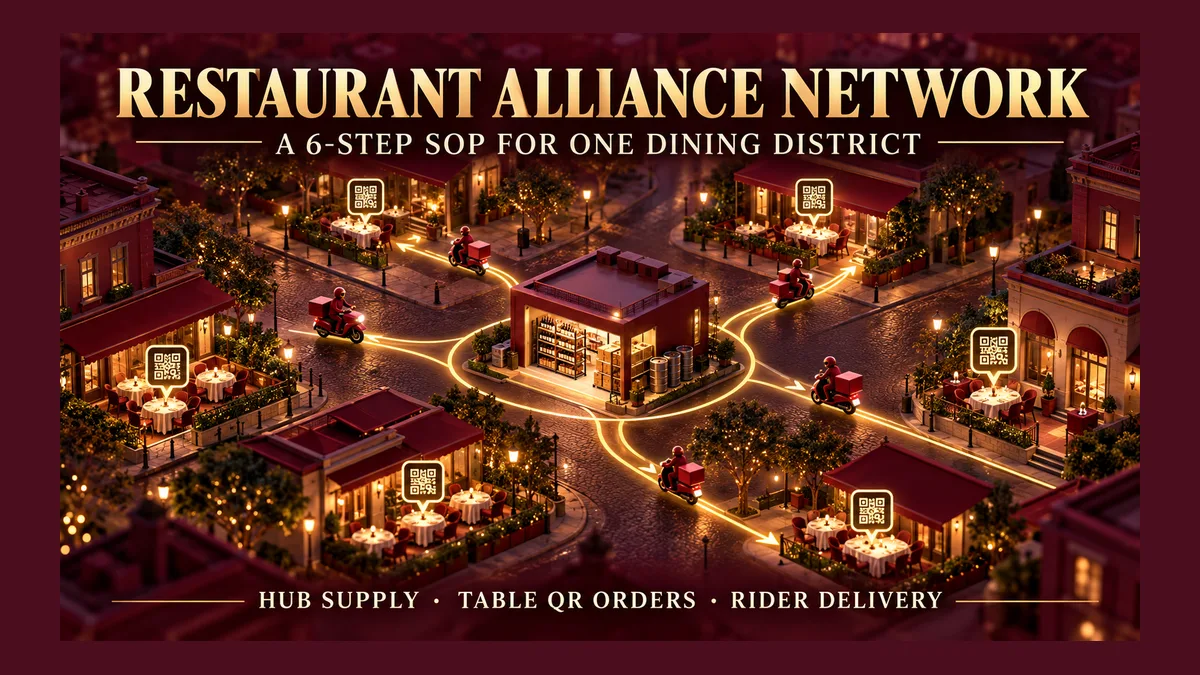
Regional alcohol distributors do not need to begin instant retail by opening a street-facing store or covering an entire city at once. Start with one commercial dining district: a micro-fulfillment hub holds inventory, restaurants provide table QR-code sales entry points, and riders deliver drinks to the table. Once the closed loop works, add community tobacco-and-liquor stores and expand the supply, fulfillment, and restaurant-sales network step by step.
The basic logic of the Restaurant Alliance Network is simple: micro-fulfillment hubs supply inventory, community stores fulfill nearby orders, and restaurants convert demand through table QR codes. The model can be broken into six steps.
Step 1: Select One Dining District and Set Up One Micro-Fulfillment Hub
First, choose one dining-focused commercial district and locate a micro-fulfillment hub nearby.
The hub is responsible for inventory, picking, and supply. It does not rely on street visibility to acquire customers, so it does not need a prime storefront; it does need convenient inbound and outbound access, easy rider pickup, and efficient local delivery. At launch, stock products around the needs of nearby restaurants.
First capture and fulfill nearby orders well; then expand coverage.
Step 2: Build Partnerships with 30 Restaurants Within a Three-Kilometre Radius
Using the micro-fulfillment hub as the centre, begin by developing 30 restaurant partners within roughly three kilometres.
The partnership can work like this: the restaurant does not stock the featured beverages or pay a deposit; a table QR code is placed at the table; customers scan it to buy; and the restaurant receives an agreed revenue share.
This is more than placing another QR code. It creates a beverage sales entry point without requiring the restaurant to carry inventory. Before launch, clarify:
- Which entry point will customers use to buy?
- Who accepts the order and who fulfills it?
- How is revenue shared, and when is settlement completed?
- Who handles stockouts, returns, exchanges, and customer complaints?
The sales entry point, fulfillment method, revenue-sharing rule, and responsibility boundary should all be written into the partnership arrangement.
Step 3: Configure Table QR Codes So Customers Can Buy by Scanning
Once a restaurant joins, link each table QR code to the relevant restaurant and table.
When customers need beverages, they scan the code, select products, confirm the order, and pay without manually entering a delivery address. The fulfillment party can see the restaurant and table destination. Configure the codes in advance and test ordering, order acceptance, and destination accuracy in real use.
Customers take fewer steps, fulfillment teams know exactly where to deliver, and restaurants can reconcile orders and revenue shares.
Step 4: Pick, Dispatch, and Deliver to the Table
At the start, the micro-fulfillment hub picks and dispatches orders. A rider collects the order from the hub and delivers it to the designated table.
The workflow is:
Customer scans → selects beverages and pays → hub picks and dispatches → rider collects → delivery reaches the table.
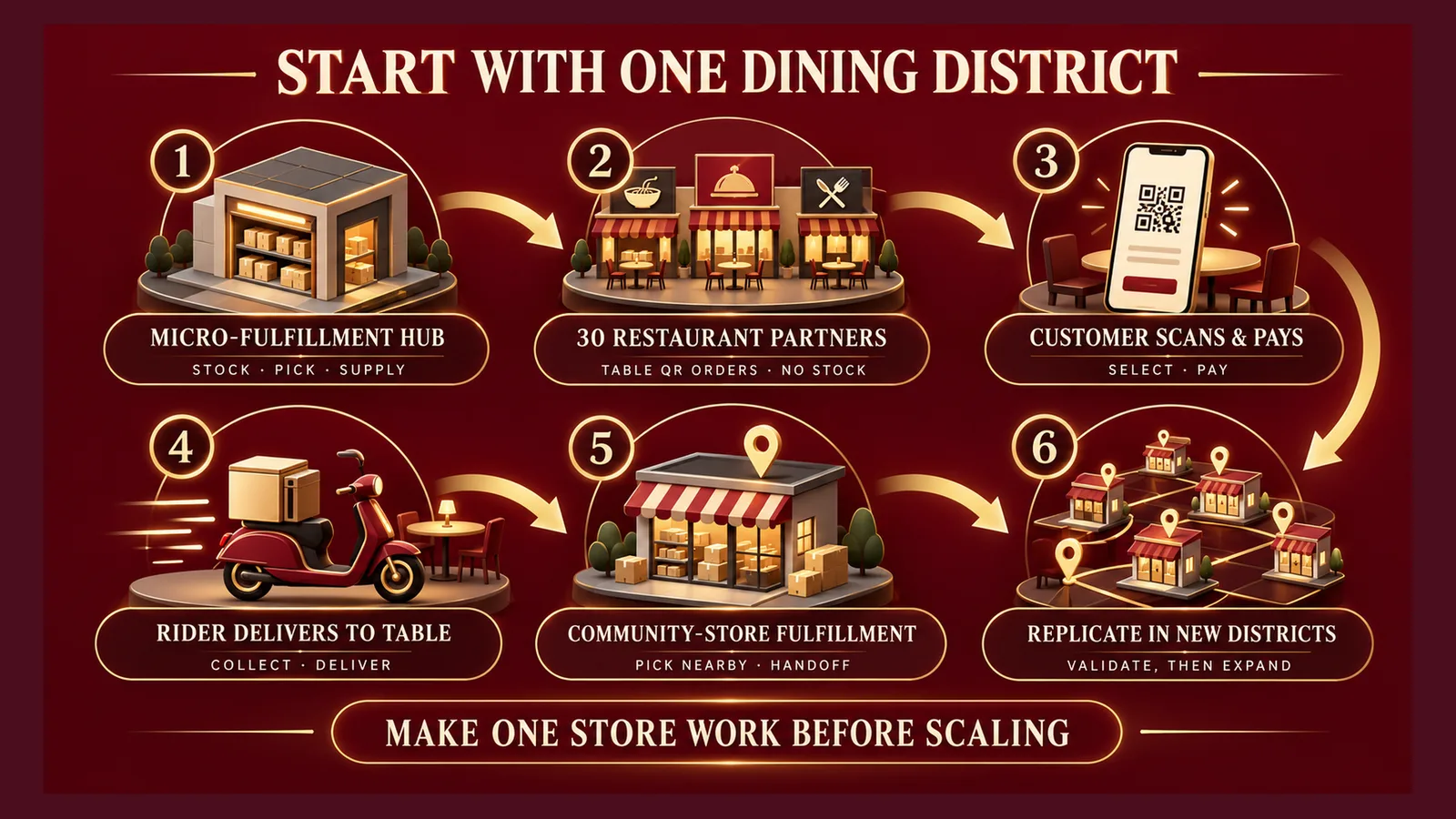
“Delivery to the table in 15 minutes” can be a service target, but it must be validated against distance, stock readiness, pickup waiting time, and rider capacity. Actual fulfillment performance should prevail.
First make the minimum loop work smoothly: one micro-fulfillment hub and 30 restaurant partners. Do not only ask whether orders arrive; test whether acceptance, delivery, and after-sales service work reliably. Then replicate the model across more districts. For example, with 10 supply nodes:
10 nodes × 30 restaurants per node = 300 restaurants.
This is a replication path, not a requirement to build 10 hubs at launch.
Step 5: Add Tobacco-and-Liquor Stores as Community Fulfillment Nodes
After gaining experience in the initial district, approach local tobacco-and-liquor stores to discuss community-store partnerships.
Micro-fulfillment hubs and community stores have different roles, rather than duplicating each other:
Micro-fulfillment hub: central inventory holding and supply to community stores.
Community store: accepts nearby orders, picks products, and hands orders to riders.
Restaurant: provides the table QR-code sales scenario.
Rider: collects and delivers the order.
As community stores join, the model can move from “direct delivery from the hub” to “central supply from the hub and nearby fulfillment through community stores.”
This article uses 300 community stores as an expansion scenario. In reality, inventory, order acceptance, delivery, and settlement should be validated in batches; the number of signed outlets alone is not enough.
Step 6: Use Community-Store Relationships to Expand into Nearby Restaurants
Community-store owners know local neighbourhoods and restaurant operators. They can jointly visit restaurants and explain the partnership model.
Restaurants provide the sales scenario, community stores handle nearby fulfillment, and both parties share revenue under the agreed rules.
Assume 300 community stores, each developing 30 new, non-overlapping restaurant partners:
300 stores × 30 restaurants = 9,000 new restaurants.
If those new outlets do not overlap with the initial 300 restaurants:
Initial 300 restaurants + 9,000 new restaurants = 9,300 restaurants.
Consider one order scenario. If every restaurant closes five orders a day:
9,300 restaurants × 5 orders = 46,500 orders per day.
Outlet counts must be de-duplicated. Order volume is a planning scenario, not actual performance or a transaction promise.
Whether scale is achieved depends on real conversion and sustained fulfillment capability.
Incremental Scenario: Extend from Everyday Dining to Banquet Partnerships
The model can also develop banquet beverage offers across different price tiers and work with hotels.
Configure products around banquet occasions, use QR-code campaigns to connect with interested guests, and let guests voluntarily register as members for later product information and service.
However, “hosting one banquet” does not mean “acquiring every guest as a member.”
Banquet conversion, member connection, and follow-up service must each be managed separately.
Validate One Store First, Then Replicate the Model
The Restaurant Alliance Network is not simply about placing table QR codes in more restaurants. It is about building a closed loop in which supply, conversion, fulfillment, delivery, and revenue sharing keep operating together.
Micro-fulfillment hubs supply inventory; community stores fulfill orders; restaurant table QR codes convert demand.
Start with one commercial district. Validate first, then expand.
Make one store work before replicating at scale.
Comment “SOP” to receive the Restaurant Alliance Network Implementation SOP and Profit-Settlement Worksheet.