
Zhenjiu’s Official Flagship Lightning Warehouses: Did a 310% Three-Month Growth Case Validate a Light-Asset Route for Premium Baijiu in Instant Retail?
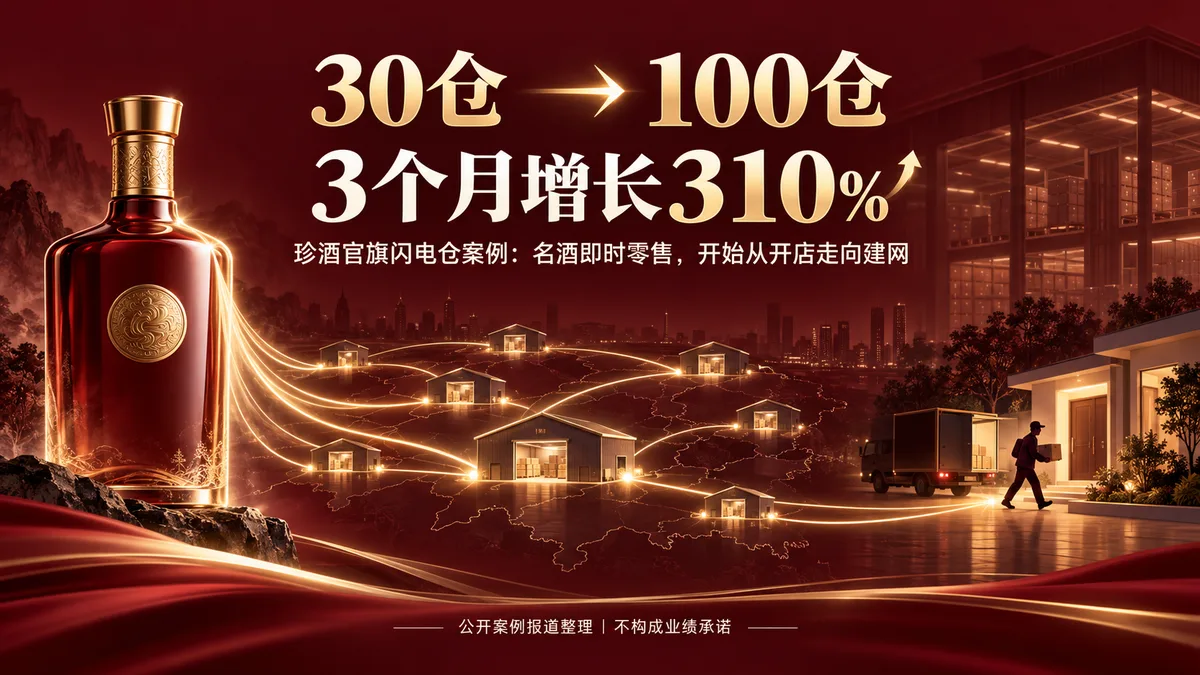
At Meituan’s Instant Retail Industry Conference on September 22, 2026, a Zhenjiu case was presented: a 30-warehouse pilot expanded to 100 warehouses across core areas of 18 cities in three months, with sales revenue up 310% sequentially. Assortment reached 3.5 times that of comparable branded liquor stores, while per-store output reached 2.5 times. Premium baijiu’s instant-retail playbook is shifting from “list products on a platform” to “use a warehouse network to build local availability.”
A 30-Warehouse Pilot Reached 100 Warehouses in Three Months: Another Route into Instant Retail#
At Meituan’s 2026 Instant Retail Industry Conference on September 22, the Zhenjiu figures drew attention.
An initial pilot of 30 official flagship lightning warehouses expanded to 100 warehouses across the core areas of 18 cities in three months. Sales revenue increased 310% sequentially. The assortment reached 3.5 times that of comparable branded liquor stores, and per-store output reached 2.5 times.
Three years ago, many baijiu companies approached instant retail by asking a distributor to open a platform storefront and list inventory. Zhenjiu’s route is different: it chose official flagship lightning warehouses.
What does that mean in practical terms? Public reporting confirms that Meituan positions the model as instant-retail infrastructure for brands: a way to improve local distribution, lower the investment required to operate in instant retail, and reach consumers more directly. The reported reason for Zhenjiu’s choice was that its existing offline distribution system could not fully absorb active consumer demand, while the model did not require the brand to build warehouses itself.
The details of title to inventory, inventory-turn responsibility, pricing permissions and data access will vary by agreement among the brand, platform, warehouse operator and local partners. A business plan should never present those mechanics as uniform industry rules. They need to be defined in contracts, system permissions and actual fulfillment design.
Where Distributors Cannot Reach Quickly, a Warehouse Network May Fill the Gap#
Why does this path appeal to a brand such as Zhenjiu? The first answer is supply coverage.
For a liquor brand expanding across regions, building an offline distribution network takes time: distributor recruitment, partner qualification, team formation, terminal rollout and local service cannot happen overnight. If demand already exists in a city but local supply is inadequate, consumers may find the brand but still fail to buy it at the moment of need.
Official flagship lightning warehouses offer another way to fill that gap: use an existing warehouse network to place instant-retail-ready products close to consumers. Zhenjiu’s move from 30 trial warehouses to 100 warehouses at least demonstrates the possibility of faster replication.
Speed is only the visible result. Coverage density is what matters. A conventional network uses distributors, stores and retail terminals as nodes. A warehouse network uses fulfillment points near consumers. Its advantage depends on warehouse density, delivery range, sellable inventory, picking efficiency and peak-hour capacity—not only on the warehouse count.
Assortment depth is another signal in the case. The report says Zhenjiu’s official flagship lightning warehouses carried 3.5 times the assortment of comparable branded liquor stores. Stores have finite shelf space and working capital; warehouse networks may be better able to carry small formats, gift boxes and tasting packs. But more SKUs do not automatically make a better operation. The assortment must fit instant-consumption occasions and turn efficiently.
Instant Retail’s First Half Was About Going Online; the Next Is About Organizing Supply#
For the past two years, a common instant-retail move for baijiu brands has been to ask distributors to open platform stores. That is a reasonable beginning. Yet a consumer’s experience is shaped by SKU depth, inventory accuracy, opening hours and delivery capability.
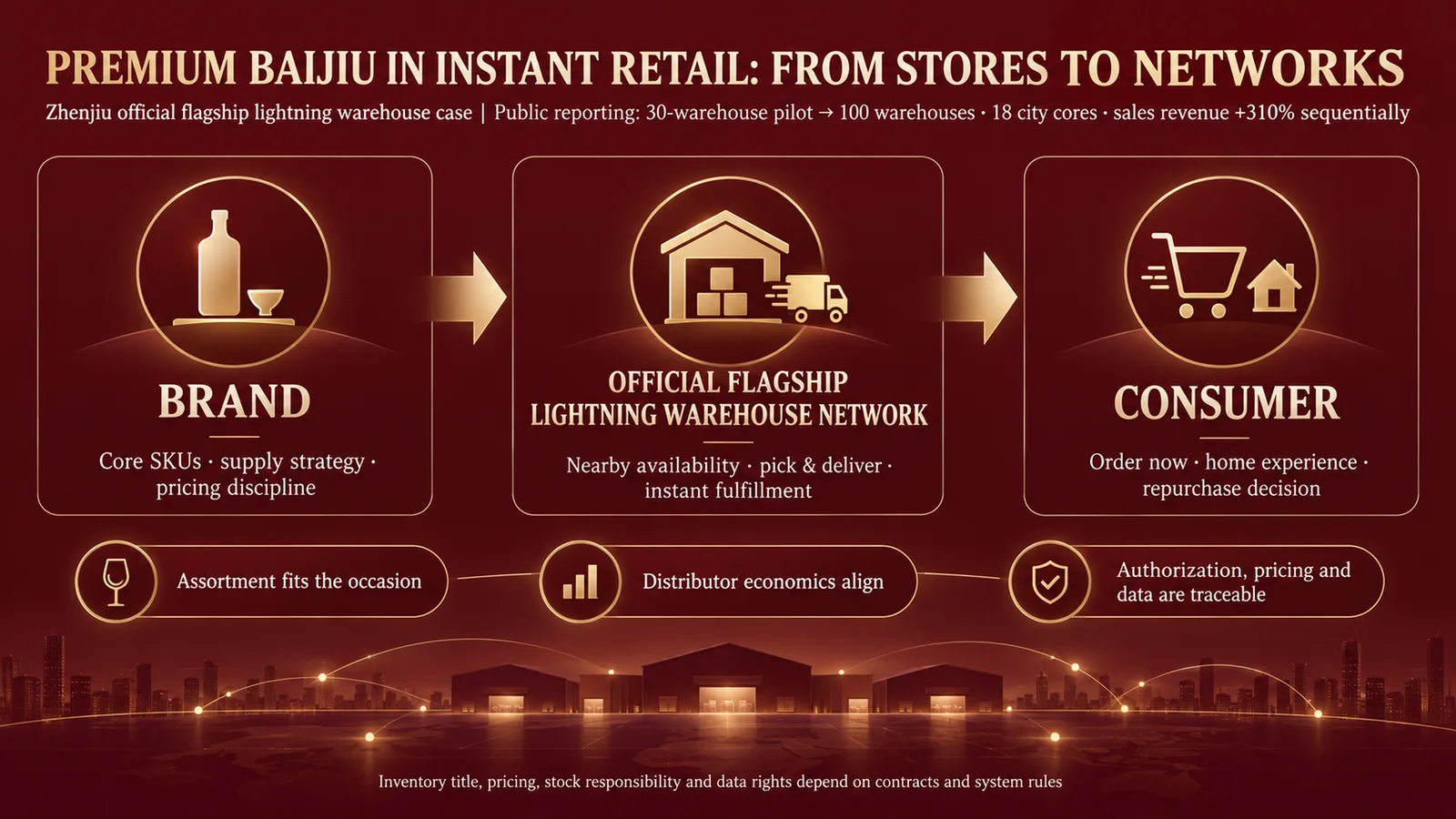
Official flagship lightning warehouses divide the work differently. Brands can focus more on product selection, supply strategy and branded experience, while the platform and warehouse network focus on nearby availability and immediate fulfillment. The model works only when several conditions are aligned:
Assortment fits instant demand: gifting, banquets, casual gatherings and emergency replenishment require different price bands, formats and packaging.
Pricing discipline is coordinated: official warehouse offers, distributor stores, conventional e-commerce and group-buying channels need clear boundaries to avoid channel conflict.
Authorization and authenticity are traceable: for premium brands, authorization, supply provenance, traceability and after-sales accountability must be clear.
Inventory and fulfillment are reliable: stockouts, cancellations, late delivery, breakage and service recovery all affect the brand directly.
Consumer data is compliant and usable: the controller, permitted purposes, contact permissions and retention period cannot be ignored merely because the sale is instant retail.
That is the difference between opening a store and building a network. Opening a store adds a sales touchpoint. Building a network organizes product, pricing, inventory, fulfillment and customer experience into repeatable local supply capability.
Official Flagship Lightning Warehouses Are Not a Universal Answer#
The model can be valuable, but it will not generate growth for every brand.
First, demand and brand relevance remain prerequisites. A warehouse network is an amplifier, not a demand engine. Without awareness, product fit and local occasions, more warehouse nodes will not produce durable orders.
Second, assortment discipline matters more than SKU count. Entering a warehouse network should not become a wholesale relocation of the full portfolio. The assortment should serve high-frequency, urgent, gifting and gathering occasions. Slow movers consume capacity and can raise operating cost.
Third, distributor economics need to be redesigned. A brand connecting directly to a warehouse network does not make distributors irrelevant. Distributors still matter for local distribution, restaurants, group-buying, channel maintenance and deeper market development. If price, territory, supply and customer ownership are unclear, warehouse-led incremental sales may become channel conflict first.
Fourth, distinguish new demand from order migration. If consumers simply move an existing purchase from a physical store to an app, the brand gains a new transaction route but not necessarily new consumption. Real increment comes from occasions triggered by immediacy and consumers who were previously not served effectively.
Premium Baijiu Instant Retail Is Moving from “Opening Stores” to “Building Networks”#
Zhenjiu is not the only liquor brand increasing its instant-retail investment. The conference itself sent a broader signal: competitive focus is moving from basic store–warehouse–delivery infrastructure toward product supply better suited to instant occasions.
For premium baijiu brands, the next step is not simply another platform listing. It is a hybrid network: the brand manages core SKUs, supply rules and pricing discipline; distributors manage local service, deep distribution and occasion development; the warehouse network handles immediate fulfillment. No party simply replaces another. Their responsibilities, data rights and economic boundaries must be redesigned.
The Zhenjiu case—30 pilot warehouses, 100 warehouses in three months, and 310% sequential sales-revenue growth—offers a reference point. When a brand wants faster consumer reach without building warehouse and delivery operations from zero, official flagship lightning warehouses may be a light-asset path worth evaluating.
But entry into a warehouse network is only the first step. Long-term results still depend on whether products sell, prices remain disciplined, channels coordinate, fulfillment is reliable, and consumers choose the brand again.
Sources and Verification Notes#
Southern Finance report reprinted by Eastmoney: Zhenjiu sales revenue up 310% after entering Meituan official flagship lightning warehouses: used to verify the 30-warehouse pilot, 100 warehouses in three months, 18-city coverage, 310% sequential sales growth, 3.5-times SKU figure and 2.5-times unit-output figure.
2026 Meituan Instant Retail Industry Conference report: used to verify the conference date, location, the official flagship lightning warehouse positioning and the “Product NEXT” plan.
Sina Tech conference report: used to corroborate the September 22 conference and public statements on instant-retail infrastructure.