
Jiuxiaojiu: 22 Directly Operated Stores and 400,000 Members — Why Regional Liquor Retailers Need to Own Customer Relationships, Not Just Add Stores
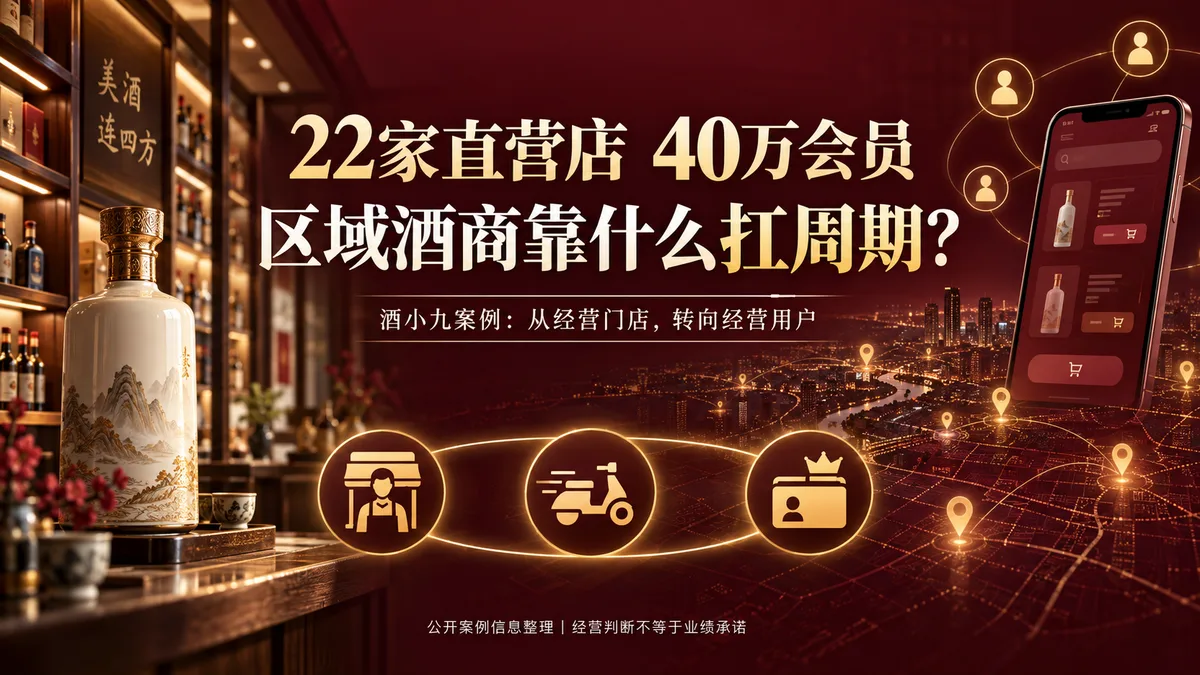
Jiuxiaojiu, a liquor retailer in Luohe, Henan, has built more than 400,000 registered users on its own app through 22 directly operated stores—roughly one-sixth of the city’s resident population. Trade-media reports say its revenue and profit both grew in January–August 2026, with private-domain operations and instant retail contributing to performance. The lesson is not simply to open more stores: use store associates to acquire customers, local fulfillment to retain them, and a membership system to turn transactions into durable customer relationships.
22 Direct Stores and 400,000 Members: A Regional Liquor Retailer Still Growing
Luohe has a resident population of about 2.34 million. Jiuxiaojiu reports more than 400,000 registered users on its own app. On that basis, roughly one in every six local residents has registered with the retailer.
Twenty-two directly operated stores, 400,000 members, and reported growth in both revenue and profit for January–August 2026: in a period when many regional liquor businesses are under pressure, that is a conspicuous scorecard.
Founder Wang Xinzhuang has worked in the liquor trade for more than two decades. The traditional route for a regional retailer was store expansion: add locations and cover more streets. But after a certain point, each extra store adds less incremental reach while rent, labor and inventory pressure continue to rise.
Jiuxiaojiu’s answer has been to move more of its operating focus toward the customer.
That does not mean stores no longer matter. Stores remain local nodes for discovery, product selection, fulfillment and service. But a regional liquor retailer’s ability to withstand volatility depends on more than how many storefronts it has. It depends on whether it has an identifiable, reachable and repeatable customer base.
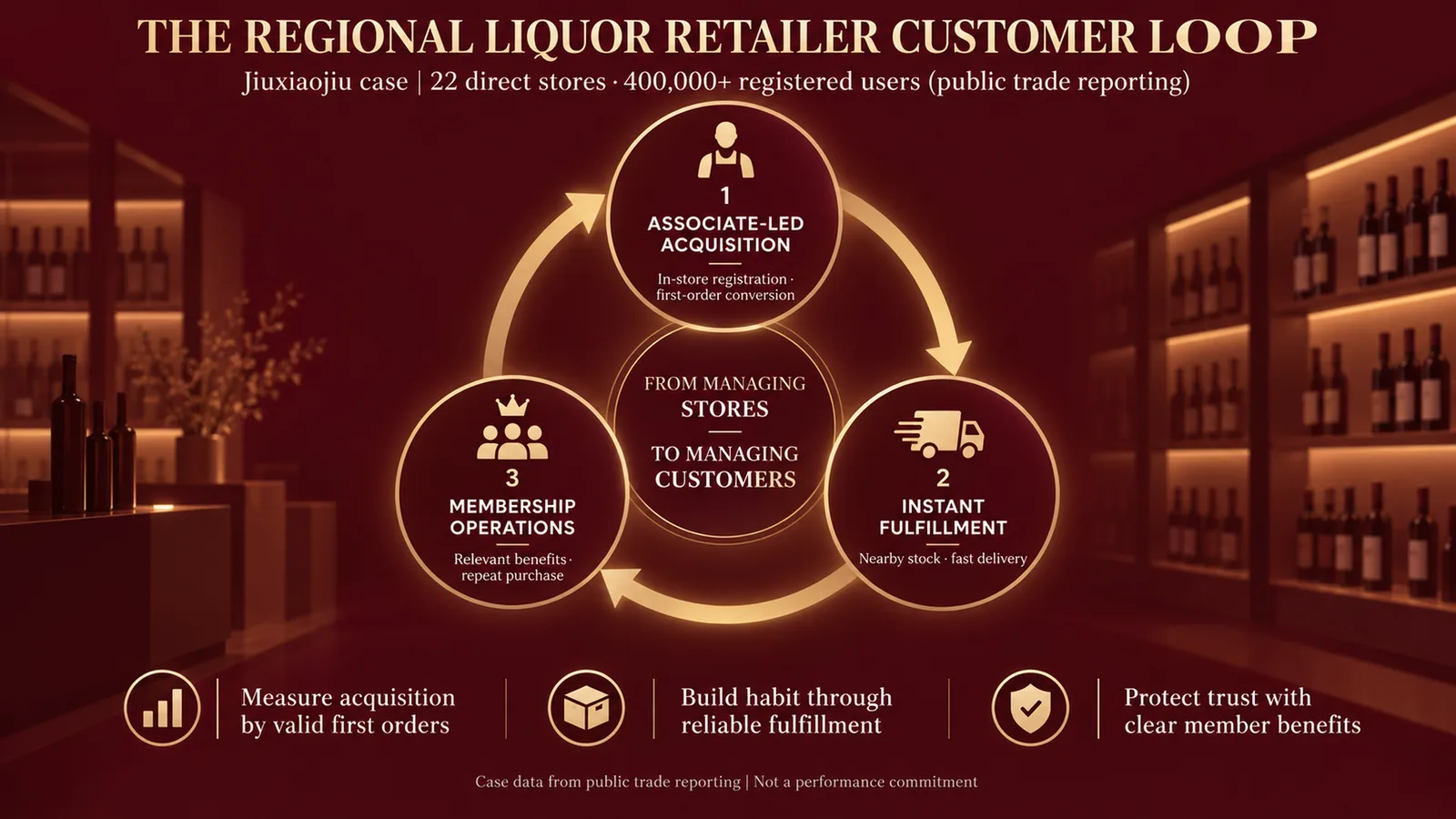
The 400,000-member base was built progressively around three linked actions: associate-led acquisition, local fulfillment-led retention and membership-led relationship building.
Customer Acquisition Is Not Only About Promotions: Every Associate Is an Entry Point
When liquor retailers talk about private-domain operations, the first instinct is often campaigns, coupons and group chats. Short-term activity is easy; building a customer base that can be operated over time is harder.
Jiuxiaojiu places acquisition in the store. Published reports say store associates are assigned registered-user growth tasks, using mechanisms such as gifts for adding WeChat and discounts for app registration. The company reportedly grew its registered-user base by around 10% in 2026.
The point is not merely another KPI. It changes the associate’s role from someone who closes a single sale to someone who opens a customer relationship. Product selection, payment and member benefits are already natural touchpoints while the shopper is in store.
For regional liquor retailers, the value of a store is not limited to shelves and a checkout counter. Frontline staff often understand local demand first: what customers buy, why they buy, when they replenish, and whether they have banquet or gifting needs.
Incentives therefore need to be tied to real customer value. Registration is only the entry point. A sound design tracks completed first orders, later repurchase, service quality and reversed or fraudulent orders. The goal is not “how many contacts were collected,” but “how many valid customer relationships were created.”
Retention Is Not Only About Low Prices: Local Fulfillment Turns Convenience into Habit
Acquisition alone does not create an asset. The customer must choose the retailer again when the next drinking occasion arises.
Jiuxiaojiu treats local delivery as part of its service proposition. Published reports cite a “15-minute delivery” commitment and describe one delivery completed in approximately 12 minutes and 43 seconds. The original Chinese draft referenced 19 minutes, but no direct public source for that precise figure was found; it is therefore not presented here as an established fact.
Whether the promise is 15 or 19 minutes, the commercial value is not the advertising number. It is the operating capability behind it: store density, ready-to-sell SKU availability, live inventory, order routing, picking speed and delivery coordination.
At home, during a meal, when friends arrive unexpectedly, or when a banquet needs more alcohol, consumers want to know: Is it nearby? Is it available now? How quickly can it arrive? When a retailer delivers at the moment of need, delivery becomes a repeat-purchase experience rather than a standalone cost.
A traditional liquor store’s service often begins when a shopper walks in and ends when they leave. Instant retail extends the service chain to the customer: ordering, picking, delivery, receipt, after-sales handling and the next relevant reminder.
Every reliable fulfillment experience reduces the effort required to choose the retailer next time. Low prices can be copied; nearby availability, fast delivery and accountable service require operating discipline.
Relationship Lock-In Is Not Scripted: Membership Is the Base for Resilience
After acquisition and fulfillment, the relationship needs a reason to continue.
In the Jiuxiaojiu case, stored-value membership is framed as part of a long-term customer relationship. Public reporting says the retailer began systematically promoting stored-value memberships in 2017 and cites a participation rate above 60% at the time. That was a company interview statement, not a verified current penetration rate across all members.
The business value of stored value is not simply taking payment early. For the customer, it should provide understandable benefits built on trust. For the retailer, it creates a more predictable repeat-purchase entry point. The prerequisites are clear terms, usable benefits, reliable refunds and accountable after-sales support. Stored value should never become merely a cash-retention device.
A regional retailer’s local reputation is the foundation of that relationship. Customers retain a balance because they believe the store will remain available, products are genuine, service is reachable and the balance will work as promised.
In strong markets, members support repeat purchase and basket size. In weaker markets, the relationship reduces dependence on one-off walk-in traffic. Stores can move, product mixes can change, and promotions expire; customers who are identified, served and engaged over time are far harder to replace.
The Regional Retailer’s Competition Is Not Store Count, but Customer Depth
The Jiuxiaojiu case does not mean every regional retailer should replicate 22 directly operated stores or pursue 400,000 members.
Cities differ in population, spending power, store density, brand mix and delivery cost. What can be generalized is the operating logic: stores deliver local service and fulfillment; associates open customer relationships; instant delivery captures immediate needs; membership turns a purchase into an ongoing relationship.
It is a three-part model:
Associate-led acquisition answers where customers come from.
Instant fulfillment answers why they stay.
Membership operations answer why they repurchase.
Each component fails in isolation. Associate acquisition without later customer value becomes a database pile-up. Delivery without customer capture becomes a pure cost center. Stored value without a dependable experience erodes trust. Connected in one consumer-operations and instant-retail system, they become a working loop.
For regional liquor retailers, the next move is not automatically “open one more store.” First understand the customers already within the existing network: who frequently needs emergency replenishment, who buys for banquets or gifting, who has gone inactive, and who merits continued service through associates, communities, campaigns and delivery.
The direction is clear, even though execution is detailed work. Associate incentives must not reward artificial sign-ups; inventory and delivery must keep their promises; member economics must remain sustainable; and customer data must be handled lawfully. Once a business shifts from managing stores to managing customers, it no longer has to place all growth bets on more rent, more shelving and more inventory.
Stores are nodes of local service. Customers are the long-term asset.