
Premium Baijiu Is Going Small: The Real Test for Small Bottles Is the Inventory Structure of Instant Retail
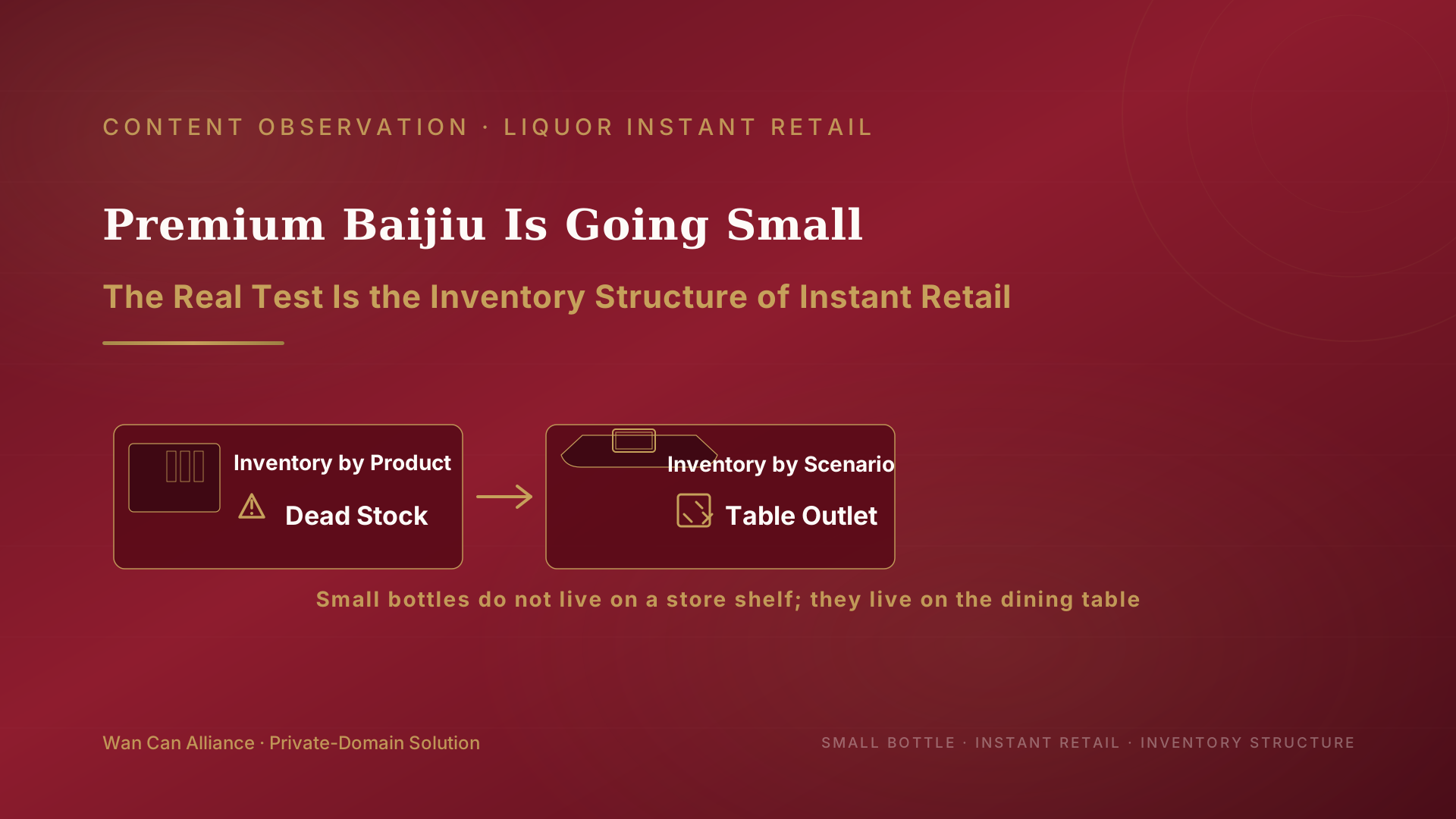
Premium baijiu brands are releasing small bottles all at once, but small bottles multiply SKU complexity several-fold, and if store inventory is organized by product rather than by consumption scenario, small bottles become an inventory black hole, the fix lies not in the warehouse but on the dining table. This article starts from why the likes of Luzhou Laojiao and Wuliangye are shrinking their bottles, breaks down why "making the bottle smaller is easy but the warehouse is hard," and lands on an approach where inventory follows scenarios.
1. The Bottle Got Smaller, and What It Targets Is Not Drink Volume but Scenarios
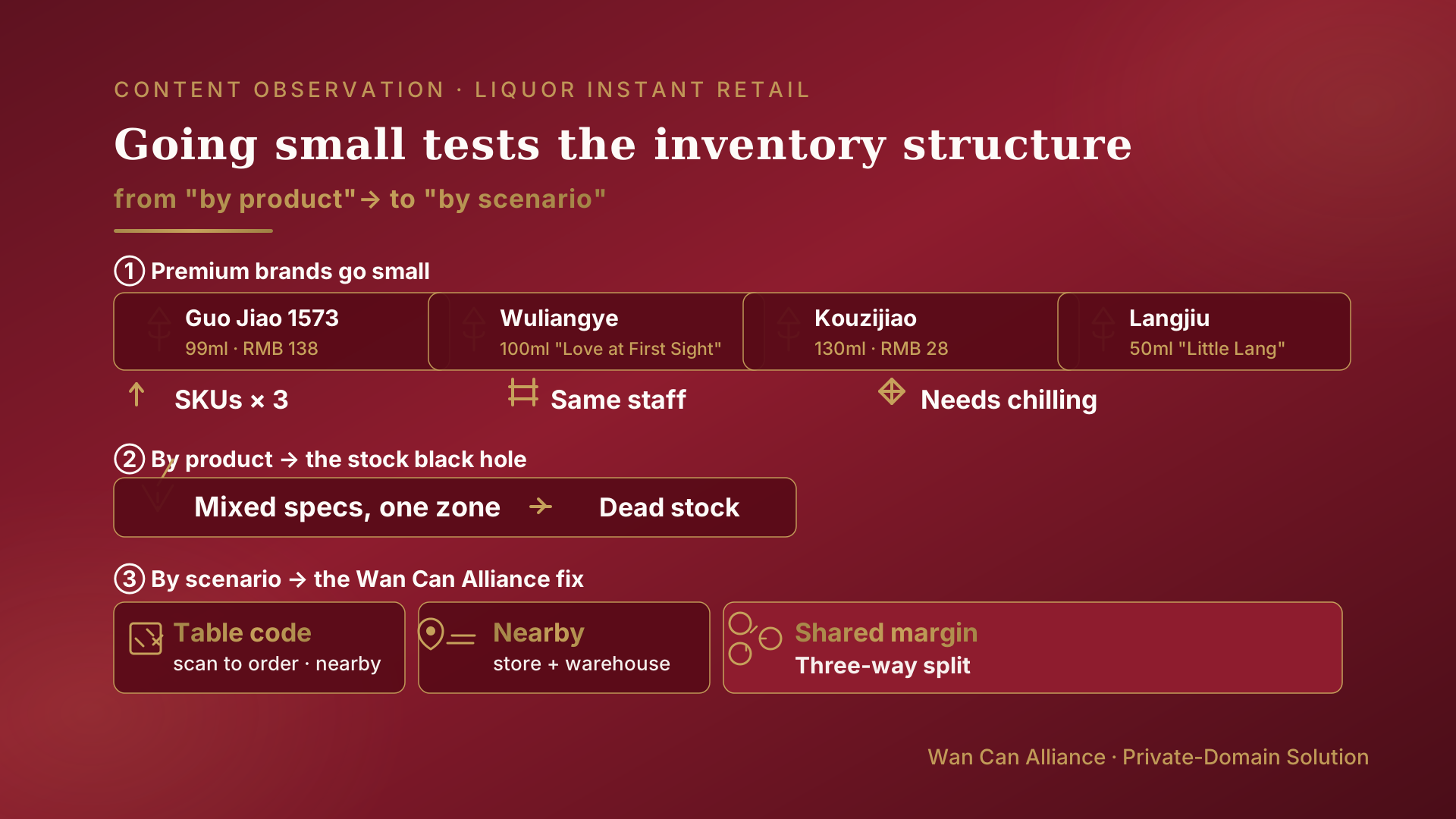
On September 23, Luzhou Laojiao launched its 99 ml Guo Jiao 1573 on its JD flagship store, 38° ABV, at an out-the-door price of RMB 138. The bottle is a scaled-down twin of the 500 ml standard edition, standing side by side like father and son.
This is no isolated case. Wuliangye introduced a 100 ml "Love at First Sight" (Yijian Qingxin) this year. Kouzijiao released its 33° ABV, 130 ml "Even a Sparrow Can Sip a Couple of Taels" (Maque Ye Neng He Er Liang) at RMB 28 a bottle. Langjiu launched a 50 ml "Little Little Lang" (Xiaoxiao Lang). Qinghua Lang also released a 100 ml double-bottle gift box for the first time. From Moutai Town to Suixi, from sauce-aroma to strong-aroma, the premium names are all making their bottles smaller.
A liquor chain operations lead in Chengdu, Zhao Ming, put it bluntly: young people will not make a special trip to a liquor store just to drink two taels of baijiu. At home scrolling on their phones, they may order one of these small, refined products on the spot, delivered within 30 minutes, woven seamlessly into a young person's consumption scene.
That remark of Zhao Ming's pinpoints the lifeline of small-bottle baijiu: it is not a category that waits for customers to come and pick it from the shelf; it has to be delivered to their hand proactively.
2. Shrinking the Bottle Is Easy; the Warehouse Gains an Extra Layer
Shrinking the bottle is not hard. The warehouse is.
A 500 ml Guo Jiao 1573 and a 99 ml version of the same product look like two specs of the same product. But in the warehouse, they are two completely different stock-keeping units. The 500 ml edition is palletized whole-case on standard racks and moved with standard totes. The 99 ml bottle is a size smaller, so it stacks differently, needs different totes, and follows a different picking route.
For the 50 ml "Little Little Lang," the 100 ml "Love at First Sight," and the 130 ml "Even a Sparrow Can Sip a Couple of Taels," each brand has added one more small-bottle product line. A store that once managed one or two specs suddenly has to manage four or five at once. The SKU count jumps from a dozen or so to several dozen. Storage capacity is unchanged. Headcount is unchanged.
Temperature is the bigger headache. Baijiu normally only needs an ambient-temperature warehouse, but some small bottles lead with an iced-drink scenario and require mixing chilled and ambient items in one delivery. That forces the warehouse to carve out a temperature-controlled zone, or at least to pre-chill the chilled bottles at the picking stage. One small bottle drags a whole string of new warehousing requirements behind it.
3. Inventory That Follows Products Turns into an Inventory Black Hole
Most stores today build their inventory structure by brand and capacity. A 500 ml row, a 99 ml row, a 50 ml row. It looks tidy, but the logic is "whatever the product line has, the warehouse holds it."
What scenario drives a customer to buy a small bottle? Adding one more on the fly at a dinner with friends. Wanting a sip alone at home. Wanting to taste a brand without buying a whole bottle. Friends showing up and gathering a table. These scenarios share one trait: immediacy. When the urge hits, they want it now; they will not plan a trip to the liquor store beforehand.
That is exactly the instant need that instant retail exists to catch. Meituan Instashopping announced an RMB 30 billion investment this year to take 30-minute delivery to full coverage. Waima, Meituan's liquor instant-retail platform, has already compressed average delivery time to 15 minutes.
But if 500 ml and 50 ml are mixed in the same picking zone, picking one 99 ml bottle means two extra steps, one extra bend, one extra glance at the label. A 15-minute promise can break on those two steps. Pick the wrong bottle once, and the return-and-exchange cost is higher than the bottle itself.
When inventory follows products, small bottles become an inventory black hole. A batch comes in, sells slowly, cannot be returned, is pushed to the deepest corner of the warehouse, and three months later a stocktake finds it gathering dust.
4. There Is a Demand on the Dining Table, but the Warehouse Has No Shelf Slot for It
Think differently. The consumption scene for small bottles is not the shelf of a liquor store; it is the dining table.
A person eating alone in a restaurant who wants a couple of sips of baijiu will not go to the nearby liquor store to buy a 500 ml bottle. It would be too much to finish, and awkward to take along. But sitting in the restaurant, with a QR code taped to the table, they scan in and order a 99 ml Guo Jiao 1573; 15 minutes later the rider sets it down at the table. It is just enough, and there is nothing to pack up.
This is exactly what Wan Can Alliance does. Centered on stores, dark stores, and community warehouses, it reaches partner restaurants within a 3 km radius. Restaurants pay no deposit and hold no stock; they only tape a dedicated Table-Code on each table. When a customer scans to order, the order is automatically dispatched to the nearest store or dark store for delivery to the restaurant. Restaurant owners and waiters both earn a share of the margin.
In this scenario, the small bottle is not an item displayed on a store shelf but a dedicated category of the dining instant-fulfillment scene. It does not take up a store shelf slot, and it does not crowd into the same picking zone as 500 ml standards. It runs on another inventory line: stocked separately for dining delivery, sized by restaurant order volume, replenished to the rhythm of table consumption.
Inventory follows scenarios rather than products. The 500 ml standard edition sells to customers who pick up in store; the 99 ml small bottle sells to customers who scan at the table. Two specs, two inventory lines, two picking paths, never interfering.
5. Small Bottles Do Not Live on a Store Shelf; They Live on the Dining Table
Back to the opening question. The premium names going small is not a test of bottle design or packaging craft; it is a test of the store's inventory structure.
When inventory is built by product, the small bottle is one more layer of burden; every extra spec is one more unit of management cost. When inventory is built by scenario, the small bottle is a new growth line; every extra scenario is one more outlet.
In essence, what Wan Can Alliance does is turn nearby restaurants into front-display points that need no lease. The 99 ml mini-bottle a customer orders by scanning at the table runs on a whole instant-fulfillment system reaching from store to table. The restaurant holds no stock, the waiters proactively recommend, the store fulfills centrally, and all three parties share the margin.
The bottle got smaller, and the warehouse has more work. But when the warehouse has more work, the business grows bigger instead.
Conclusion
Small-bottle baijiu does not lack demand; what it lacks is a matching inventory structure. When inventory shifts from being built by product to being built by scenario, small bottles finally become a growth line.
Appendix: Data and Case Sources
Luzhou Laojiao Guo Jiao 1573 new 99 ml SKU (38° ABV, RMB 138 out the door); Wuliangye 100 ml "Love at First Sight"; Langjiu 50 ml "Little Little Lang"; quote from Zhao Ming, a liquor chain operations lead in Chengdu
Kouzijiao 33° ABV 130 ml "Even a Sparrow Can Sip a Couple of Taels" (RMB 28 a bottle) and 36° ABV 180 ml spec; Qinghua Lang 100 ml double-bottle gift box; Luzhou Laojiao "Gaoguang" 28° ABV 50 ml mini at RMB 16.9
Meituan Instashopping invests RMB 30 billion to build a "30-minute goods circle"; craft beer sales up 100% year on year
Waima: covers red wine, baijiu, imported spirits, and beer, averaging 15-minute delivery
Wan Can Alliance model (stores, dark stores, community warehouses; 3 km radius; Table-Code ordering; three-party margin sharing)
【Note: Data sourced from Jiu Shijie, Chuan Guan News, Nanfang+, the Meituan official site, and our product capability documents, per the data-source list at the top of the original article. This article is industry observation only; images are AI-generated.】