
Time to Change the Entry Point of the Jar-Sealing List: From Visit Records to Life Milestones
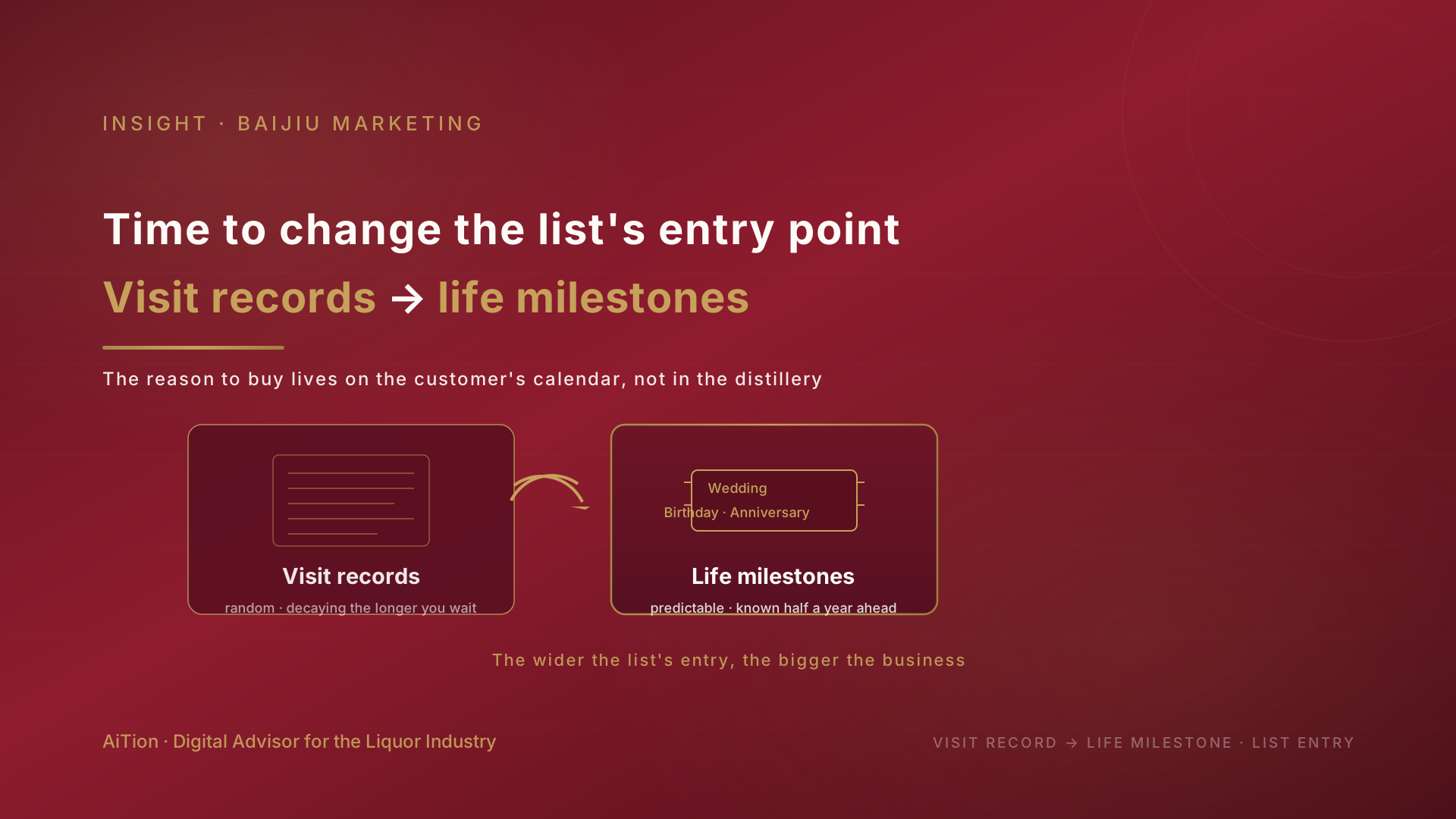
The reason someone buys a sealed jar of wine is moving forward in time, from "I once visited the distillery" to "I have a life milestone coming up", and once the reason lives in the customer's own life, the entry point of the list switches from visit records to milestone data, yet most distillers only hold the former. This article explains why milestones are predictable while visits are random, then lands on the three fields worth filling first: the occasion, the reminder time, and the gifting chain. However wide the list's entry point is, that is how big the business can get — of the people you know, how many have a reason to open a jar in the next half year.
I. Whether jar-sealing sells, look first at where the list came from
Anyone who has walked a distillery's jar-sealing area has seen the scene: rows of clay jars stacked in the temperature-controlled cellar, each bearing a red tag with a number and a name. The ceremony ends, the customer takes photos, adds the salesperson on WeChat, and the most productive day of the year slips by.
After the crowd leaves, the real work starts. The salesperson returns to the office and enters today's attendees one by one into a ledger. That ledger is the distillery's entire customer inventory for the jar-sealing business.
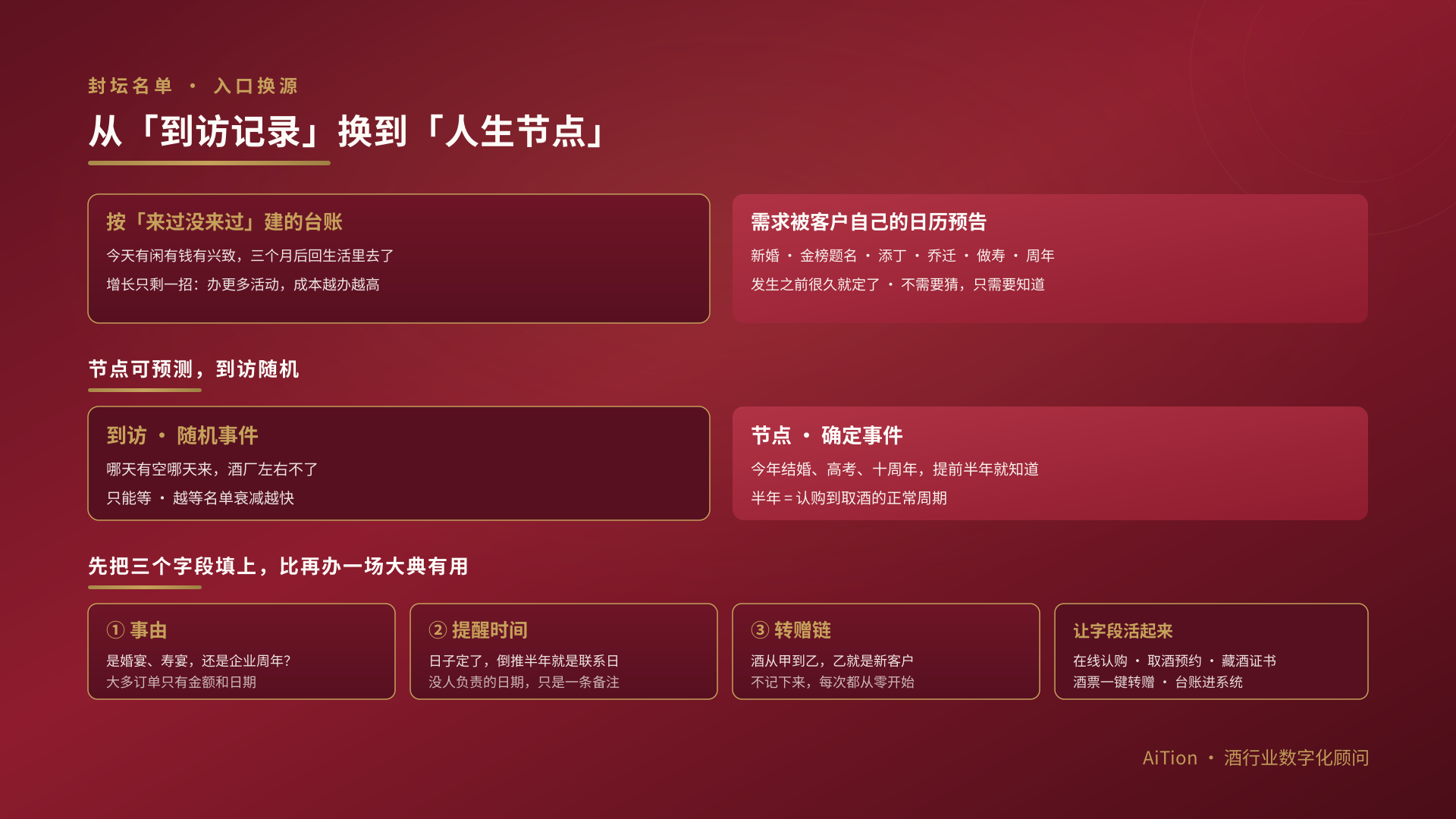
The problem is that the ledger is built around "has visited or not", not around "has a reason to buy or not".
A customer signs a jar today, most likely because at this moment he happens to have spare time, spare money, and the inclination. Three months later you come back to him, and he has returned to his own life: the kids are in tutoring, the working capital is turning over, the elderly relative needs a check-up. Not a single field in the ledger hints at when he will become that inclined person again.
So the jar-sealing business is left with only one way to grow: hold more events and invite more people. The cost climbs every time, and the people who show up get harder to attract every time.
Do one sealing ceremony and the site, hospitality, lodging, and gift bags, plus a month of salespeople's outreach beforehand, easily add up to several hundred thousand yuan. What it buys back is a list of a few hundred names and maybe a dozen-odd jars that actually close. That arithmetic works if you only count it once. If you have to count it every year while the list barely grows, you are paying acquisition cost over and over for the same few people.
II. The reason is not in the distillery; it sits on the customer's own calendar
Li Bai wrote, "When life goes well, seize joy; never let a golden cup sit empty facing the moon" (Changjinjiu, Qiang Jin Jiu). He meant that the moment matters more than the wine. Jar-sealing is the same: when a customer needs a jar of wine has nothing to do with how handsome your jar cellar is; it depends on what sits on his calendar.
A wedding, a child acing the exams, a newborn, a housewarming, a parent's big birthday, a company anniversary — these dates share one trait: they are fixed long before they arrive.
In other words, the demand has been announced in advance by the customer's own calendar. You do not need to guess; you only need to know.
Guizhou Jiangjiu Group put it plainly in its seal-keeping project: one jar for life's big moments. A new marriage, a child acing the exams, the joy of a newborn, an important anniversary, the founding anniversary of a company — all become scenarios that can be ordered in advance, with the customer's name, dates, and a blessing engraved on the jar. This turns jar-sealing from a souvenir into a ritual reserved ahead of time.
The line "To make this spring wine, so that it may bless long life" (wei ci chun jiu, yi jie mei shou) from "Month Seven" of the Odes of Bin in the Book of Songs (Shijing) describes precisely that deferred-redemption relationship between brewing and birthday-wishing. Brewing takes time; the feast has a date. The lead time in between is where the real profit of this business lives.
III. Milestones are predictable; visits are random
Set these two things side by side and the difference shows.
A visit is a random event. When a customer has a free day, when he makes up his mind — the distillery cannot influence it. You can only wait, and the longer you wait, the faster the list decays.
A milestone is a certain event. A person is getting married this year, a child sits the national exam this year, a company turns ten this year — these moments can be known half a year in advance. Half a year is exactly the normal cycle from subscription to wine collection.
That means the entry point of the list can switch from "visit records" to "milestone data". And part of that milestone data distillers already hold; it is just scattered across different departments.
Scattered across departments means no one is accountable for the whole table. Those handling banquet wine only look at claim verification; those handling custom wine only look at scheduling; those handling the back-to-distillery tour only look at visit counts. Every department processes its own slice of the flow, and no one stitches the fields together to see what kind of person sits behind them, and when that person needs wine.
The banquet application records the number of tables and the date. The custom-wine order carries a scenario field and the usage date. The reception list of the back-to-distillery tour holds the company name and the purpose of the visit. On normal days these fields are treated as process information, used for approval and settlement. They are also, at the same time, a timetable.
Look at that table from another department's angle, and it becomes a list of jar-sealing leads for six months out.
IV. Filling in these three fields beats staging one more ceremony
If you manage a distillery's jar-sealing business, set the systems aside for a moment and look at three fields first.
The first is the occasion. Most jar-sealing orders today carry only an amount and a date; the occasion field sits empty. Fill it in, and you learn whether this jar is for a wedding, a birthday feast, or a company anniversary.
The second is the reminder time. Once the occasion is set, the date is set; count back half a year and you have the day when the customer must be contacted. If no one owns that date, it does not exist. When it does not land on a specific person's shoulders, it is not a date — it is just a note.
The third is the gifting chain. When a jar passes from person A to person B, B is a new customer. If that chain is not recorded, every handover starts over from zero.
None of the three fields is complicated. What is hard is making them come alive. Customers submit subscriptions and pickup appointments online, the sealed-wine certificate lives on the customer's own phone, the wine ticket can be gifted in one tap, and salespeople can place orders for customers directly on the plant floor. Only when the ledger moves out of the salesperson's drawer and into a system do the fields get filled, do the reminders get seen, and does the gifting chain survive.
A jar-sealing customer is not a one-off income; it is an asset that needs continuous stewardship. If an asset is to be managed, there must first be a ledger.
Conclusion: however wide the entry point, that is how big the business gets
Back to the original question. The ceiling of the jar-sealing business is often not capacity, not the jar cellar, and not the quality of the liquor.
It is the list. How many people do you know, and of those, how many have a reason to open a jar sometime in the next half year?
The former relies on staging events, and it only gets more expensive. The latter relies on a searchable timetable, and it only gets more accurate.
Even the best wine fears a remote alley. Even more so, it fears that the list hanging at the mouth of the alley is still the one from three years ago.
Appendix: Data and case sources
Guizhou Jiangjiu Group's "one jar for life's big moments" seal-keeping project (wedding, acing the exams, newborn, important anniversary, company founding anniversary can be ordered in advance, with engraving on the jar): enterprise-reported
"Month Seven" of the Odes of Bin in the Book of Songs — "To make this spring wine, so that it may bless long life": classical quotation
Li Bai, Qiang Jin Jiu — "When life goes well, seize joy; never let a golden cup sit empty facing the moon": classical quotation
Normal cycle from subscription to wine collection is about six months: industry convention (original article's framing)
【Note:The images in this article are generated by AI】