
Lidu's Jar-Sealing Playbook: Why an Annual Sealing Festival Beats Other Makers' Whole-Year Sealing
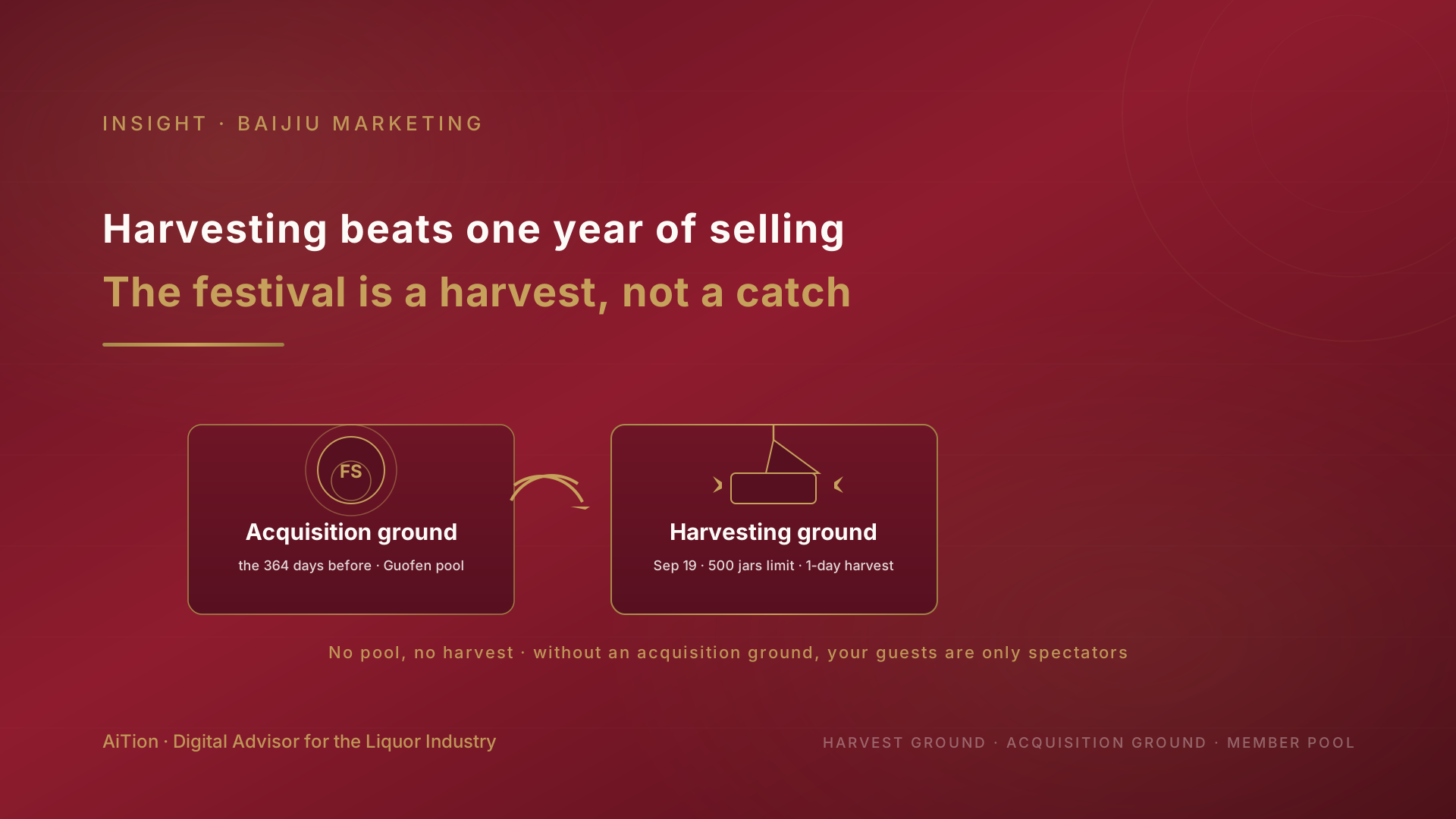
Traditional liquor makers sell jar-sealing through salespeople cold-calling from phone books, yet with high unit prices, low purchase frequency, and a high trust threshold, efficiency is inherently low. Lidu did the opposite: it moved customer acquisition from the big event to the days before it — farming its membership pool, the "Guofen Home", for 364 days, so that when its Global Seal-Keepers Convention arrives on September 19, only 500 globally limited jars get filtered straight out of the pool, cashing in a whole year of accumulation in a single day. This article unpacks the essential difference between a "harvesting ground" and an "acquisition ground", and lays out the three-step recipe: build a pool first, then tier it, then harvest. Hold a big event without a pool, and the livelier the event, the more your guests are just spectators.
I. Jar-sealing is a hard business by nature
Look at two pictures first.
In the first, a jar-sealing salesperson at some liquor maker scrolls to the bottom of a contact list and dials one number after another. "Brother, want to try jar-sealing?" The other side either doesn't pick up, or hangs up after a few polite words. After much effort, one person agrees to visit the plant; the tour, tasting, and meal all roll by, and the customer says they'll think it over. Anyone who has done sales knows that "thinking it over" usually means "not happening." The wine, meal, and labor for that one order all go into the cost column, whether it closes or not.
In the second, on September 19, at the National Treasure Lidu Winery, the Global Seal-Keepers Convention is underway. The flagship "Winning Jar" is limited to 500 jars worldwide, each carrying its own exclusive imprint. The people here were not called by phone — they came on their own, pockets full, afraid to be too late.
Same industry, same business, but a very different picture.
The gap is not in the liquor itself. As for the wine body, quite a few makers are not far behind. As for ceremony and hospitality, everyone can stage something respectable. The gap is not in the single day of September 19 — it is in the 364 days before it.
Treat jar-sealing as a business, and a few traits surface, each one making life hard for sales.
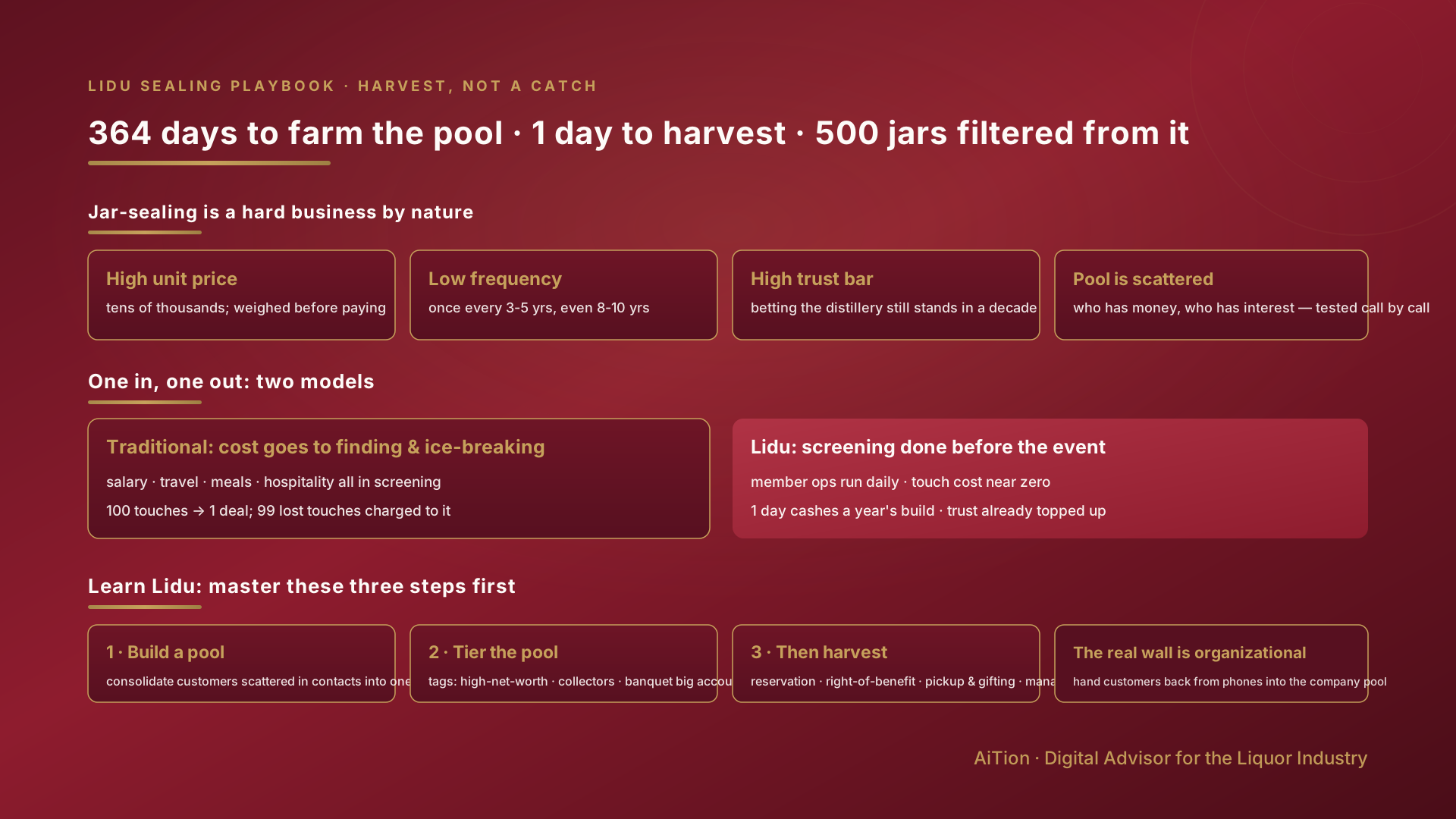
Unit prices are high, easily tens of thousands to hundreds of thousands; customers weigh the decision repeatedly before paying. Frequency is low — sealing a jar runs from three to five years at the short end and eight to ten years at the long end; a person may only need you once in a lifetime. The trust threshold is steep — money handed over, liquor stored in your cellar, and what the customer is really betting on is whether your distillery still exists, still honors its promises, and still keeps its word a decade from now.
Try this business with cold calls and door-to-door sweeps and efficiency cannot be high. Call a hundred numbers; ninety-nine are not target customers, and for the one that might be, trust has to be built from zero. Every deal a salesperson closes is like fishing anew; miss the catch, and all the prior effort is wasted.
To be fair, this is not about lazy salespeople — it is a problem with the model itself. The customer pool is scattered. Who has money, who has interest, who has bought before — all of that can only be tested one call at a time.
II. What Lidu got right
Lidu's approach, in one line, is moving customer acquisition from the big event to the days before it.
The outside world sees the September 19 convention; it does not see the 364 days before. Lidu runs its own membership community over the long term, known in the trade as the "Guofen Home" (the maker's club of fans). What does this organization do day to day? It consolidates members and tiers them with tags. Which ones are ordinary enthusiasts, which are high-net-worth collectors, which have bought year after year across multiple editions — layer by layer, everything is clear.
So when the sealing festival arrives, who shows up? Old acquaintances who have been fed content all year and know the brand inside out. They do not need to be persuaded; they only need to be served. The 500-jar limit is less about selling than about filtering from the pool. The filtering takes a single day; building the pool took a year.
There is another layer. Customers who arrive carrying trust see the 500-jar limit with different eyes. In a stranger's eyes it is marketing-speak; in an old member's eyes it is a pass only insiders get to grab. The same exclusive imprint is a gimmick to the former and an identity badge to the latter.
Many people studying Lidu's jar-sealing fixate on the ceremony, the jar design, and the limited numbering. All fair, but all of those are the final step. The step that really counts is the quiet, unremarkable customer pool.
III. One in, one out: two models
Put the two approaches side by side and the arithmetic becomes clear.
In the traditional model, cost goes to finding people and breaking the ice. The salesperson's salary, travel, dinner tables, and hospitality all sink into the screening stage. One hundred touches yield one deal, and the cost of the other ninety-nine lands on that single deal.
In the Lidu model, screening is already done before the event. Member operations keep turning daily, and reaching an existing member, compared with a cold visit, costs so little it is almost not worth counting. The eye-catching conversion on event day is really the centralized payout of a whole year's accumulation.
One builds trust from zero on site; the other arrives with trust already topped up.
The sealing festival is a harvesting ground, not an acquisition ground. Acquisition has to come first, or there is nothing to harvest. Hold a big event without a pool and, however lively it is, the people who come are spectators who forget it all when they leave.
IV. To learn from Lidu, first learn not to rush the big event
So to learn from Lidu, the first lesson is precisely the opposite of rushing to copy its big event. The event is a harvesting move, and harvesting moves cannot be copied. What can be copied is the three steps before it.
Step one: build a pool first
Every bottle sold, every tasting session, every back-to-distillery tour is a customer entrance. The problem is that these customers normally sit scattered in salespeople's phones and WeChat, walking away with the person who leaves. The first thing to do is turn them into the company's own pool and consolidate it in one place.
Step two: tier the pool
A big pool does not mean you can sell jar-sealing. You need to know who can afford it, who has interest, who has repurchased. Tag customers and pull them out layer by layer — high-net-worth buyers, wine-collection enthusiasts, big banquet-wine accounts. Pull the jar-sealing list from the tags, not by fishing from the phone book.
Step three: then harvest
With a pool in hand and a precise list, high-ticket lines like jar-sealing, customization, and distillery return tours have something to latch onto. Who sealed a jar, how long ago, when to remind them to collect their wine, whether it can be gifted to another person — high-value customers must be managed, not left to go silent the moment a jar is sold.
Across these three steps, the first two rest on consumer-operations capability: turning scattered customers into members and then tiering those members. The third lands on jar-sealing business management — from sealing reservations and benefit certification to wine collection and gifting — managing customers as an asset. Mature solutions exist in the market for all of these links, and our own product capabilities cover them. The hard wall to climb is not the technology one; it is the organizational one — handing customers over from salespeople's phones back into the company's own pool.
Back to the headline
So back to the question in the headline. Why does Lidu's annual sealing festival beat other makers' whole-year jar-sealing sales?
Because Lidu's efforts for the year were never spent on that single day.
Before you plan your next sealing festival, ask yourself one question first: where is my "Guofen Home"? Without a pool, no matter how beautifully you stage the event, you are simply inviting strangers to watch some spectacle.
When the spectacle fades, the jars still will not sell.
Appendix: Data and case sources
Global Seal-Keepers Convention at the National Treasure Lidu Winery; flagship "Winning Jar" globally limited to 500 jars, each with an exclusive imprint: Lidu official event information, September 19, 2025 (enterprise-reported)
Guofen Home: Lidu's long-running membership community (industry/media-reported)
Business traits such as jar-sealing unit price, frequency, and trust threshold: industry-convention synthesis, not individualized data
【Note:The product images in this article are generated by AI】