
From 45% to 82% Bottle-Open Rate: How a Cap Code Cleared Up the Murky Math of Liquor Makers' Marketing Spend
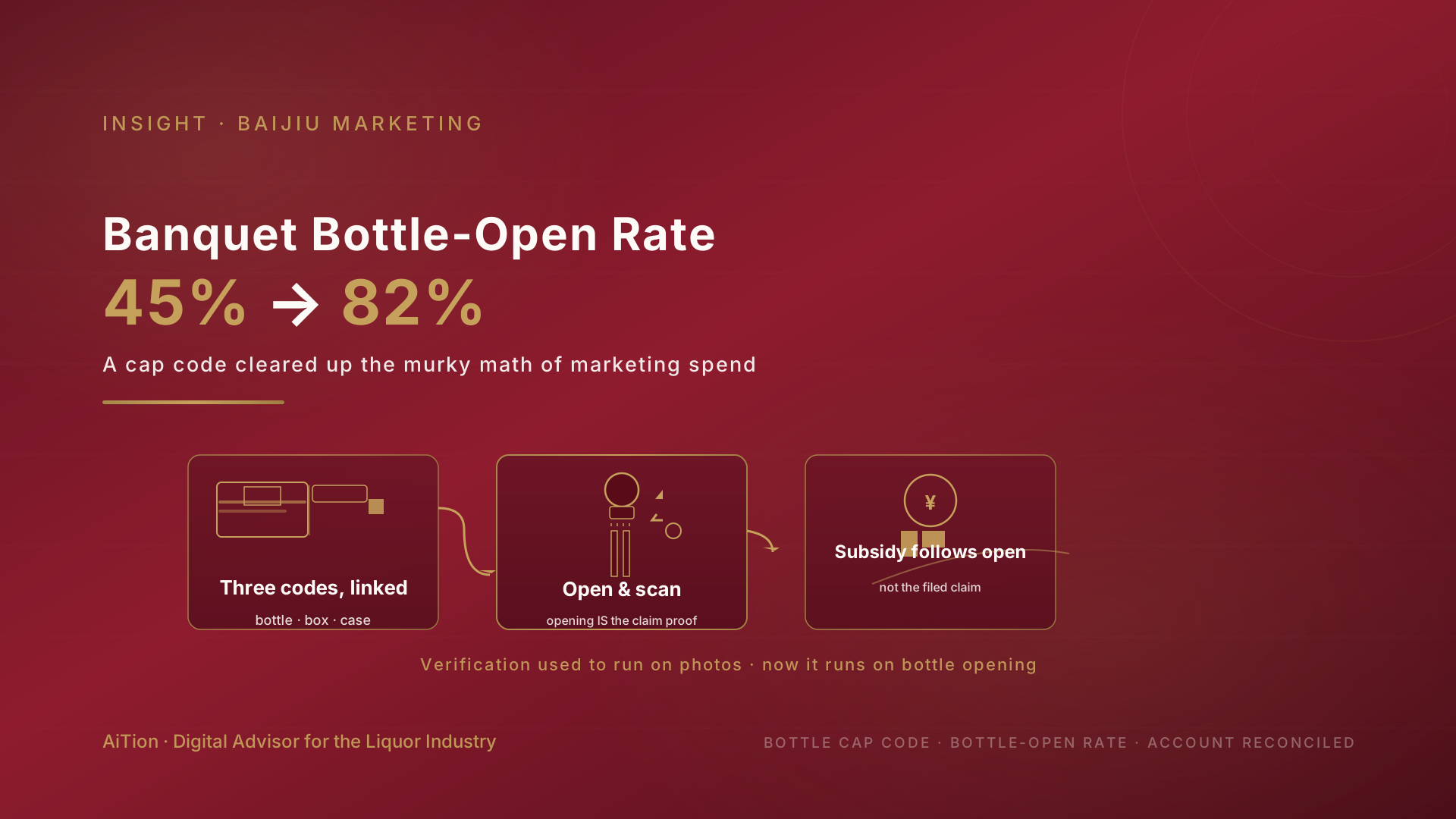
Traditional liquor makers verify banquet subsidies with photos, snapping empty bottles, table counts, and banners in one go, so the real bottle-open ratio sits far below what the report figures claim. This article breaks down how a "cap code" (a code on the bottle cap) swaps the verification basis from photos to actual bottle opening — subsidy follows the opened bottle, not the filed claim. Named data from Wuliangye, Jiugui, Tanjiu, and Yanghe lines up one by one, and one undisclosed maker pushed its banquet bottle-open rate from 45% to 82%. Once the accounts are settled, as who wins and who chafes recalculates; and two buckets of cold water — the scan rate and the red-packet size — still have to be balanced.
I. The banquet plate is shrinking
At a wedding that wrapped up last month, a Mr. Li noticed a detail. Each table held two bottles of well-packaged baijiu, yet over most of the event the caps on most tables' bottles were never even broken; at the send-off they were boxed back up untouched and went home with the hosts.
The bottles on the table are face. Whether they get drunk is another matter.
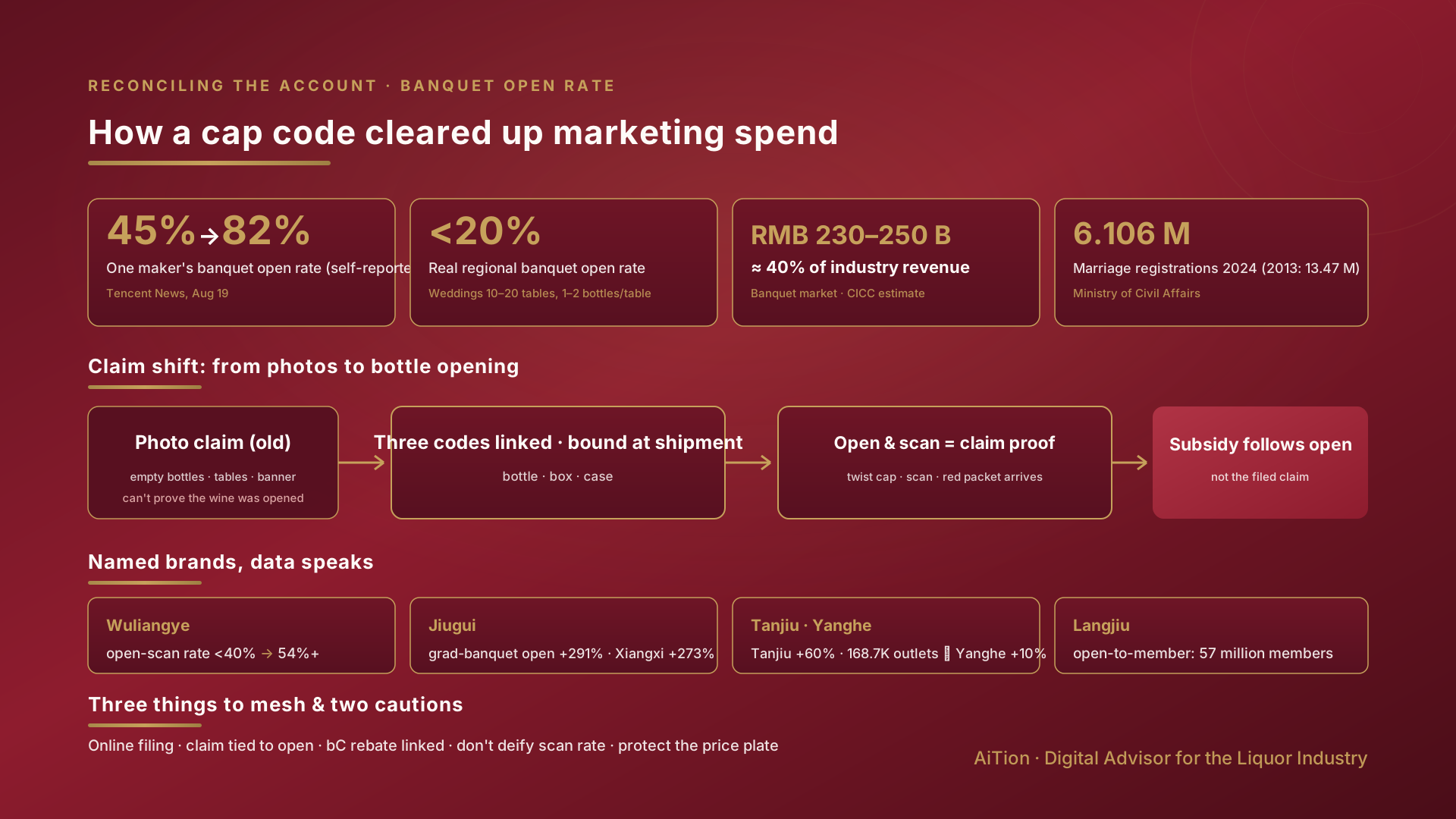
This is a real scene in an August 19 report by Tencent News. The same report carries several other figures, each one jarring. Across quite a few regional markets, the real bottle-open rate for banquet baijiu is under 20%. The mainstream scale of weddings has shrunk from 20-plus tables to 10–20 tables, and per-table stocking has dropped from 3–4 bottles to 1–2. Terminal research in Zhengzhou, Hefei, and Wuhan shows that the number of graduation-banquet (shengxueyan) sessions fell about 40% year-on-year. The Ministry of Civil Affairs data is blunter: nationwide marriage registrations fell from 13.47 million couples in 2013 to 6.106 million couples in 2024.
The whole industry can feel that the banquet plate is shrinking.
But today the topic is not the plate. It is where, over the long run, the real money liquor makers pour into that plate has actually been going.
II. How that money is spent
Traditional liquor makers run banquets in much the same way. The factory gives distributors a dedicated banquet policy, distributors file the banquet information, and once the banquet wraps up, the claim is settled.
How is it settled?
This is the most common picture in the industry. When the banquet is over, a salesperson hurries to the restaurant and points a phone at the messy table. Empty bottles — snap one. Number of tables — snap one. The festive banner at the door — snap one. The photos are sent back and the subsidy goes through its process.
That process has run for years and sounds fine at first glance. All the problems are in the details.
A photo proves the banquet happened; it cannot prove the wine was opened. A case of wine has its subsidy filed, then the whole sealed case quietly flows into the distribution channel and becomes cut-rate stock that undercuts the maker's own price system — hardly breaking news in this industry. False filing, expense withholding, and channel diversion with chaotic pricing were all called out by name as unspoken rules in the report mentioned above. One industry participant said it plainly: in many makers' banquet market-flow figures, the share of bottles actually opened is far lower than the report numbers.
How big is the plate
In an earlier estimate by CICC, the baijiu banquet market is worth about RMB 230–250 billion, accounting for roughly 40% of total industry revenue.
40% of the business, verified by photos.
With a hole that big, someone should have patched it long ago. Yet it has run this way for years. Maybe it was never that no one could control it. A murky account is most comfortable for one reason: no one is accountable. Flows rise on the report; distributors hold onto their expenses; salespeople see their targets ticked off. Whoever pokes the bubble suffers first.
III. How the account got settled
The turning point is, by a dark kind of humor, this: the "one-item-one-code" technology was first used by the industry purely as an anti-counterfeiting label. Even in our own liquor-maker projects, our earliest imagination of it stopped at scan-to-verify authenticity and fending off fakes. No one expected it to grow into a market-flow tool that turned the banquet account upside down.
Pull the mechanism apart and it is not complex — almost plain.
The bottle code, box code, and case code — three codes linked together — are bound to the banquet order at shipment. At the banquet, a consumer twists off the cap, scans, and a red packet lands in their account. The act of opening the bottle is itself the verification credential. When the banquet ends, the system settles subsidies against the real count of bottles opened. Unopened bottles earn no policy. If a whole case flows to a non-designated region, the backend raises an alert immediately.
In one line: subsidy follows the opened bottle, not the filed claim.
Named data beats mechanism
At Wuliangye's June 2025 shareholders' meeting, deputy general manager Jiang Jia disclosed a set of figures. The banquet-wine bottle-open scan rate rose from under 40% to over 54%, and banquet sessions grew 24% year-on-year. Jiugui, running graduation banquets in 2025, lifted its scan bottle-open rate by 291%, and Xiangxi sales followed with a 273% rise. Tanjiu's bottle-open count grew 60% year-on-year, across 168,700 open-bottle outlets. Yanghe's within-province bottle-open rate also rose more than 10%.
As for the most eye-catching number of all — one maker pushing its banquet bottle-open rate from 45% to 82% — it comes from the August 19 Tencent News report. The original did not name the company, and the claim is self-reported by the enterprise, pending verification. But the direction is unmistakable. Even a player like Langjiu has used scan-to-open membership to amass 57 million members — a figure officially released by Langjiu Co. on August 4. On August 19 they upgraded the membership system again at their estate member festival.
The playbook keeps getting fancier
With Luzhou Laojiao Tequ Red 60, a guest who opens a bottle and scans is guaranteed a red packet of RMB 6.6 to 666, and when open-bottle counts hit 68 and 98 bottles, the host receives a 5-gram and a 10-gram gold keepsake respectively. Xijiu runs a reverse red packet: for each bottle a consumer opens, the corresponding terminal store gets a RMB 50–60 promotion reward. Jiannanchun's "one code, ten scans" pushes even further — a single bottle's scan allowance can be shared by up to 10 people, pulling an entire table into the play.
Verification used to run on photos; now it runs on bottle opening.
IV. After the account is settled, who feels it
For liquor makers, the value lands first on money. Banquet subsidies have for the first time a ROI that can be calculated — how much spend maps to how many real bottle openings is fully visible in the backend. The old leakage, where half the subsidy turned into bargain-channel stock, is now structurally plugged.
One layer deeper is data. The people scanning are the ones who truly opened the bottles — not distributors, not hoarders. Which region's open-bottle numbers are sagging, which price tier's repurchase is climbing — questions that once took expensive research firms — now flow back on their own.
The deepest and most uncomfortable layer is channel relations. With expense flowing straight to the C-end, the arbitrage space for distributors narrows, and short-term friction is unavoidable. Yet flip it around: terminal stores earn referral money through reverse red packets, and distributors edge from freight-handler toward service-provider — the very transformation the whole industry has been shouting about for years. Scanning did not invent this direction; it just laid the bill on the table.
For distributors and terminals, less arbitrage now, more clout later. Every side is doing its own math on this account.
V. Three things that have to mesh
In our experience running liquor-maker and distributor projects, success in digitizing the banquet scenario has never hinged on the act of handing out red packets. The red packet is only the surface; what truly decides the outcome is whether three things mesh.
Banquet filing must go online — table count, scale tiers, and wine-use volume entered structurally, instead of salespeople using photos as proof. Claim rules must be tied hard to bottle-open data — one bottle opened counts as one, and settlement runs automatically when the banquet ends. The bC rebate must be linked — consumers scan and stores benefit so both sides push, and only then does the bottle-open rate actually rise.
Along this chain, our scan-marketing system handles code association, rebate settlement, and anti-diversion alerts, while the banquet-wine system handles filing, tiers, and expense claims. Turn two things into one, and the account is truly clear.
VI. A bucket of cold water
Do not rush to deify the scan-rate metric.
One self-media outlet estimated that of Langjiu PLUS's 57 million members, daily active users number about 12,000 — an activity rate under 0.02%. That figure is a self-media estimate, pending verification, but the problem it hints at is real. Most scan-and-claim users leave right after collecting the packet. Open-bottle data solves the seeing-them problem; it does not solve the keeping-them problem.
There is more. A red packet is, in essence, a disguised price cut; if the intensity runs out of control it still pierces the price system. Gujing Gongjiu pairs its premium series with a phone worth over RMB 20,000 as the grand prize and its mid- and low-end series with ones over RMB 3,000 — building that gradient is exactly the guard against this. Handing out red packets is easy; knowing how much to give without hurting the price plate is hard.
VII. Before peak season, do one thing first
Mid-Autumn and National Day are around the corner; the banquet claim peak is almost here.
If you have energy for only one thing, first audit the claim basis of your existing banquet policy. Those still running on photos — plug that hole first. If you have margin left, then connect bottle-open data with expense settlement so subsidies can dare to flow straight to the C-end. Leave next year's questions for next year. But one metric can be set right now: budget banquets by real bottle-open rate, not by filed sessions.
The plate is shrinking, sure. With the account settled, you can still squeeze increment out of a shrunken plate.
Conclusion
If you manage channel expenses at a liquor maker, or run the banquet trade at a chain liquor store, and want to talk about how this account is structured — let's talk in the comments. No selling. Just the numbers.
Appendix: Data and case sources
Regional banquet bottle-open rate under 20%, shrinking wedding scale and per-table stocking, and ~40% year-on-year drop in Zhengzhou/Hefei/Wuhan graduation-banquet sessions: Tencent News report, August 19, 2025
Nationwide marriage registrations, 13.47 million couples (2013) to 6.106 million (2024): Ministry of Civil Affairs data
Baijiu banquet market of about RMB 230–250 billion, ~40% of total industry revenue: CICC estimate
Wuliangye banquet bottle-open scan rate from under 40% to over 54%, banquet sessions up 24% year-on-year: Wuliangye June 2025 shareholders' meeting (disclosed by deputy GM Jiang Jia)
Jiugui 2025 graduation-banquet scan bottle-open rate up 291%, Xiangxi sales up 273%: enterprise-reported public coverage
Tanjiu bottle-open count up 60% year-on-year, 168,700 open-bottle outlets: enterprise-reported public coverage
Yanghe within-province bottle-open rate up over 10%: enterprise-reported public coverage
One maker's banquet bottle-open rate from 45% to 82%: Tencent News report, August 19, 2025 (company unnamed; self-reported, pending verification)
Langjiu scan-to-open membership of 57 million members: Langjiu Co. official data, August 4, 2025; membership system upgraded August 19 at estate member festival
Luzhou Laojiao Red 60 red packets of RMB 6.6–666, open-bottle counts and gold keepsakes: enterprise public coverage
Xijiu reverse red packet (RMB 50–60 store promotion reward per bottle opened): enterprise public coverage
Jiannanchun one-code-ten-scans (up to 10 participants per bottle): enterprise public coverage
Langjiu PLUS 57 million members, ~12,000 daily active users, activity rate under 0.02%: self-media estimate, pending verification
Gujing Gongjiu grand-prize phone gradient (premium series over RMB 20,000, mid/low-end over RMB 3,000): enterprise public coverage
【Note:The images in this article are generated by AI】