
No Channel Stocking, How Does Wine Get Into Restaurants? A Full Breakdown of a Working "Table QR + Community Warehouse" Model
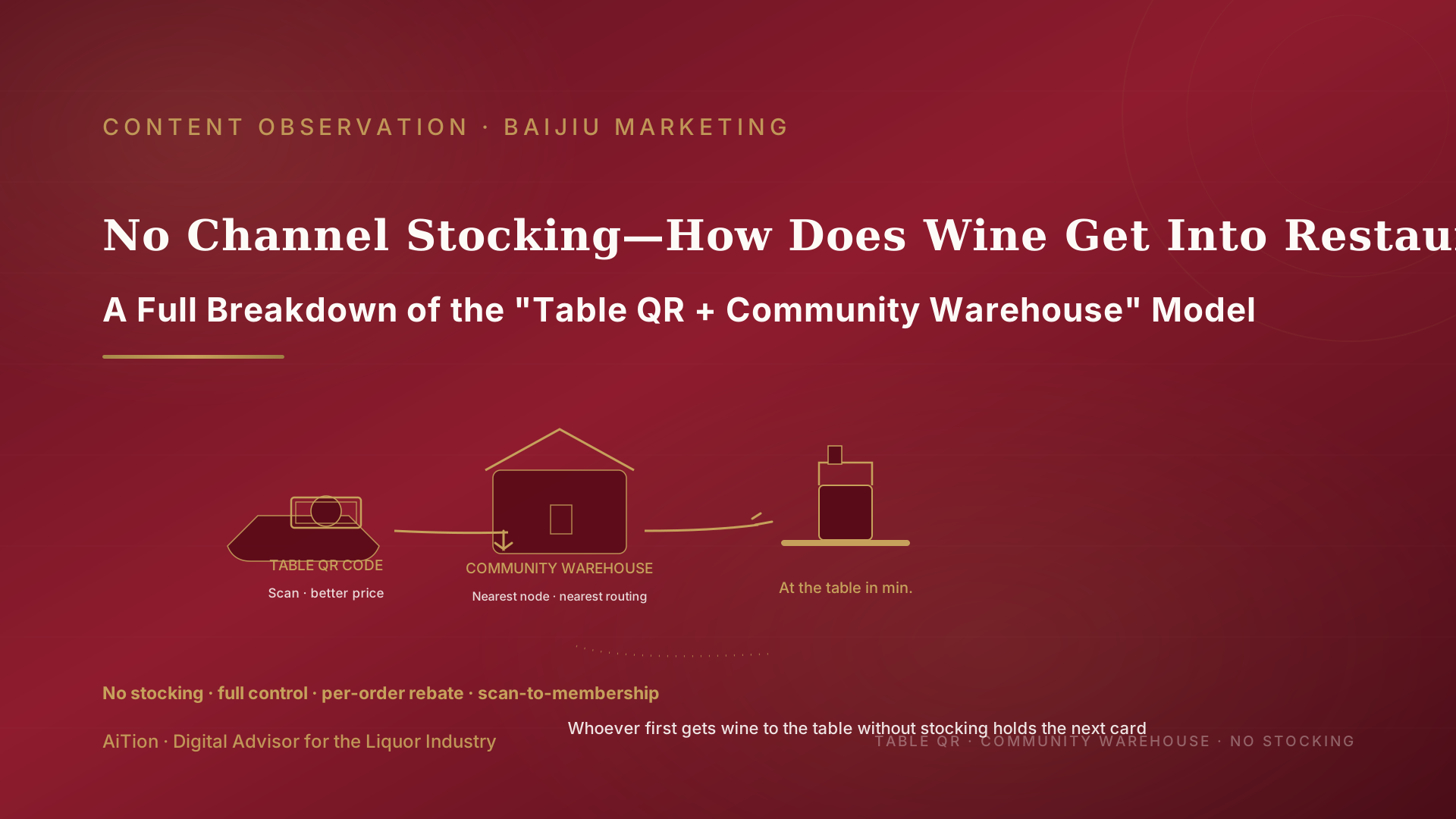
When distributors and stores begin collectively saying "no" to channel stocking, and stock piles up in the distillery as the most stinging reality for regional liquor makers, some people switch to a different playbook: no longer force inventory onto distributors, but open a storefront of their own, spread low-cost community warehouses, and place a QR code on each restaurant table—diners scan, the system auto-locates the nearest community warehouse, and the wine reaches the table within a dozen minutes. This article fully breaks down the "table QR + community warehouse" model—how four roles each get what they want in a zero-inventory closed loop, how it casually unties the "no outside liquor allowed" knot, five traps that can bury you, and its true value: swapping the growth yard-stick from "volume shipped" to "bottle-open rate."
I. The channel-stocking road has truly reached its end
First, one question: how long has it been since you, because of the words "channel stocking," felt a genuine, gut-level pang of frustration?
The distillery owners I know could, a few years back, really squeeze a mountain of gold out of channel stocking. Take orders in early spring, pile up stock through the channel, force volume in peak season—once goods left the plant, they counted as sold, and everything else was the distributor's problem. Back then, distributors were the distillery's "capital reservoir" and its risk-taker understudies.
Not anymore. The old magic has worn off. It's not that the wine became hard to sell; it's that the risk-takers, one by one, have gotten sharp.
Just look at a few numbers—no padding, and don't rush to argue.
The China Alcoholic Drinks Association data is right here: the liquor industry's average inventory-turn days have stretched to 900 days, up 10% from a year earlier. 900 days—think about it: the batch your factory pushed out three years ago still hasn't sold. Inventory volume added another 25% in a year, and price inversion has gone from isolated SKUs to the norm: market transaction prices lower than ex-factory prices.
This isn't one unlucky brand; the whole chain is collectively wincing. The industry line "90% of distributors lose money from blind stockpiling" gets more unsettling the longer you sit with it.
And so, something unthinkable in the past three decades has genuinely begun: distributors and stores are collectively saying "no" to channel stocking. Ask them to stock up and they demand payment up front; ask for a security deposit and they feel the inventory in their hands like a hot potato. Small stores are even more blunt: rather than bet on whether your batch will sell, they'd rather free up the capital and do something steadier.
When channels won't play along, the goods stay stuck in the plant. That is the truest, most stinging situation facing most regional distilleries today.
II. But someone switched to a different idea: no channel stocking; "send" the wine INTO restaurants
I recently dissected an approach that is working. To be clear: this is one regional liquor company's practice, and I've blurred the details—but the skeleton is real, and the blood is warm.
It no longer forces inventory onto distributors. It opened one or two self-run stores in the city, not big, just a storefront. The real trick is behind it.
It spread a batch of low-cost "community unmanned warehouses." How low-cost? Find a community corner store willing to cooperate, free up one shelf, and put some wine on it. The cost is so low it's nearly negligible. The store owner doesn't even manage delivery; when the courier comes to pick up parcels, they just help pack the orders on the way.
So where do the orders come from? That's where the real craft lies. The brand approaches the restaurant but never once mentions "stocking." It places a code on the table. A diner wants to drink at the meal, scans the code, and the system auto-locates the nearest community warehouse, places the order, pays, and within a dozen minutes the wine is on the table.
Note: the money goes straight to the brand; it never passes through the restaurant's hands at all.
So what does the restaurant get? Rebates. Any order placed through that table code earns the restaurant over 30% in rebates. They carry zero inventory and front zero capital—they just put out a code, and selling wine earns them more than selling their own dishes. Tell me, why wouldn't they?
Let me walk you through the books of this chessboard line by line:
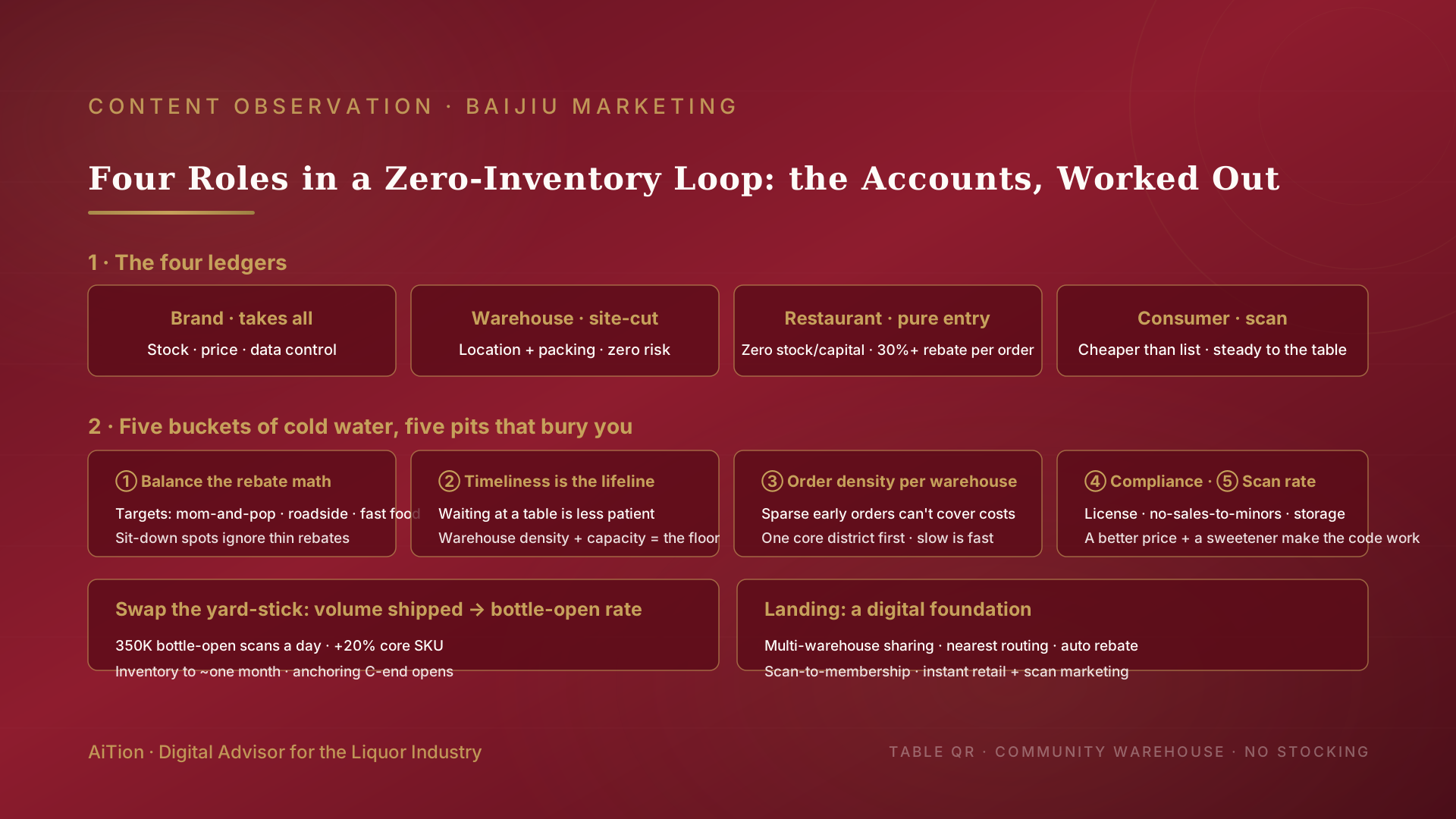
The brand: full control of stock, pricing, and data. The goods are in its own hands, and so are the orders and the data.
The community warehouse: supplies only the location and a bit of packing effort, earns the site-cut money, zero risk.
The restaurant: zero inventory, zero capital, zero risk, purely an entry point, taking rebates per order.
The consumer: scans to order, at a price friendlier than the restaurant's own wine list, and the wine arrives stably at the table.
Four roles—three make money lying down, and one keeps the goods firmly in its own hands. Every link in the traditional channel-stocking chain that "feet up-front money to hoard stock and bets the downstream can sell it" has been cleanly bypassed.
III. Where the elegance lies
What I admire most is that it casually dissolves a thirty-year dead knot: "no outside liquor allowed."
That deal used to be at odds within itself. Consumers found restaurant wine expensive; restaurants relied on beverage markup for gross margin; neither could persuade the other, and both felt shortchanged. Now? The consumer scans and gets a price cheaper than the wine list; the restaurant carries zero inventory and clears a rebate; the brand gets the order and the user—all three win. There are only two losers: the traditional multi-tier wholesalers, and the platforms that live on commissions.
Even more elegant: because every transaction happens on the brand's own code, the price system is inherently unified. The dining-channel's worst headaches—price chaos, channel crossing, cap-pulling—simply can't arise structurally: it's your own price, your own collected money, so no one can pry it.
In down-market regions, some have already run this playbook in an "unguided wilderness version." The industry calls it the "Yongjiu model": unified pricing on the code, service-staff bottle-opening commissions credited instantly, gifts shipped directly by the factory without touching store inventory, and distributors restocking on credit without channel stocking. Some jest it's the "heretical cultivation" of channel digitalization—yet it genuinely moves volume fast in B/C-tier restaurants. Tell me: a direction where even a wilderness playbook can move at speed—isn't it worth a second look?
IV. But don't rush to copy: five traps can bury you
Honestly, this model isn't enter-and-win for everyone. Let me pour five buckets of cold water so you think it through before diving in.
First, the rebate math must balance. Restaurants selling wine themselves start at fifty-plus points of gross margin; if your rebate is too thin, good sit-down restaurants won't even look. The model's precise target is the store that "has drinking demand but neither the ability nor the mind to sell wine professionally"—mom-and-pop shops, roadside stalls, barbecue joints, quick-service spots. You yourself must first be clear which kind of store your wine deserves.
Second, fulfillment timeliness is the lifeline. A person waiting for wine at a table has even less patience than waiting at home. If the wine doesn't arrive before the dishes, the experience collapses. The density and delivery capacity of your community warehouses determine the model's floor.
Third, order density per warehouse. Early on, orders are sparse, and each warehouse's packing labor and site-cut share may not cover the cost. My advice is blunt: first make one core business district work thoroughly; don't blanket the whole city from the start. Slow is fast.
Fourth, compliance is no joke. Liquor retail licensing, verification of no-sales-to-minors, and the qualifications and safety of storing wine in community warehouses—self-delivery has to obey the same rules. One slip and the model is wiped to zero, with no chance to come back.
Fifth, don't overestimate the table code's scan rate. A code on the table—why should a user scan it? Without hooks like "an obviously better scan price + a small sweetener on the side," the code is just a piece of table paper.
V. Its real value is swapping the measuring stick
Deep down, at its core, this model has the distillery swap its growth yard-stick from "volume shipped" to "bottle-open rate."
In the past, performance was measured by how much left the plant; once goods reached the distributor, it counted as success, and marketing ended there. Now what matters is—whether the wine was actually drunk, whether users were truly reached, and whether the data was captured. One leading distillery's single-day bottle-open scans of 350,000 bottles, a 20% shipment increase on its core Spring Festival SKU, and inventory optimized to around a month of water level—all run on the same logic: pinning the growth anchor on C-end bottle-open volume rather than B-end shipment volume.
And this "table QR + community warehouse" model, in essence, in the most painful, hardest-to-control dining scenario, wrenchingly bends "shipment-volume thinking" into "bottle-open thinking."
For regional distilleries, this may be a more valuable lesson than any technology: you don't need to become a giant—you only need to hold the goods in your own hands and keep your users on your own books. That is your lifeline, and no one can take it from you.
VI. Landing it needs a digital foundation
Now that I've dissected so much, let me be honest. The skeleton of this model—multi-warehouse inventory sharing, nearest routing, per-order rebate settlement, scan-to-membership. Every link depends on a sound digital system.
We've done similar projects. Let the brand see in real time how much stock each warehouse has left and which one needs restocking; let riders take orders from the nearest warehouse; let restaurant rebates settle automatically in the system, no month-end reconciliation fights; let diners who scanned settle into members that can be re-reached. This stack maps to a combination of an instant-retail system and a scan-to-marketing system—if you'd like to hear more, we can break it into its own article later.
But that's a technology matter, and a story for another day. Today, what I want wine-industry friends to first understand is a direction: now that everyone is unwilling to keep channel-stocking, whoever first learns to "get wine to the table without stocking" holds the next card. It's time to take your fate back into your own hands.
Appendix: Data and Case Sources
Industry data: liquor industry average inventory-turn days of 900 days, up 10% year over year; inventory volume up 25% in a year; price inversion (market price below ex-factory price) becoming the norm; "90% of distributors lose money from blind stockpiling" (source: China Alcoholic Drinks Association, "Interim Research Report on China's Baijiu Market, 2025")
"Table QR + community warehouse" model: one regional liquor company's practice, details blurred (brand controls stock/price/data, community warehouse earns site-cut with zero risk, restaurant carries zero inventory and takes 30%+ rebates, consumers scan for lower prices)
Yongjiu model: unified pricing on the code, service-staff bottle-opening commissions credited instantly, gifts shipped by factory without touching store inventory, distributors restock on credit without channel stocking (source: industry media / service-provider public reports)
Bottle-open data: one leading distillery's single-day bottle-open scans of 350,000 bottles, 20% shipment increase on core Spring Festival SKU, inventory optimized to around one month of water level (source: a leading distillery's public report, company-stated basis)
Landing system: multi-warehouse inventory sharing, nearest routing, per-order rebate settlement, scan-to-membership, mapping to a combination of instant-retail and scan-to-marketing systems (project case)
【Note: The images in this article were AI-generated; data sources: China Alcoholic Drinks Association, "Interim Research Report on China's Baijiu Market, 2025"; the "Yongjiu model" appears in industry-media/service-provider public reports; bottle-open data appears in a leading distillery's public report (company-stated basis). 】