
Distillery Tours and Sealed-Jar Experiences: The Liquor Industry's Next Gold Mine Is in the Scenic Areas
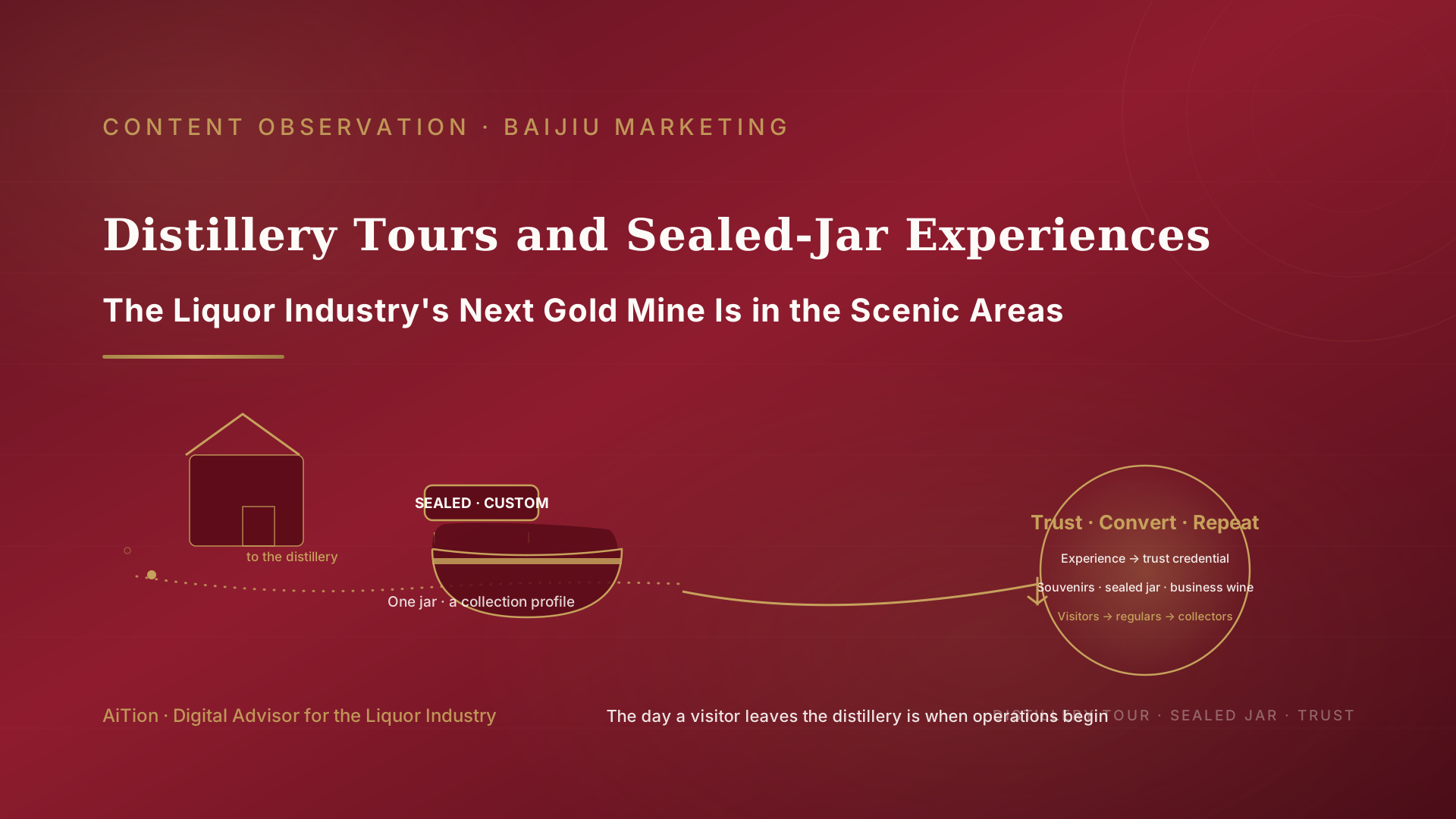
For the past decade, a visitor to Maotai Town would take an hour for photos, two hours to buy liquor, and three hours to leave; distillery tourism was essentially a giveaway for sales. Now "shifting from selling liquor to selling a lifestyle" has become the consensus across the producing regions, as the Langjiu special train, Renhuai's million-level visitors, and a string of distillery figures heat up, turning the distillery tour from a reception process into an "experience-conversion-repurchase" operating entry point. This article unpacks the industry chessboard and single-point heat of liquor-tourism integration, explains why the value of a distillery tour lies not in tickets but in the souvenir purchases, word-of-mouth retelling, and business entertainment reuse that a single visit buys, and lays out the landing chain of booking reception, experience conversion, and data settlement.
I. A High-Speed Rail Special in the Field, and a Producing-Region Chessboard
On August 24, 2026, a high-speed rail special departed from Kaifeng in Henan, carrying ten thousand visitors straight to the Langjiu Estate in Gulin, Sichuan, for three days and two nights to see the full "grow-nourish-store" process. A distillery chartering high-speed rail to pick up guests—unthinkable five years ago.
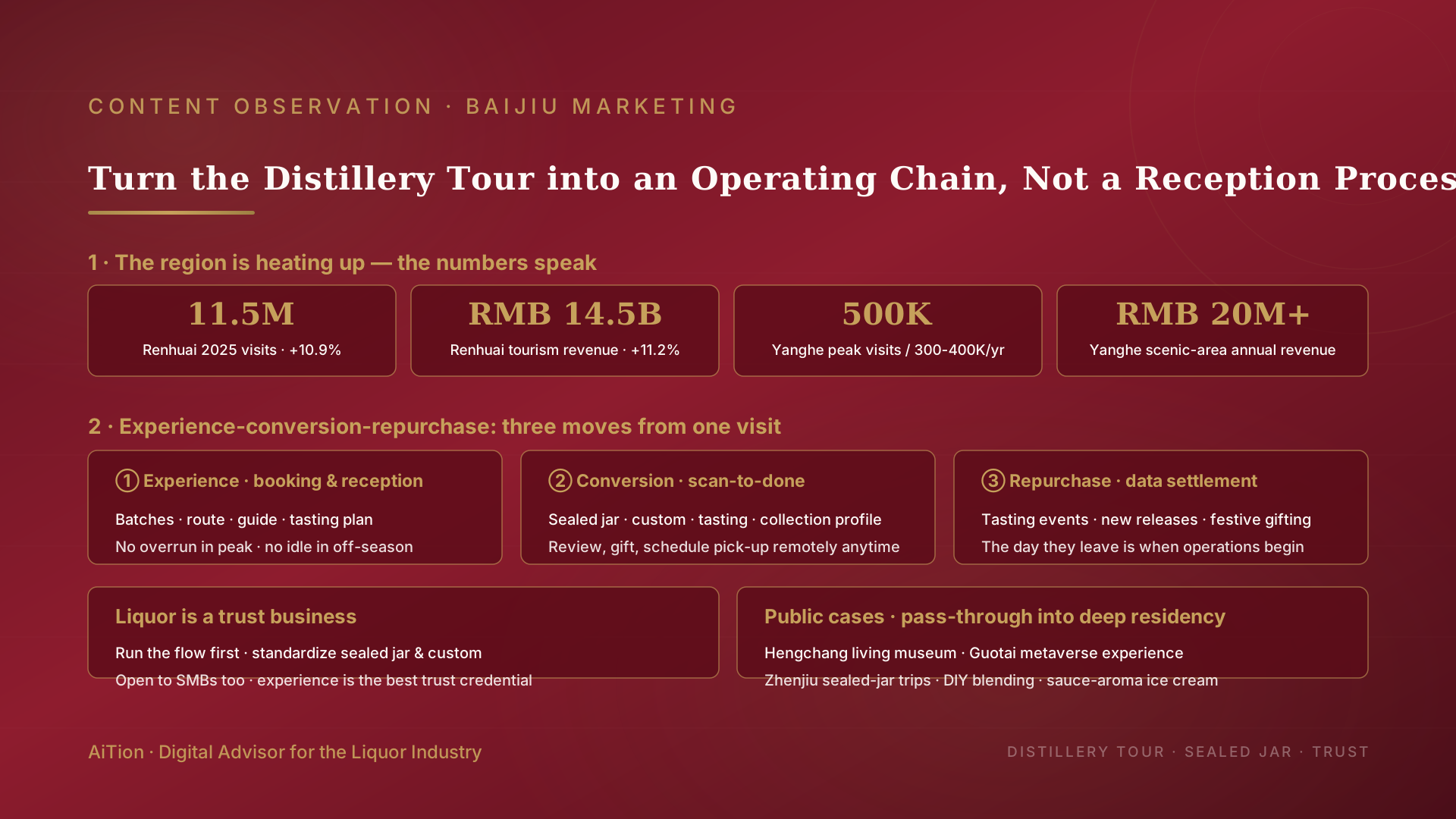
The bigger chessboard is in Guizhou. The province has issued an action plan titled "Building the Upgraded Version of Shifting from Selling Liquor to Selling a Lifestyle (2026-2030)," with 19 tasks, dividing liquor-tourism integration into a three-tier system of benchmark scenarios, specialty liquor estates, and urban liquor-culture spaces. In 2025, Renhuai received 11.5 million tourist visits and RMB 14.5 billion in comprehensive tourism revenue, up 10.9% and 11.2% respectively. Renhuai's three-year cultural-and-tourism action plan sets the 2028 goal of breaking 13.3 million visits.
Single points are equally hot. Hengchang Shaofang Estate received over 10,000 visitors from June 2025 to June 2026; Guotai Estate received over a thousand batches, nearly 12,000 people, in the first half of 2026. Yanghe operates two national 4A scenic areas in Suqian, receiving 300,000-400,000 visitors a year, with 500,000 at peak, and generating over RMB 20 million annually in tickets, dining, and cultural merchandise.
II. From Selling Liquor to Selling a Lifestyle
I first entered a sauce-aroma distillery's storage cellar a few years ago.
Sunlight slanted in through the high windows onto rows of clay jars, and the air was thick with moist grain-marc and earthy smells. The veteran worker guiding me casually patted a jar and said this one had aged for twenty years. In that moment I suddenly understood that with liquor, you are drinking time.
For the past decade, a visitor to Maotai Town would take an hour for photos, two hours to buy liquor, and three hours to leave. Distillery tourism was essentially a giveaway for sales. Not anymore. That line the governor said during his Renhuai inspection has become the producing-region consensus: speed up the shift from selling liquor to selling a lifestyle. The distillery estate is changing from "workshop + tasting hall" into a compound platform of "experience + residence + study tour + business." Zunyi has certified 25 star-rated specialty liquor estates to date.
III. The Value of a Distillery Tour Is Not in the Ticket
For distillery brands, this adds a premier entry point to consumer operations: trust.
Liquor is a trust business.
Distributors pay on trust, and consumers order on trust. And there is no faster path to build trust than letting him see your fermentation pits with his own eyes, touch your jars with his own hands, and personally seal a jar of his own.
The value of a distillery tour is not in the ticket, but in the three moves a single visit can buy: buying souvenirs and sealed-jar liquor on the spot; retelling to friends back home "I've been to that distillery"; and thinking of you first for the next corporate reception or banquet. Yanghe receives 500,000 visitors a year; even if one-tenth convert into collection, sealed-jar, and group-purchasing customers, that is a ten-million-level business.
IV. The Real Difficulty: Look, Leave, and the Show Is Over
The difficulty is also real: for many distilleries, the "tour" is still a guide-led one-hour walk-through. Visitors look and leave, no data is captured, no one is retained. It's lively while it lasts, then the crowd breaks up, and the next marketing campaign starts from zero again.
Turn the distillery tour into an "experience-conversion-repurchase" operating chain, not a reception process.
Booking reception: use a distillery-tour system to manage batches, paths, commentary, and tasting arrangements, so peak season doesn't blow up and off-season doesn't idle. Experience conversion: make sealed-jar, custom, and tasting purchases one-scan-to-done—a visitor who fancies a jar in the cellar scans a QR code to order and seal it, leaves a collection profile, and can review, gift, and schedule withdrawal remotely anytime; this is the sealed-jar system's home turf. Data settlement: each visitor's data from booking to leaving enters the consumer operations system, and follow-up tasting events, new-product launches, and festive gifting reach out automatically.
The day a visitor leaves the distillery is when operations begin.
V. Public Cases: Turning Pass-Through Tourism into Deep Residency
The public cases are striking enough: Hengchang Shaofang has turned its brewing workshop into a "living sauce-aroma liquor museum," layered with a contemporary art center and a high-end hotel, turning "pass-through tourism" into "deep residency." Guotai Estate's metaverse immersive experience center lets visitors "travel" into the microbial world through VR goggles, telling the complicated science of brewing as a story younger audiences love. Guizhou Zhenjiu Liquor-Tourism Integration Industrial Park offers sealed-jar trips, DIY cocktail blending, and sauce-aroma ice cream.
Throughout our consumer operations projects, we keep seeing one repeated pattern: distilleries that fold "on-site experience" into their membership system retain and get repurchase from high-value customers noticeably better than those relying on phone calls alone. Experience is the best credential of trust, and a system is where that credential is stored and put to use.
VI. Equally Open to Small and Medium Distilleries
The producing regions have already paved the road: from selling liquor to selling a lifestyle. This road is equally open to small and medium distilleries. There's no need to build an InterContinental from day one; first make the distillery-tour flow run smoothly, turn sealed jars and customization into standard products, and accumulate visitor data—that already beats most peers.
Wisdom acquired from books alone is shallow; you must put it into practice to truly understand it. This verse speaks to visitors, and it speaks to distilleries: whether your liquor is good, rather than declaring it a hundred times in advertising, is better proven by inviting people to come see the plant once.
Conclusion
If you are planning next year's distillery-tour and sealed-jar business and want to upgrade "reception" into "operations," feel free to talk with us. We don't make liquor for you, but we can help you turn visitors into regulars, and regulars into collectors.
Appendix: Data and Case Sources
Langjiu: on August 24, 2026, a high-speed rail special departed Kaifeng (Henan), carrying 10,000 visitors to the Langjiu Estate in Gulin (Sichuan) for three days and two nights, visiting the full "grow-nourish-store" process (source: official brand announcement)
Guizhou Province: "Action Plan for Building the Upgraded Version of Shifting from Selling Liquor to Selling a Lifestyle (2026-2030)," 19 tasks, three-tier system of benchmark scenarios, specialty liquor estates, and urban liquor-culture spaces (source: official government document)
Renhuai: 2025, 11.5 million tourist visits and RMB 14.5 billion in comprehensive tourism revenue, up 10.9% and 11.2%; three-year action plan targets breaking 13.3 million visits in 2028 (source: official Renhuai disclosure)
Hengchang Shaofang Estate: over 10,000 visitors from June 2025 to June 2026
Guotai Estate: over a thousand batches, nearly 12,000 people, in the first half of 2026
Yanghe (Suqian): two national 4A scenic areas, 300,000-400,000 visitors a year, 500,000 at peak, over RMB 20 million annually in tickets/dining/cultural merchandise
Zunyi: 25 star-rated specialty liquor estates certified to date
Consumer-trend analysis (a distillery tour buys souvenir purchases, word-of-mouth retelling, and business-entertainment reuse; folding on-site experience into membership improves high-value customer retention and repurchase) is this article's framework
【Note: The images in this article were AI-generated; data sources: official brand announcements, China Alcoholic Drinks Association, industry-institution estimates, and platform disclosures. 】