
From Private-Label Wine to Branded Customization, How to Scale a Custom Liquor Business
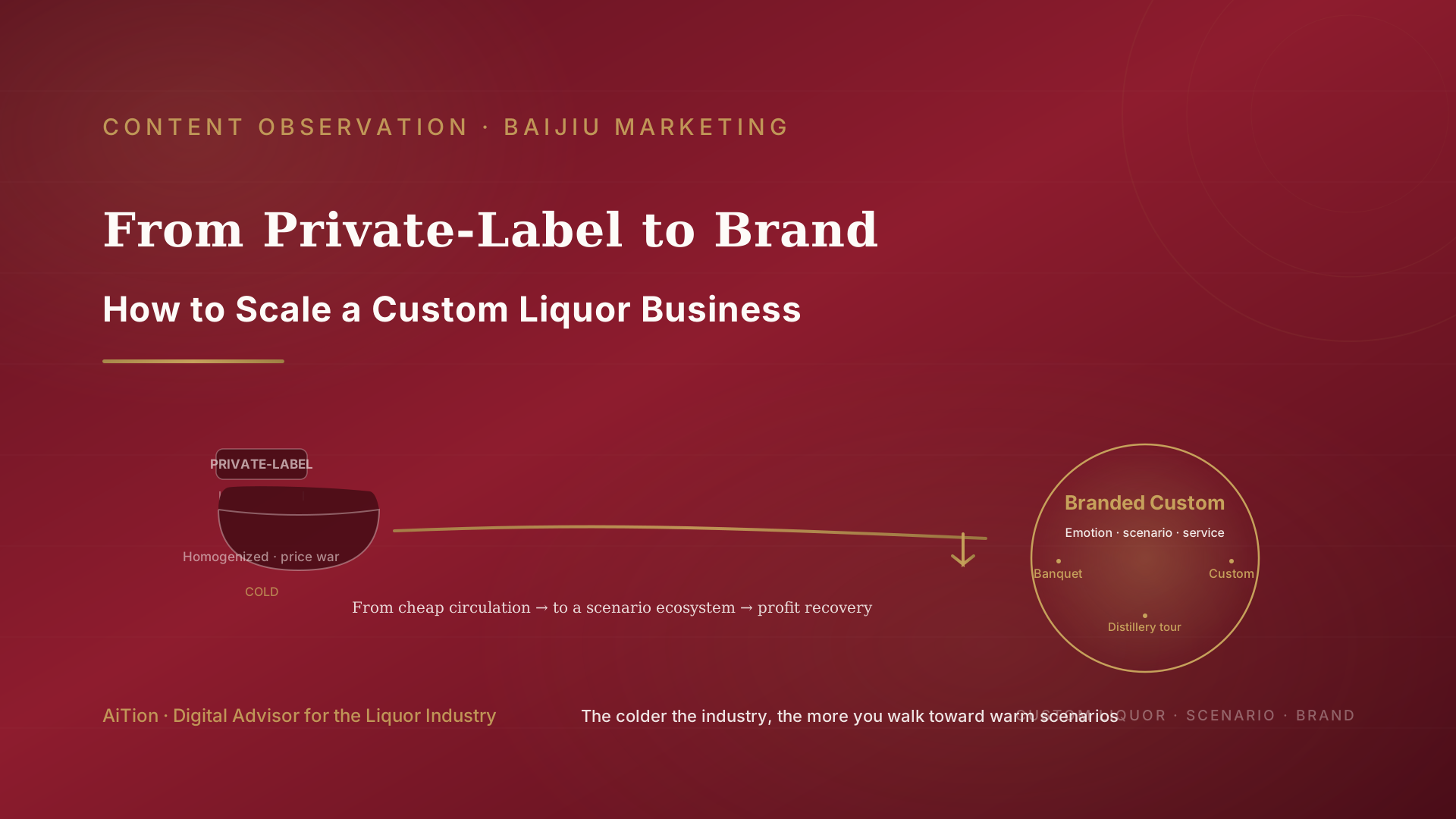
In the first half of 2026, the baijiu industry is under pressure across volume, price, and profit, and the old road of pushing inventory to hit numbers is narrowing fast, as homogenized circulation business turns cold. On the flip side, businesses with emotion, scenarios, and service—customization, banquets, and distillery tours—are warming up, and custom liquor is moving from private-label to branded. This article unpacks how distilleries and distributors seize the changed product and operating logic of scenario-based business, using digitalization to turn banquets into data, customize flows, and convert distillery tours, taking the custom liquor business from instinct-driven to data-driven.
I. Half Chill, Half Warmth
First, feel the industry's chill. In the first half of 2026, the baijiu industry is under pressure across volume, price, and profit, with channel inventory piling up and end-market sell-through weakening, so the old road of pushing inventory to hit numbers is narrowing fast.
Now the other side's warmth. Carrying its century-old cellar story, Chengyu Shaofang has opened a custom liquor estate on Keji Second Road in Xi'an's Hi-Tech Zone, offering enterprise, wedding, personal, and sealed-jar customization all in one stop. Around banquet scenarios, Jintanzi Liquor has laid out a full price-point product line, from the RMB 98 Huangpin Banquet to the RMB 1,588 aged laochen wine, targeting weddings, longevity banquets, and school-admission banquets. In Heilongjiang, Dadi Liquor has strung loose liquor, customization, sealed jars, and banquets into one chain, and even won a silver medal at the International Spirits Challenge (Brussels).
One side is cold, the other is warm. What's cold is homogenized circulation business; what's warm is business with emotion, scenarios, and service.
II. Consumption Logic Has Changed, Product Logic Must Follow
Behind the rise of scenario-based business is a change in consumption logic. Baijiu used to be a social accessory—the wine followed the banquet. Now drinking is emotional expression—the wine follows the scenario. Weddings call for decorum, school-admission banquets for good omens, corporate gifting for face, and personal collecting for memory.
Product logic must follow. No longer one bottle for every occasion, but product lines built around scenarios—banquet wine, custom wine, and distillery-tour experiences, each with its own playbook. On the distributor side, scenario business is a chance to repair margins. Circulated famous brands are thinning in profit, but banquet hosting, corporate group-purchasing, and customization services carry notably wider margins and also settle customer relationships.
III. Three Scenarios, Three Problems
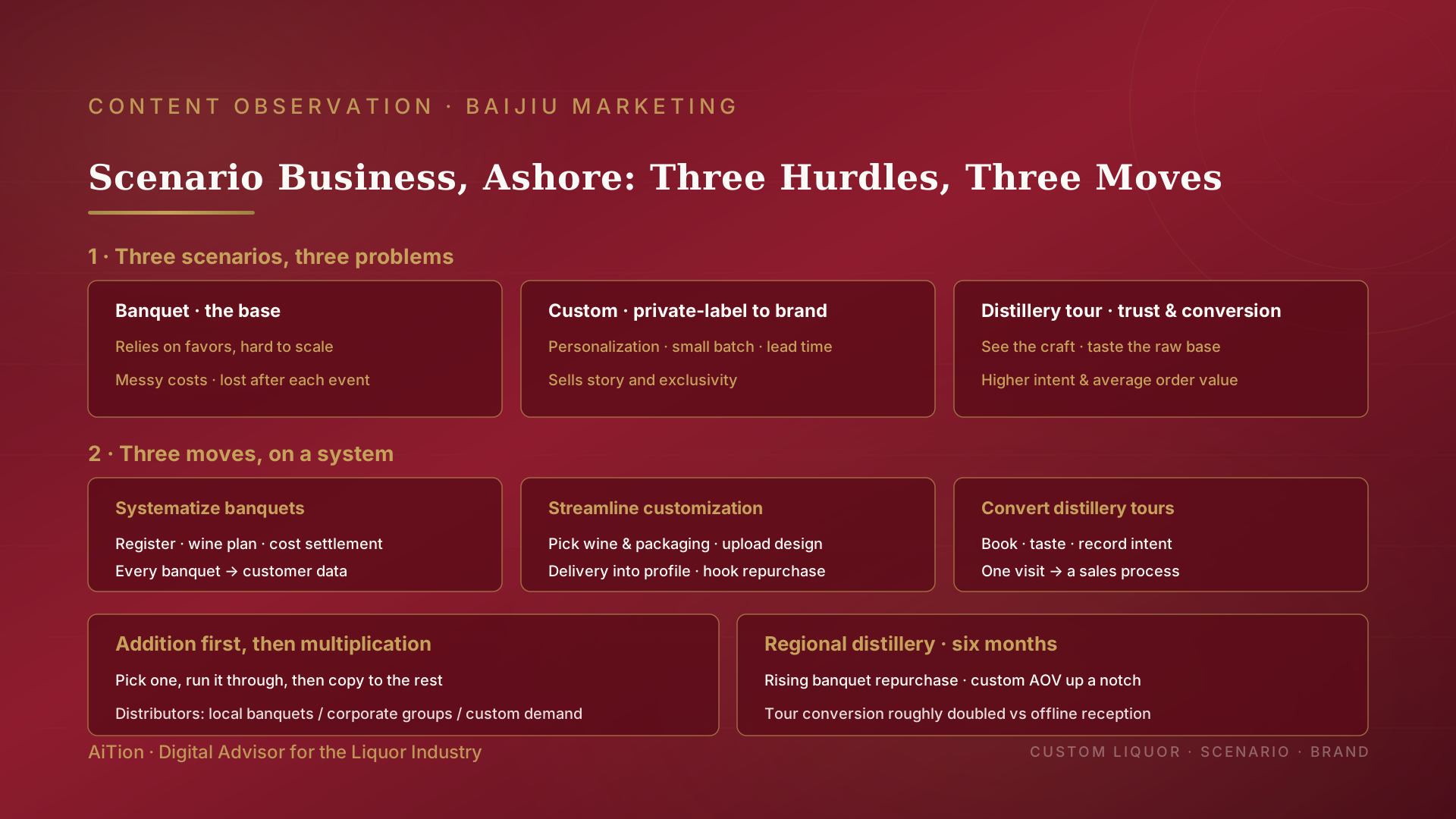
Three scenarios, three problems. Banquet wine is the basic plate of baijiu consumption, but the traditional approach leans heavily on salespeople's personal ties—hard to replicate, hard to scale, with chaotic expense management, and once a banquet ends, the customer is lost. Moving custom wine from private-label to branded sits behind three hurdles: personalization, small batches, and delivery lead times. Traditional private-label wine fights on price; real custom wine sells story and a sense of exclusivity. Distillery tours solve trust and conversion—when customers walk into the workshop, see the brewing process, and taste the raw base liquor, both their intent to order and their average order value rise noticeably.
The opportunity is inside it too. Banquets can be datafied—who hosted, which wine was used, how much was spent, and when the next event happens, settled down into precise repurchase prediction. Customization can be streamlined—online ordering, design, production progress, and delivery all visible, turning customization from high-threshold into replicable. Distillery tours can become a conversion funnel—how many came, who showed intent, whether follow-up happened afterward, all traceable end to end.
IV. Three Things, on a System
Three things, on a system. Systematize banquets: registration, wine plans, expense settlement, and data settlement as one online workflow, turning every banquet into customer data. Streamline customization: pick the wine body and packaging online, upload design drafts, track production progress anytime, and let delivery auto-enter the customer profile, planting the hook for repurchase. Convert distillery tours: booking, reception, tasting records, intent registration, and post-event follow-up, turning one visit into a sales process rather than a fanfare.
At the public-case level, Tianciyuan Liquor has launched sealed-jar customization for corporate anniversaries, project completion, and customer appreciation, offering on-site jar selection, engraving, sealing, cellar storage, and jar-opening ceremony planning as a full suite of services (source: the company's public materials, as stated by the company). Jintanzi Liquor uses its full price-point line to serve stable supply needs from wedding and banquet-hosting agencies.
A regional distillery we served digitized all three businesses—banquets, customization, and distillery tours—at once. Banquet registration auto-generates customer profiles, custom orders are fully visible across the flow, and distillery-tour visitors uniformly enter the customer pool for intent tracking. In six months, banquet repurchase rates rose, custom average order value climbed a notch, and distillery-tour conversion roughly doubled versus offline reception. No magic—it simply caught every lead each sale left behind.
V. Addition First, Then Multiplication
Do addition before multiplication. Pick the one scenario closest to your own strengths—banquets, customization, or distillery tours—run it through first, then replicate it to the other two. Distributors shouldn't fixate on circulation spreads either. The local banquet market, the corporate group-purchasing circle, and custom-liquor demand are places where you are closer, know better, and can more easily make it happen than the manufacturer.
Conclusion
Scenarios won't disappear; they'll just be satisfied in a new way. Selling liquor is a business; operating scenarios is an ecosystem. The colder the industry, the more you must walk toward where the warmth is—and warmth lives exactly in the scenarios with human touch, ritual, and story.
If your banquet, customization, and distillery-tour businesses are still at the spreadsheet-and-network stage, our banquet-wine system, custom-liquor system, and distillery-tour system can move all three from experience-driven to data-driven. Feel free to start with the one that troubles you most, and see how much leaking leads digitalization can catch for you.
Appendix: Data and Case Sources
Industry background: first half of 2026, baijiu under pressure across volume/price/profit, high channel inventory, weak sell-through (this article's judgment)
Chengyu Shaofang: custom liquor estate on Keji Second Road, Xi'an Hi-Tech Zone, enterprise/wedding/personal/sealed-jar customization in one stop
Jintanzi Liquor: full price-point banquet line, RMB 98 Huangpin Banquet to RMB 1,588 aged laochen wine, covering weddings, longevity, and school-admission banquets
Dadi Liquor (Heilongjiang): loose liquor, customization, sealed jars, banquets as one chain, silver medal at the International Spirits Challenge (Brussels)
Tianciyuan Liquor: full suite of corporate anniversary/completion/appreciation sealed-jar services (source: the company's public materials, as stated by the company)
Regional distillery case: banquets, customization, and distillery tours digitized together, rising banquet repurchase, higher custom average order value, distillery-tour conversion roughly double offline reception
【Note: The images in this article were AI-generated. 】