
Jiuxiaoer vs Waima Songjiu: Private-Domain Foundation or Platform Ecosystem — Which Is More "Irreplaceable"?
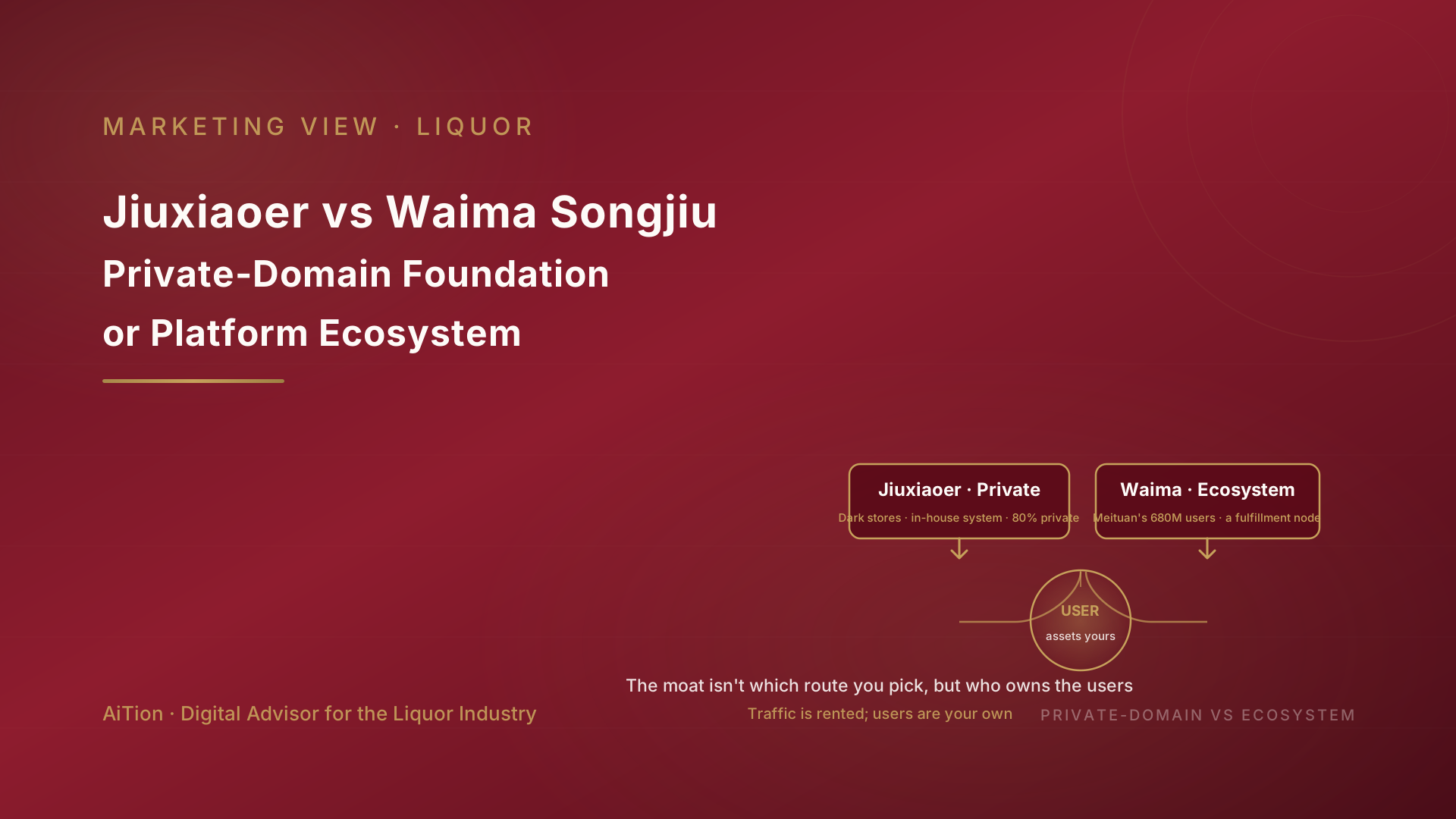
Jiuxiaoer and Waima Songjiu have both crossed RMB 6 billion in GMV — one betting on private-domain, self-built operations, the other leaning on the Meituan ecosystem. This article takes a cool-eyed look at the two routes, and points out that a distributor's real moat is not which route they pick, but whether they manage to hold user assets in their own hands.
I. On the RMB 6 Billion Line, Two Kinds of Players Stand Side by Side
In liquor instant retail, something interesting just happened: Jiuxiaoer and Waima Songjiu have both broken RMB 6 billion in GMV.
A few years ago these two were not players of the same class at all. Jiuxiaoer began liquor O2O in 2014, building its own dark stores and running its own delivery fleet — the archetypal heavy-asset workhorse. Waima Songjiu only opened its first store in Huizhou in 2021, carrying the Meituan banner, with a much later start.
Now the two stand side by side on that RMB 6 billion line. So people start asking: between a private-domain foundation and a platform ecosystem, which is more irreplaceable?
II. One Question, Two Answers
There's a lot of noise around this question, but the direction is off.
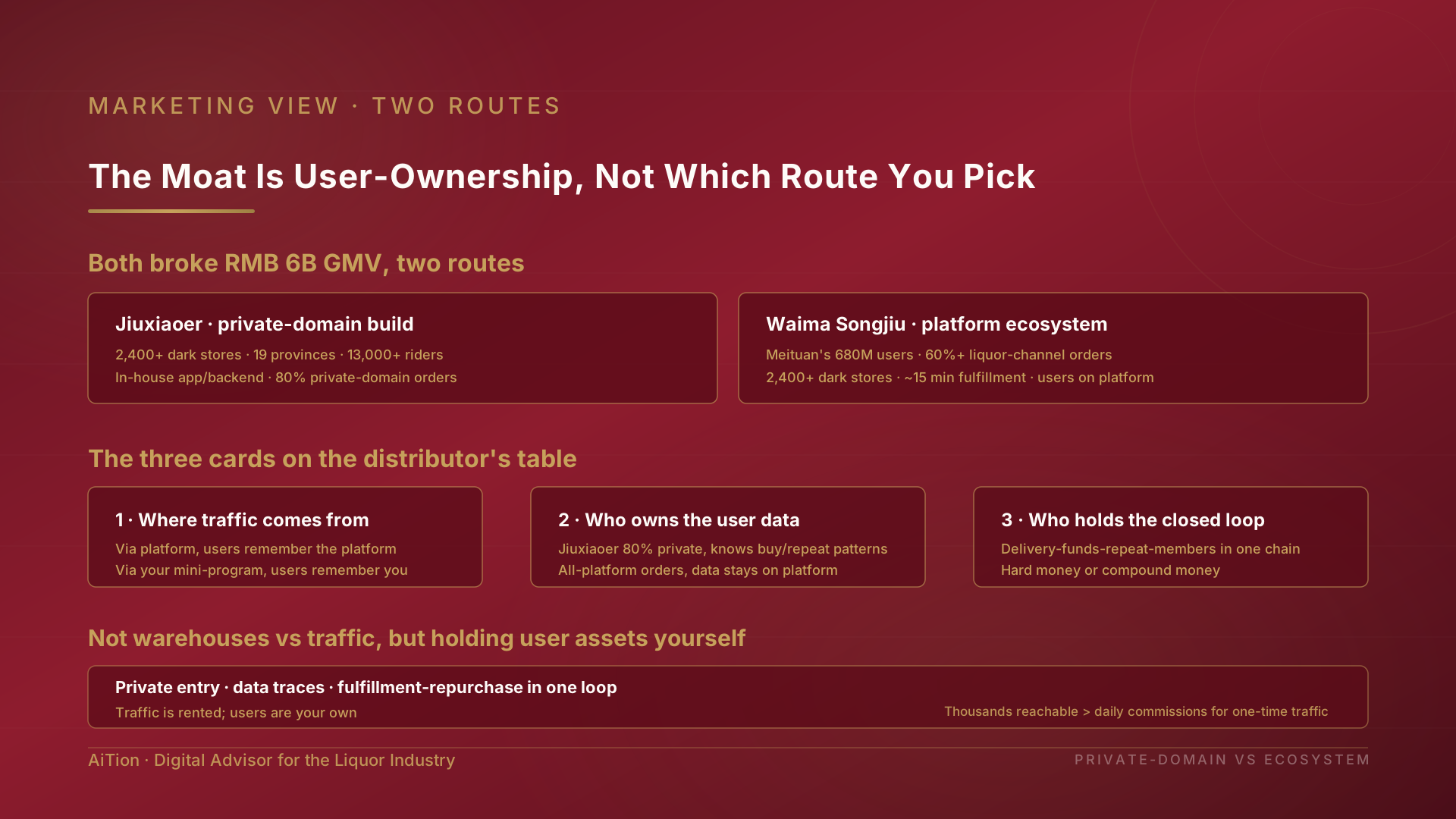
Look at Jiuxiaoer first. Its approach is clumsy: more than 2,400 dark stores spread across 19 provinces and 580-plus cities and counties, a delivery fleet of over 13,000 it raises itself, an app and mini-program it develops in-house, and even a self-researched backend system. One figure in its public disclosures is striking: over 80% of its orders come from the private domain.
That number reads like showing off. Actually it's describing the other half: the remaining 20% has to be fed by the public domain. The so-called private-domain foundation is solid, but it still needs a public-domain feed pipe on top, or the water level won't hold.
Now look at Waima Songjiu. It sits on Meituan's shoulders, tapping directly into Meituan's 680 million active users, and receives more than 60% of the orders on Meituan's app liquor channel. It has more than 2,400 dark stores across 23 provinces and 200-plus cities and counties, with average fulfillment of around 15 minutes.
Waima looks like a silver-spoon kid. Born with a golden spoon means it has to carry Meituan's surname for life. The traffic is the platform's, the riders are the platform's, and even that Morning Glory retail system is Meituan's. It has taken fulfillment and supply chain to the extreme, but the thread of user relationships is held in Meituan's hands.
Two models: one throws money at self-building, the other ties its life to an ecosystem.
III. Who Is More Irreplaceable, the Answer Is Less Romantic
When you look back at who's more irreplaceable now, the answer is less romantic.
Jiuxiaoer's heavy assets are genuinely hard to copy. Asking a regional distributor to open 2,400 dark stores and raise 13,000 riders is a joke. But what Jiuxiaoer actually values is not the warehouses and riders — it's that self-researched system and the user data it has accumulated. Those things it can use itself; you can't copy them, and it won't give them to you either.
Waima Songjiu is more direct. It proves one thing: standing beside a 680-million-user traffic entrance, even if you do nothing, order volume rises anyway. The cost is that you will always be a fulfillment node inside Meituan's instant retail. The day Meituan adjusts its strategy or changes its traffic-routing rules, your ecosystem advantage can turn into ecosystem risk overnight.
So for distributors, agonizing over whether to learn from Jiuxiaoer or Waima already drops you into a pit.
You are neither Jiuxiaoer, nor can you become Waima. You are a regional distributor in some city, with a few stores, a batch of repeat customers, and a stretch of local relationships. What these two RMB 6 billion players show you is not homework to copy; it's a clearer view of the table.
IV. The Three Cards on the Table
There are three cards on the table.
The first card is where traffic comes from. The platform can send you customers, but it can't send away your anxiety. When the order goes through Meituan, the user remembers Meituan; when the order goes through your own mini-program, the user remembers you.
The second card is who owns the user data. Jiuxiaoer's 80% private-domain orders means it knows who bought, what they bought, and how often they repurchase. If you rely entirely on the platform for orders, that data sits on the platform's backend, and all you see is a string of isolated transactions.
The third card is who holds the business closed loop. Whether delivery, funds, repurchase, and membership string together into one chain or each runs its own way decides whether you earn hard-money profits or compound profits.
Let that earlier line settle here: traffic is rented, and users are your own.
What can a regional distributor do? Not compete with Jiuxiaoer on warehouses, nor with Waima on traffic. It's to take back part of the user-assets matter from the platform at the lowest cost first.
V. Three Practices, None Complicated
Concretely, there are three practices, none complicated.
First, have your own private-domain entry point. You don't have to build an app; a WeChat mini-program mall is enough. Slowly accumulate walk-in, delivery, and banquet customers into your own pool through QR scans, membership, and enterprise WeChat. Keep taking platform orders, but find a way to draw a little of each one into your own pool.
Second, leave a trace of user data. Which type of customer likes buying what, which season has high repurchase, how many times a year banquet customers appear — if you only look at these on the platform backend, it's like building your customer profile on someone else's wall. Record it in your own system; even the most basic member ledger beats none at all.
Third, string fulfillment and repurchase together. Self-owned delivery capacity isn't a must, but repurchase reminders, member benefits, and banquet follow-ups need to run in your system, not inside the platform's message templates.
VI. The Foundation Is the Real Moat
Among the regional liquor merchants we've worked with, the ones who started early have already accumulated three to five hundred core customers into their own membership system. For one Mid-Autumn banquet, everything from order-taking, wine pairing, to follow-up runs as a closed loop inside their own system. The platform is still used, but the backbone of the business is no longer there.
This isn't exactly a revolution. But two years from now, looking at two stores both doing instant retail, one holds thousands of customers it can reach again and again, and the other still pays the platform commission every day to trade for one-time traffic. The gap is not in scale; it's in the foundation.
Sun Tzu said the skilled fighter brings the enemy to him, not the other way around. Business is the same. Being able to mobilize traffic without being mobilized by it is real skill. Drucker put it more plainly: the purpose of a business is to create a customer. Note, create, not rent.
Distributor friends can do their own reckoning: how many customers truly yours did the money you spent on platform commission this year buy? If the answer is hardly any, then the route dispute has little to do with you — what you should shore up first is your own foundation.
If you're doing liquor instant retail and want to talk about how to use one system to string membership, repurchase, banquet, and same-city delivery together, slowly accumulating user assets back into your own hands, you can reach us. No empty talk, only what's actually done.
Appendix: Data and Case Sources
Jiuxiaoer: GMV topped RMB 6 billion; 2,400+ dark stores across 19 provinces and 580+ cities/counties; 13,000+ self-run delivery staff; over 80% of orders from the private domain
Waima Songjiu: GMV topped RMB 6 billion; backed by Meituan's 680 million active users; more than 60% of Meituan app liquor-channel orders routed to it; 2,400+ dark stores across 23 provinces and 200+ cities/counties; average fulfillment around 15 minutes; the Morning Glory retail system belongs to the Meituan system
Regional liquor merchant case: three to five hundred core customers accumulated into a self-built membership system, with a Mid-Autumn banquet running as an in-system closed loop throughout
The RMB 6 billion GMV, dark-store count, and user-scale figures follow the calibration noted at the end of the article
【Note: The images in this article are AI-generated; the GMV, dark-store counts, user-scale and other figures cited here come from platform disclosures and public media reporting, reflecting company self-reported or media-estimated calibrations. 】