
Everyone in the Liquor Industry Is Making Videos—The Hype Is Real, But It Only Counts If You Can Hold the Traffic

Founders of leading distilleries building their personal boss-IP, business teams making videos as an all-hands effort, and distilleries going downmarket to coach terminals on running same-city accounts—video has become an organizational behavior across the liquor industry. But the value of short video lies in the closed loop; a traffic matrix without member conversion and a store fulfillment system often ends with a lot of noise and zero lasting results.
I. Everyone in the Industry Is Making Videos—the Hype Is Real
Lately, scrolling your phone, you keep running into the same kind of content. A distillery boss pouring liquor at the workshop, explaining how this batch ferments; a sales rep toasting at a table, captioning it with what got closed today; a tobacco-and-liquor store owner quoting prices into the camera, saying a fresh batch just arrived.
See enough of it and you get the illusion that the entire liquor industry switched overnight to self-media.
This is not my illusion. From founders of leading distilleries personally going live on camera, to brands requiring their business teams to shoot short videos across the board, to distilleries going downmarket to coach tobacco-and-liquor shops and restaurant owners on running same-city accounts, the whole chain has moved. Everyone making videos, every household going live—it has become the industry's new normal.
The hype is real. But what comes after all the noise?
II. Where Is the Money Behind This Video Wave Going?
The essence of videofying the liquor industry is a wave of integrated online-omni development. Online handles lead-gen, acquisition, communication, and sales; offline handles warehousing, delivery, and terminal service—two legs forming one complete closed loop.
On this direction, leaders are already running ahead. Zhenjiu Liduzhuang Group chairman Wu Xiangdong, Jiuxian Group's Hao Hongfeng, Gansu Yishun's Zhang Bingqing, and Jinhui Yunjiu Warehouse's Chi Jinqing—several well-known bosses in the industry have personally stepped into personal-IP, trading real on-camera presence for trust. In July last year, Gansu Yishun launched an all-hands short-video matrix strategy, declaring everyone a brand ambassador. Golden Maples' Shanghai Moka under Jinfeng Liquor used short video to introduce the new category idea of sugar-free, light-load, breaking through the perception barrier of traditional yellow rice wine.
The logic behind all these moves is the same. Traditional channel growth has hit its ceiling, the inventory-pushing model no longer works, inventories are high, and profits are inverted—both factories and distributors are desperate for a low-cost, direct-to-consumer opening. Short video is cheap, direct, and reaches young people, making it look like the most cost-effective solution right now.
But I've been staring at this boom for a long time, and something always feels missing.
III. The Traffic Arrives—Can You Catch It?
Short video solves the problem of getting more people to see you. But the essence of the liquor business is getting people to buy from you.
This is what a lot of distilleries' video-making looks like. The content team works for a month, the account grows by tens of thousands of followers, the view counts are pleasing—but ask about conversion and no one can say. Who the followers are is unknown, whether they bought is unknown, and whether they'd repurchase after buying is even more unknown. The video goes out like a stone thrown into water—a bubble, then nothing.
The problem lies in the breakpoints.
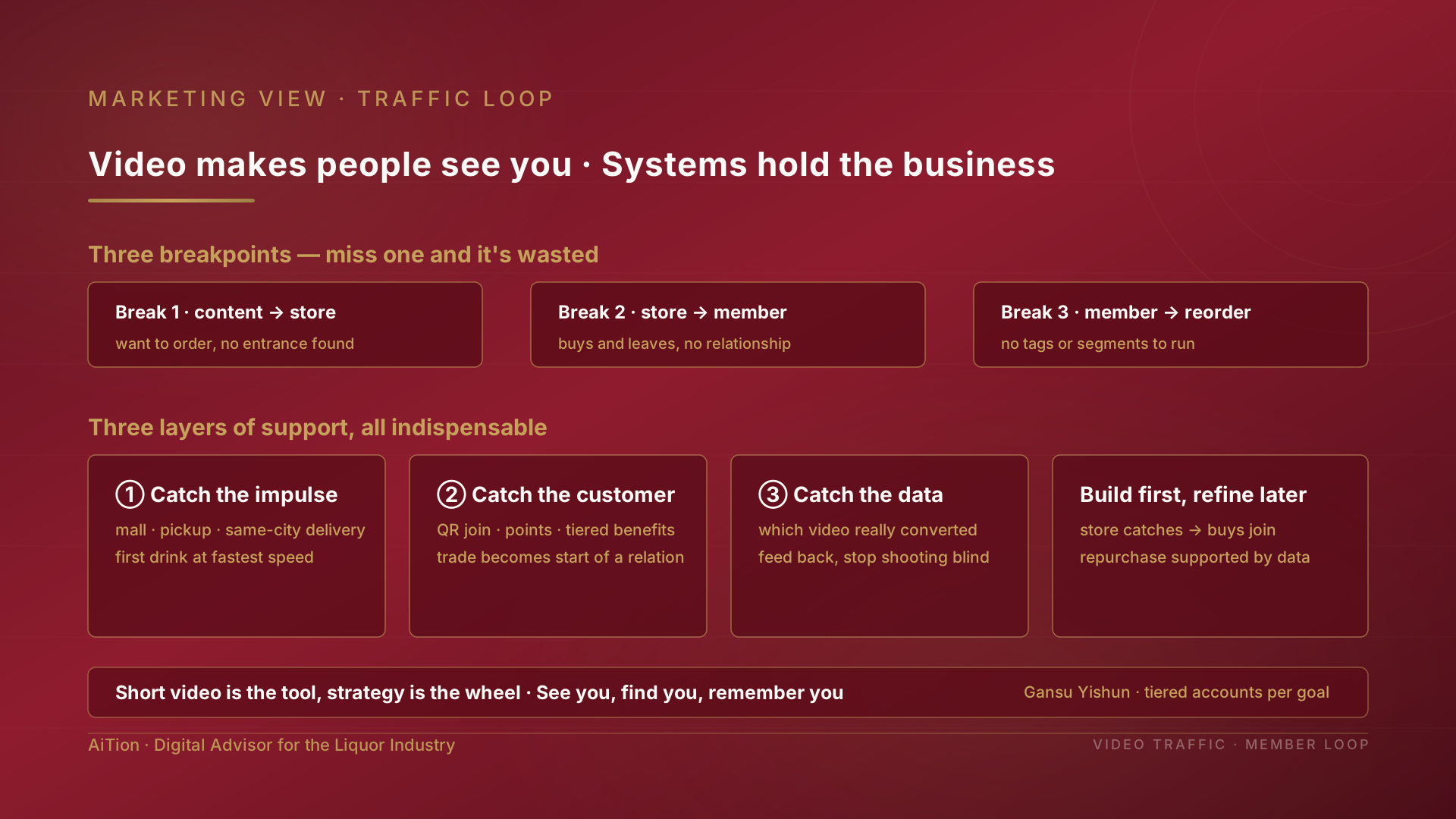
The first breakpoint is from content to store. A user scrolls to a tobacco-and-liquor store in a short video and wants to order, but can't find the entrance. The second breakpoint is from store visit to membership. The guest comes in, places an order, leaves—and the transaction ends there, leaving no relationship behind. The third breakpoint is from membership to repurchase. Even if they add WeChat, there are no tags, no tiering, no knowing who should be offered new products and who should get discounts.
The three breakpoints are interlocked; if any one fails, the videos made before are all wasted. A lot of noise, but no money coming in and no people retained.
IV. The Cameras Are Spread Out—Where's the Loop?
To catch this wave of traffic, content teams alone aren't enough—you need systems. My view is that three layers of support are all indispensable.
The first layer catches the impulse. A user sees a video and gets the idea—now the worst thing is being unable to find you. The store needs to catch same-city traffic, with mini-program mall, store pickup, and same-city delivery all working. This layer tests instant-retail capability: if a user wants a drink right after watching the video, let them get it as fast as possible.
The second layer catches the person. Finishing this one purchase isn't the end; the goal is to turn a one-time customer into a repeatedly reachable member. QR-code membership, member points, tiered benefits—these moves look trivial but determine whether traffic is a passerby or a familiar. This layer relies on consumer operations, turning each transaction into the start of a relationship.
The third layer catches the data. Which video really drove buyers, which region's same-city account has the highest conversion—this data must flow back into operational decisions. With data, you know where to spend and which direction to shoot. A content matrix without data feedback is just shooting blind.
When all three layers catch, video turns from self-amusement into part of the business.
V. How Others Do It—What We Can Learn
Gansu Yishun's all-hands matrix deserves a closer look. It doesn't just have employees shoot video; it tiers the accounts—strategy-leading, terminal-combat, and personal self-propagation, each managing its own lane, using different accounts to hit different goals. The clever part is that it understands short video's biggest value is localization: a tobacco-and-liquor store owner shooting their own shelves and banquet scenes sits closer to consumers than a headquarters-funded ad.
In projects we've served, some liquor merchants took a steadier path. Pick one city as a pilot, get same-city accounts and store pickup running, and let nearby 3-kilometer foot traffic enter the private-domain pool through the mini-program first, then gradually layer on member benefits and tiered operations. Small steps, but each lands on the loop. That pool later became the base for its repurchase—slower to show results than scattered video-making, but solid.
VI. Short Video Isn't the Strategy—It's the Tool of the Strategy
Having said all this, the one thing I most want to stress is this. Short video is the tool; strategy is the steering wheel. The tool itself produces no value; value comes from the chain built with it—from seeing you, to finding you, to remembering you.
The boss-IP should be built, same-city accounts should be spread, live streaming should be normalized—none of this is wrong. But before spreading the cameras, ask yourself three questions. When traffic arrives, can the store catch it? When a customer buys, can they become a member? When a member repurchases, is there data to support it? If you can't answer those three questions, don't rush to add budget—fix the foundation first.
Build first, optimize later.
If you're figuring out how video traffic connects with store business, or want to see whether our consumer-operations management system and instant-retail system can help, feel free to leave a comment—digital solutions.
Appendix: Data and Case Sources
Boss-IP cases: Zhenjiu Liduzhuang Group chairman Wu Xiangdong, Jiuxian Group's Hao Hongfeng, Gansu Yishun's Zhang Bingqing, and Jinhui Yunjiu Warehouse's Chi Jinqing personally stepped into personal-IP
Gansu Yishun: launched its all-hands short-video matrix strategy in July last year, declaring everyone a brand ambassador
Golden Maples' Shanghai Moka under Jinfeng Liquor: used short video to introduce the sugar-free, light-load category idea, breaking the perception barrier of traditional yellow rice wine
This is written as industry observation; no precise statistics are cited
【Note: The images in this article are AI-generated, and the above data and cases come from public reporting.】