
Revenue Up 50% in H1: Why Does China Resources Beer Open an Exclusive Product Line Just for Jiu Xiao Er?
China Resources Beer and the instant-retail platform Jiu Xiao Er jointly launched three platform-exclusive custom products, and Jiu Xiao Er's first-half revenue growth approached 50%. The platform uses consumer data to define products in reverse, while the brewer handles R&D and production—a symbiotic model that is rewriting the rules of the liquor distribution channel. This article breaks down how distributors can shift from passive shelf-merchandising to actively running on data, and hold the ground of their local business.
I. A Platform's Name Printed on a Beer Bottle
A bottle of beer with the platform's name printed on it—three years ago, no one would have dared to imagine this.
On August 5, China Resources Beer and Jiu Xiao Er held a launch event where three platform-exclusive custom products officially debuted. Snow Ganchun, Snow Manju, and Snow Hanchang are positioned for three scenarios respectively: premium craft brewing, social gatherings, and everyday drinking. The specifications and pricing are differentiated from the open-market product line and sold exclusively on the Jiu Xiao Er platform.
For a brewer to open a separate product line just for a platform used to be the other way around. In the past, the brewer made what it made, the distributor sold what it was given, and the consumer bought what was offered. Now the chain has turned on its head: the platform tells the brewer what to make based on consumer data, while the brewer handles R&D and production.
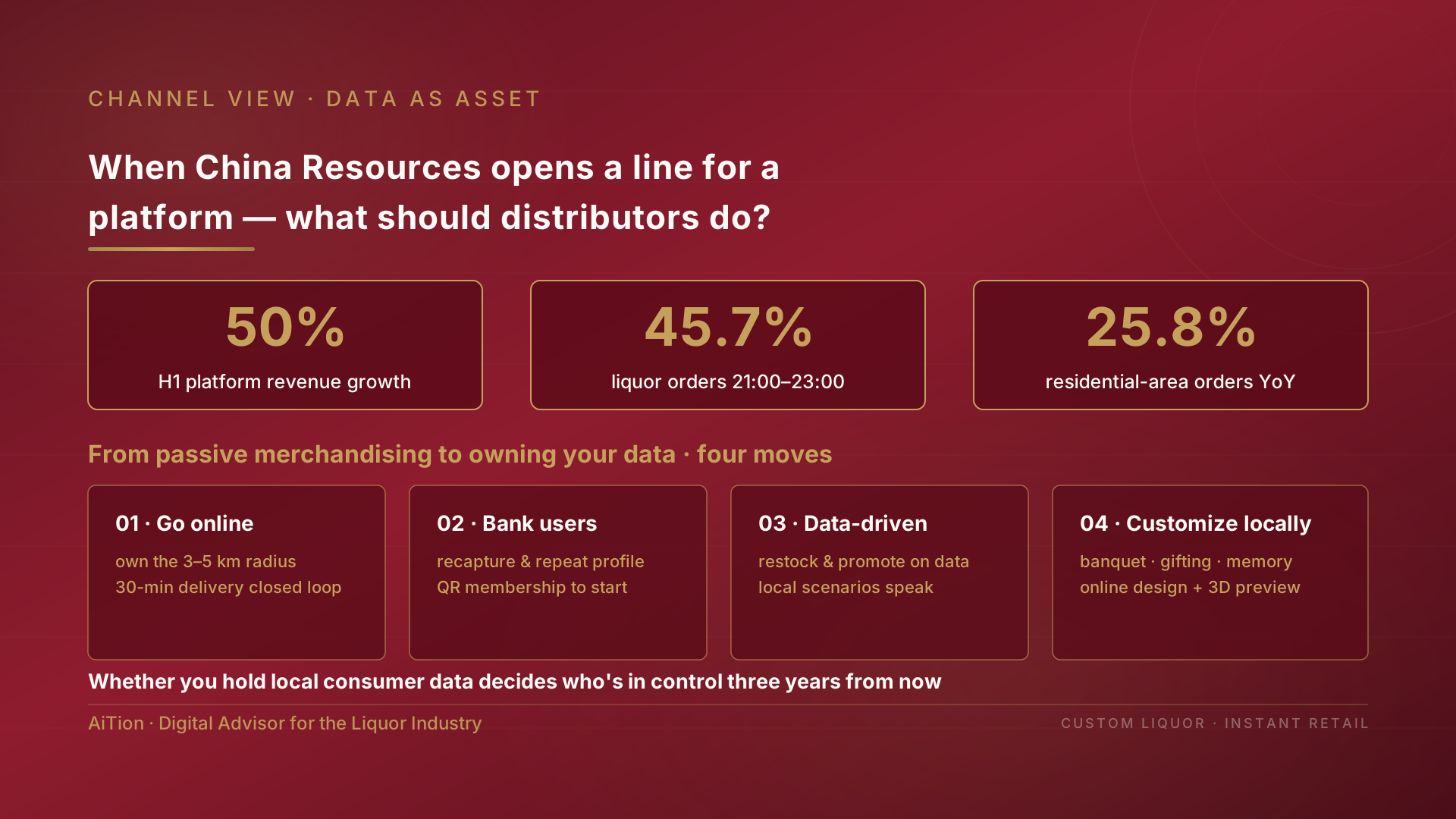
Jiu Xiao Er chairman Li Yongxin also reported a figure at the launch: first-half 2026 platform revenue grew nearly 50% year-over-year.
A distribution channel growing faster than most brewers, and with the standing to custom-order products in reverse—this news is worth a second look from every distributor.
Li Yongxin added at the launch that instant retail will not replace traditional liquor channels, but will serve as a supplementary channel form adapted to modern urban life. That is both an empty phrase and an honest one. The channel will not be replaced, but the channel's profit structure will certainly be rewritten. When a platform holds the purchase records of tens of millions of young consumers, it will no longer settle for earning just delivery fees.
II. It's Not Scarcity Anymore—It's Who Can Sell the Goods
Look deeper, and this is channel bargaining power moving house.
Over the past few decades, where did the power in the liquor channel sit? In the hands of those who had the goods. The brewer controlled allocation, the distributor stockpiled inventory, the terminal stocked the shelves—whoever held scarce supply had the final word. The distributor lived off the information gap and the logistics gap: I know where to get the goods, and I can move them where they need to go; the margin in between is my profit.
That logic no longer holds. With industry overcapacity and mounting inventories, goods have never been scarce—what's scarce is someone who can sell them to consumers. Whoever can reach the consumer holds the bargaining power.
What does a platform have? When consumers buy liquor, in which scenarios, and what they are willing to pay for. That data is worth far more than the inventory sitting in a warehouse.
China Resources Beer is a giant with tens of billions in annual revenue; its willingness to open a separate product line for an instant-retail platform shows it buys this logic. The platform understands consumers, and the brewer accepts it.
III. The Distributor's Awkward Position Is Also an Opportunity
For distributors, this looks painful.
Platform reverse-customization wipes out the information gap in one stroke. The platform knows local consumers better than the distributor does, the brewer listens directly to the platform, and the distributor stuck in the middle feels awkward. Go one step further: if the platform builds its own supply chain and connects directly with brewers, bypassing distributors, the inventory value and channel value of traditional distributors would both shrink.
But look at it from another angle—Jiu Xiao Er is itself a super-distributor. It proves one thing: the distributor path can still work; it's just that the playbook has changed.
Distributors used to make money on the goods margin; from now on they must make money on the data margin. Whoever can accumulate their own consumer data will stand firm in the next round of channel gaming.
Let me walk through the real problems distributors face today. Slow sell-through, inventory stuck in warehouses. A broken relationship with consumers—lost contact the moment a sale is done. Growing dependence on platforms, yet the users, data, and memberships all sit with the platform. The local market is being nibbled away by instant retail, and orders beyond a 3-kilometer radius simply cannot be caught.
These four problems share a single root cause: the distributor holds no digital assets of its own.
IV. From Passive Merchandising to Actively Running on Data—Four Things You Can Do Now
Action One: Move the Store Online
Use a mini-program you control to catch orders within a 3-to-5-kilometer radius of the city, so outside platforms don't skim off all your local customers. Multi-store unified management, same-city delivery capacity integration, and localized marketing playbooks—this stack is already a mature solution. Among the chain liquor retailers we serve, quite a few have already run the closed loop of 30-minute delivery.
Action Two: Bank Every Customer From Every Order
Who bought, what they bought, when they bought, whether they repurchased—all this data must be recorded. Even starting with a QR-code membership signup is better than losing contact the moment a sale ends.
Action Three: Use Data to Drive Restocking and Promotion
Which local liquor sells well, which scenarios move more—let the data speak. Restocking shouldn't rely on gut instinct, and promotion shouldn't chase the crowd.
Here's another detail unfolding in the industry. Meituan data shows that orders between 21:00 and 23:00 account for 45.7% of instant-retail liquor orders, and residential-area liquor orders rose 25.8% year-over-year. When consumers want a drink late at night, they open the app, place an order, and it arrives in 30 minutes. This scenario used to belong to convenience stores and delivery platforms; now liquor distributors are fully capable of doing it themselves. Local warehousing, local stores, local delivery—you already own all three; what's missing is the digital chain that strings them together.
Action Four: Try Local Customization
If a platform can customize in reverse, so can a distributor. Local banquets, corporate gifting, and commemorative occasions are needs platforms can't cover—and they're exactly a distributor's territory. With online design, 3D preview, and end-to-end order management, a customization business can be up and running without much investment.
V. Custom Liquor + Instant Retail System Solutions
What's really worth learning from the Jiu Xiao Er case isn't its 50% growth—it's its approach to treating data as an asset. Platforms have their playbook, and distributors have their moat. Local personal relationships, service radius, and scenario penetration are things outside platforms cannot grab quickly.
But a moat must also be reinforced digitally. Whether you hold local consumer data determines, three years from now, whether you're the one in control or the one being controlled.
If you're in liquor distribution and want to talk about building your own same-city instant-retail closed loop, or starting a local customization business, leave a comment. Let's talk only about how to actually do it—no fluff.
Appendix: Data and Case Sources
China Resources Beer × Jiu Xiao Er launch: August 5, 2026, three platform-exclusive custom products (Snow Ganchun, Snow Manju, Snow Hanchang) officially debuted
Jiu Xiao Er chairman Li Yongxin: first-half 2026 platform revenue grew nearly 50% year-over-year
Meituan data: instant-retail liquor orders between 21:00 and 23:00 account for 45.7%; residential-area liquor orders rose 25.8% year-over-year
【Note: The images in this article are AI-generated, and the above data and cases come from public reporting.】