
When Distilleries Start Making AI Short Dramas, Baijiu Marketing Enters a "Content Arms Race"
In the first half of 2026, China's AI drama and animated-drama market hit RMB 22 billion, with Douyin adding 221,900 AI dramas and animated dramas in six months—roughly one every 13 minutes. Distilleries including Huanggou, Guangliang, Wuliangye, Hainan Coconut Island, and Pagoda Brand have all jumped into AI short dramas. But behind the hype, AI only lowers the barrier to making a drama; what decides whether audiences stay hooked is still the content itself. The real test for distilleries is turning the people who watched the drama into their own members—delivering follow-through and accumulating user assets through a "content–consumer–data" triple loop.
I. On the Wine Table, the New Topic Is AI Short Dramas
In 2026, if you're still at the dinner table talking capacity, fermentation cellars, and vintage years, you might already be a step behind.
The new topic among distillery bosses is scripts, storyboards, and AI rendering.
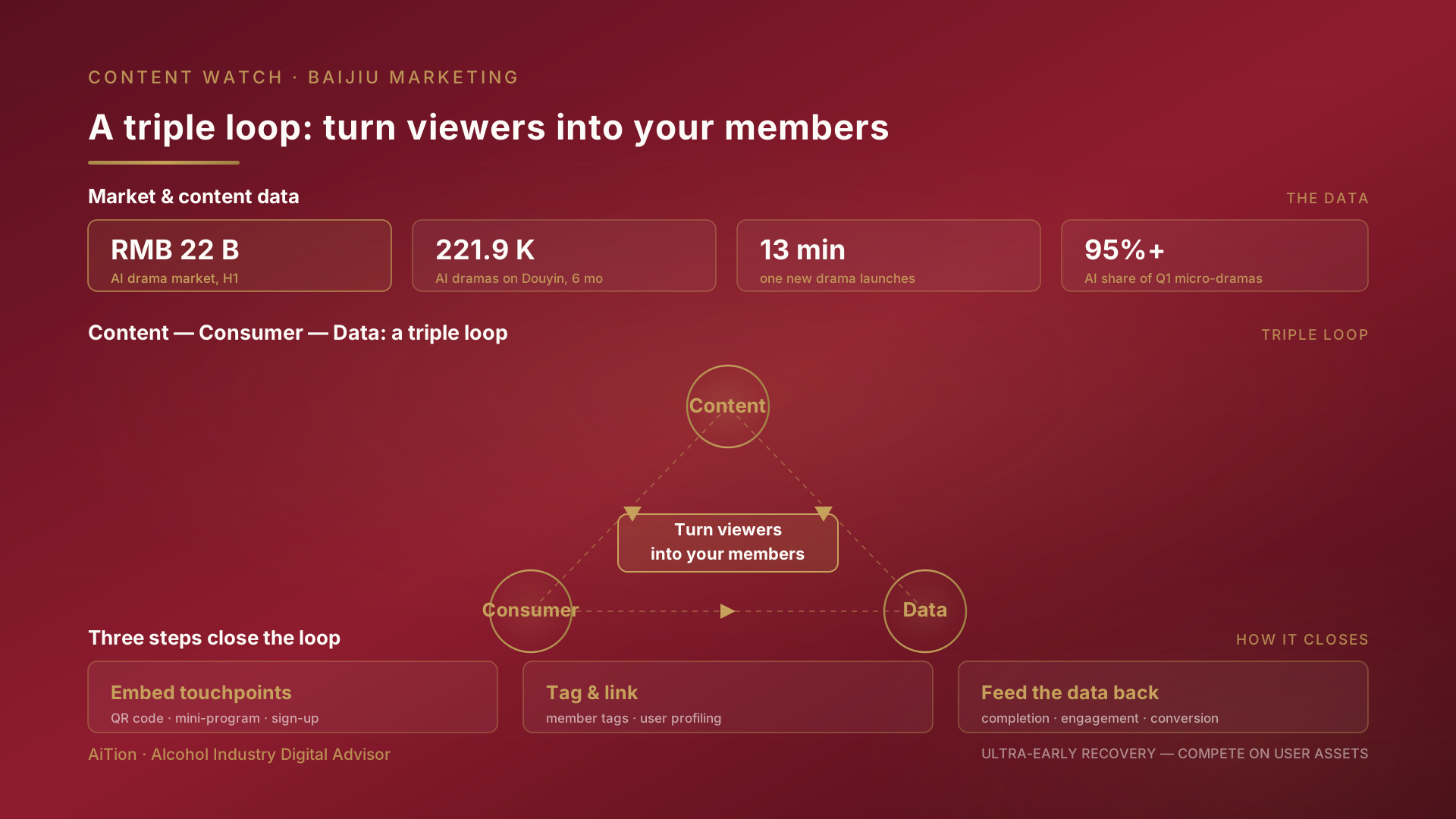
In the first half of this year, China's AI drama and animated-drama market reached RMB 22 billion. On Douyin alone, 221,900 new AI dramas and animated dramas launched in six months. What does 220,000-plus titles mean? On average, a new short drama goes live every 13 minutes.
II. Distilleries Didn't Miss This Train
Huanggou Liquor released an AI-animated microfilm for the Spring Festival, titled "Fubao's Festive Revelry." It's 14 minutes long, with no brewing workshops, none of the old lines about cellars, starter-culture aroma, or vintage. Instead, a little fortune spirit named "Fubao" descends to the human world, awakens the goodwill of a small town, and finally gathers into a sacred-dragon power that purges the demons. In May, it won the 17th Tiger Roar Awards' AI Creative Excellence Award—the first time an AI-animated microfilm in China's liquor industry has won this honor.
Guangliang Liquor plays it even bolder. In May it released the AI short drama "The Unorthodox Academy of Baijiu Cultivation," with a wild premise: an international cocktail master transmigrates back to ancient times and becomes a "drunkard," then stages a comeback driven by his bartending skills and obsession with "fine liquor." It's already into its second season, with the two seasons totaling more than 30 minutes.
The Huobao brand under Wuliangye launched "Walking Toward the Light" in early May—a three-episode short drama that drives the plot through level-by-level challenges. Hainan Coconut Island released the red-themed short drama "The Soul of Coconut Island," evoking how the military medics of Qiongya (Hainan) helped save the nation in wartime. Zhejiang's Pagoda Brand Shaoxing Wine, for its part, took part as a special support unit in the first China (Zhejiang) AI Short Drama Competition.
From baijiu to yellow rice wine, from New Year's animations to transmigration wish-fulfillment dramas. The liquor industry's enthusiasm for making AI short dramas can no longer be described as mere testing of the waters.
III. Why AI Short Dramas
Behind all this sits a very practical logic.
Baijiu's consumer base is changing structurally. Business banqueting is ebbing, everyday solo drinking is rising, and social drivers are giving way to self-pleasing motives. Gen Z and "her power" are redefining the logic of liquor consumption. Traditional advertising on CCTV, at airports, and on high-speed railway platforms reaches the previous generation of consumers. Today's young people scroll Douyin, Xiaohongshu, and Bilibili—they buy emotional value and want interest-based socializing.
AI short dramas happen to hit this window. Production costs are an order of magnitude lower than live-action dramas, the cycle is compressed from months to weeks, and the cost of trial and error is extremely low. A 14-minute AI animation, if produced by a live-action team, might cost five to ten times as much. And AI short dramas naturally fit short-video platforms' algorithmic recommendation engines, with completion, engagement, and share rates all backed by data.
IV. The Real Question Beneath the Hype
But for all the buzz, there's a more essential question nobody can dodge.
Once the technological dividend is fully consumed, once audiences lose their novelty for "AI faces," what will keep consumers in the liquor industry's AI dramas?
Open Douyin today and AI short dramas have flooded the feed to the point of face-blindness. The characters all look similar and the plot patterns are all much the same. "Fubao's Festive Revelry" won an award not because it used AI, but because it told a complete story. No product shoved in, no ad copy recited—only emotion. "The Unorthodox Academy of Baijiu Cultivation" made it to a second season not because the tech was great, but because the premise was interesting enough that audiences were willing to keep following.
AI only lowered the barrier to making a drama. What decides whether audiences buy in is still the content itself.
V. What It Means for Marketing Leaders
The logic of content production changed first. Distilleries used to do marketing with the mindset of "I want to tell consumers how good my liquor is"—vintage, cellars, craftsmanship, awards. Now they have to reverse it: what story do consumers want to watch, and how can my liquor appear in that story naturally? At the AI short drama competition, Pagoda Brand explicitly required creators to integrate the brand in natural ways—set dressing, drinking interaction, atmosphere—and to discard hard-ad placement. It's not about making content serve the product; it's about making the product serve the content.
Harder than content production is the follow-through after seeding. An AI short drama blows up, viewers are moved emotionally—then what? Without subsequent member retention, private-domain follow-through, and data tracking, that wave of traffic is one-off. Viewers finish the drama, scroll away, like it, and forget. A distillery spends heavily on content and gets back only a few exposure numbers—ROI simply doesn't add up.
VI. AI Is Not a Panacea
There's another thing many people haven't realized. AI is not a panacea. The China Alcoholic Drinks Association recently held a high-level seminar, with Moutai, Wuliangye, Jinshiyuan, and Sichuan Liquor Group, plus institutions like Harbin Institute of Technology and Inspur, jointly discussing the "2026 China Alcohol Industry AI Development Report." The report is planned for release in August—the baijiu industry's first systematic mapping of AI integration paths.
The meaning is clear. AI's application in the liquor industry is moving from scattered explorations by individual companies into a new stage of industry-wide consensus-building and systematic planning. But consensus isn't the answer. AI can generate a short drama for you; it won't decide what story that drama should tell, won't find the people who'll be moved, and can't retain any data for you.
We've observed a fairly common phenomenon in real projects. One leading distillery's marketing department produced a large volume of brand content—short videos, livestreams, tasting events—spread broadly. But after consumers watched, drank, and attended events, the brand had no idea who these people were, where they were, or when they'd buy next. Content seeding was lively; user assets were never retained.
VII. Breakthrough: The Content–Consumer–Data Triple Loop
How do you break the deadlock?
The key is building a "content–consumer–data" triple loop.
Embed consumer touchpoints in the AI short drama or any brand content. Scanning a QR code, mini-program, member registration—these turn content exposure into recognizable user behavior. Then, through member tagging and user profiling, link "people who watched the drama" with "people who bought liquor." Finally, use the data to feed back into content production. Which plotlines have high completion rates? Which scenes get high engagement? What kind of storyline best drives downstream conversion?
The logic isn't complicated, but it requires distilleries to adjust their organizational structure. Marketing owns content, the digital function owns data, and sales owns conversion. If the three departments each fight alone, even great content is a castle in the air.
VIII. An Ultra-Early Recovery—Competing on User Assets
A recent Goldman Sachs research note said the baijiu industry's toughest destocking phase is over and it now sits at an "ultra-early stage of recovery." But this recovery isn't a return to the past—it's a new phase. Channel-driven gives way to consumer-driven, product logic gives way to content logic, and scale expansion gives way to user-asset accumulation.
Distilleries making AI short dramas look like they're chasing a trend; in fact, they're testing their own marketing fundamentals. The test isn't whether you can use AI tools—it's whether you can turn people who watched the drama into your members.
Conclusion
If you're also thinking about how to plan out digital marketing for distilleries, feel free to leave a comment. We have experience in content operations and consumer retention working with multiple leading distilleries, and it may offer some reference points.
Appendix: Data and Case Sources
China Netcasting Services Association data: In Q1 2026, AI micro-dramas accounted for over 95% of all micro-dramas launched industry-wide
In the first half of 2026, China's AI drama and animated-drama market reached RMB 22 billion (Tencent News, 2026-08-05)
Huanggou Liquor's "Fubao's Festive Revelry" won the 17th Tiger Roar Awards' AI Creative Excellence Award (Tencent News, 2026-08-05)
Guangliang Liquor's "The Unorthodox Academy of Baijiu Cultivation," Wuliangye's "Walking Toward the Light," Hainan Coconut Island's "The Soul of Coconut Island," and Pagoda Brand Shaoxing Wine's participation in the AI short drama competition (Tencent News, 2026-08-05)
Seminar on compiling the "2026 China Alcohol Industry AI Development Report," attended by Moutai, Wuliangye, Jinshiyuan, Sichuan Liquor Group, Harbin Institute of Technology, Inspur, and others (Tangjiu Kuaixun, 2026-08-04)
Goldman Sachs research note: baijiu industry at an "ultra-early stage of recovery" (Sanxiang Metropolis Daily, 2026-08-02)
[All images in this article are AI-generated; the data and cases above come from public reporting, and the market-size figures are cited from industry institutions.]