
From "Selling Baijiu" to "Selling a Lifestyle": What Digital Foundations Do Distilleries Need for C-End Scenario Operations?
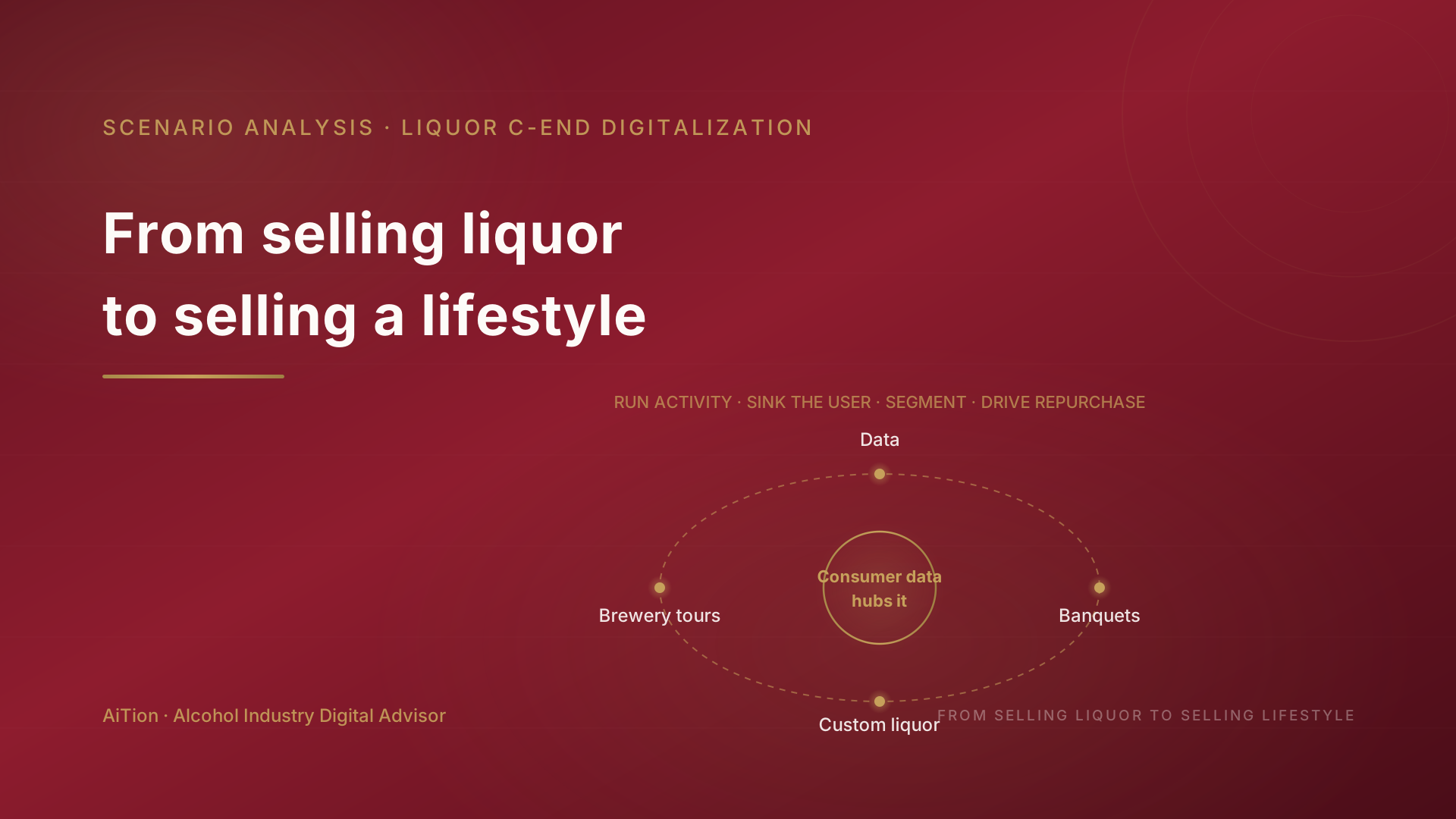
In the first half of the year, profits in the alcohol, beverage, refined tea manufacturing sector fell 17.7% year-over-year. 86.4% of surveyed distilleries reported consumers becoming more rational and prioritizing value-for-money, and 49.3% reported consumption scenarios shifting from business gifting to everyday essentials. Distilleries are collectively pivoting to the C-end for growth, but scenario creativity isn't what's missing—four digital foundations are: unified consumer data aggregation and tiered operations, digitalized distillery tour processes, banquet cost control with on-site marketing, and online design plus fulfillment loops for custom baijiu. The four form a closed loop with consumer data as the axis; miss any layer and you lose people, money, or data.
I. Scenarios Are Changing—and Changing Fast
On August 3, 21st Century Business Herald's "Baijiu Watch Weekly" published an article headlined roughly as distilleries collectively pivoting to the C-end for growth. It listed a string of moves: Guyuelongshan teaming up with a Shanghai scenic area to build a yellow rice wine culture base; Moutai, Fenjiu, and Wuliangye advancing baijiu-tourism integration and dining scenarios; Langjiu launching 39% ABV Qinghua Lang in the Beijing-Tianjin-Hebei region, positioned for light business occasions, long multi-person banquets, and light sipping.
Put these moves together, and the direction is clear. Traditional business banqueting is shrinking, and distilleries must find new consumption scenarios.
The data tells the story better. National Bureau of Statistics data shows profits in the alcohol, beverage, and refined tea manufacturing sector fell 17.7% year-over-year in the first half. In the "2026 China Baijiu Market Interim Research Report" jointly released by the China Alcoholic Drinks Association and KPMG China, one set of figures stands out: 86.4% of surveyed enterprises reported consumers trending rational and prioritizing value-for-money; 49.3% reported consumption scenarios shifting from business gifting to everyday essentials; 47.6% said consumption motives shifted from social obligations to personal enjoyment.
Consumption scenarios are moving toward the everyday, toward the individual, toward small gatherings and solitary drinking. This is entirely different from the government-and-business banqueting logic baijiu relied on for the past two decades.
Earlier still, in July this year, Guizhou issued the "Guizhou Province Action Plan for Upgrading the Shift from 'Selling Baijiu' to 'Selling a Lifestyle' (2026-2030)," explicitly proposing that baijiu consumption scenario matrices be fully formed by 2030. A provincial government writing "selling a lifestyle" into an action plan shows this has moved beyond individual companies' marketing creativity to become an industry-level strategic direction.
II. Scenarios Changed—Have Backend Capabilities Kept Up?
These moves look lively, but when it comes to actually executing them, the problems lie behind the scenes.
Baijiu-tourism integration: guests arrive at the distillery, finish the tour, and leave—was the visit data retained? A tasting event was held and attendees scanned to join as members—did anyone follow up to reach them? Low-ABV baijiu was pushed into banquet channels—did expense verification prevent fake reporting and arbitrage? A consumer wants a personalized custom baijiu—how long is the cycle from communication to delivery?
These are all backend capability problems. Scenarios changed at the front end; if the backend's consumer data aggregation, process standardization, cost control, and fulfillment delivery don't upgrade in step, then no matter how lively the scenario, people won't stay and the money won't add up.
My own judgment: in most distilleries' C-end scenario operations today, scenario creativity isn't lacking—what's lacking is four layers of digital foundation.
III. Four Missing Foundations
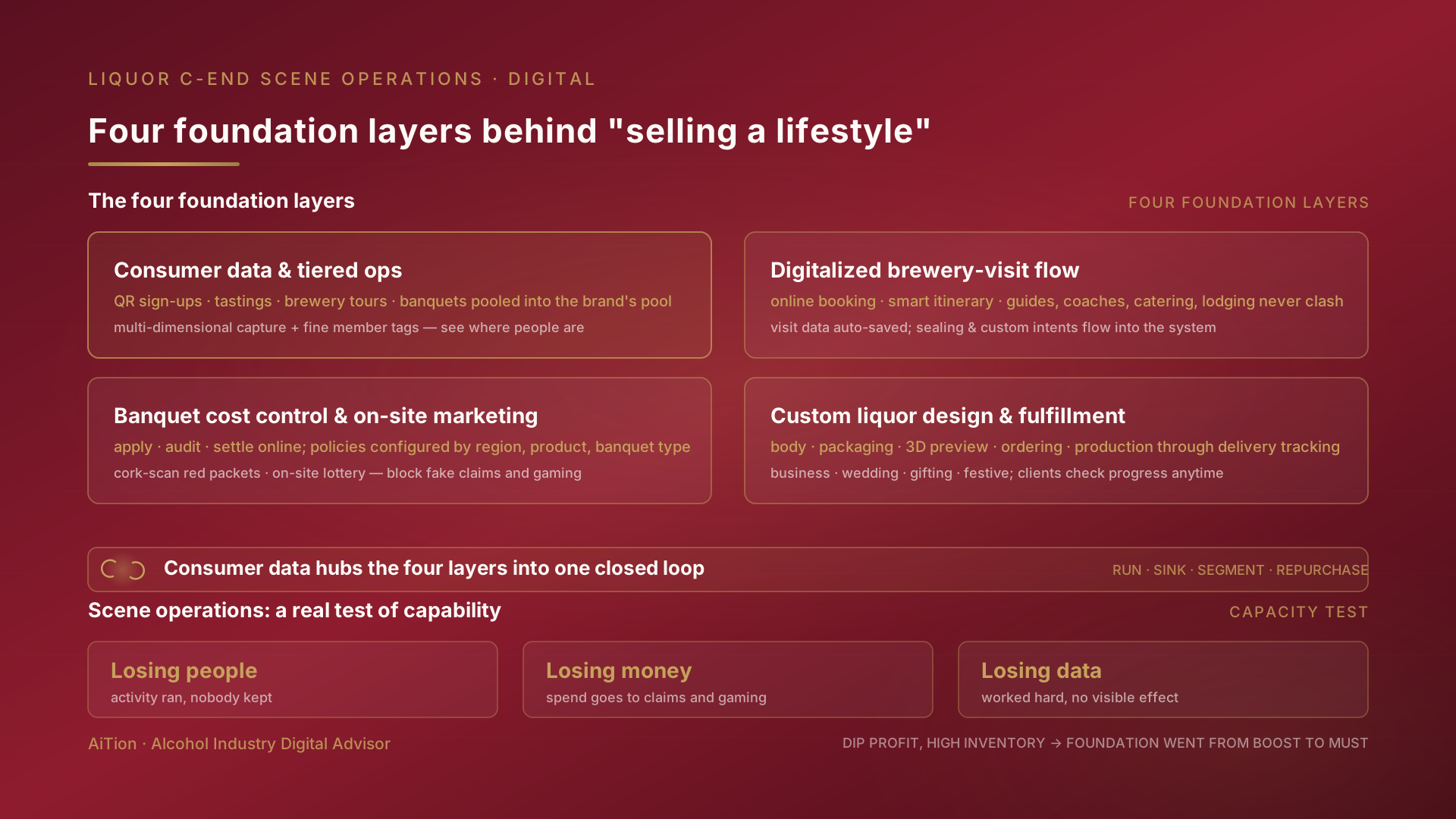
Foundation One: Consumer Data Aggregation and Tiered Operations
For distilleries doing C-end scenario operations, the first problem to solve is: where are the people?
Guests who came on distillery tours, members who scanned to join at tasting events, participants who interacted at banquets, buyers who ordered from the online mall—these consumers are scattered across different scenarios, different channels, and different systems. Many distilleries' current reality: every scenario can run an event, but once the event ends, the people lose contact with the brand, and data scatters everywhere with no unified aggregation.
Without unified aggregation, tiered operations are out of the question. You don't know who's a high-net-worth customer, who's price-sensitive, or who attended three tasting events but never bought a bottle. The scenario was executed, the people weren't retained—which amounts to nothing.
Our consumer operations management system solves exactly this. Omni-domain consumer aggregation brings consumers from multiple scenarios—scan-based acquisition, offline tasting events, distillery tours, fengtan activities, banquet interactions—into a unified brand private-domain member pool, paired with multi-dimensional data collection and a refined member tagging system, so distilleries can truly see where their people are.
Foundation Two: Digitalizing Distillery Tour and Estate Experience Processes
Baijiu-tourism integration has become a shared choice among leading distilleries, but the operational difficulty of distillery tours is underestimated.
How do you handle guest invitations? How do you plan itineraries? How do you dispatch guides, vehicles, catering, and accommodation? Will multiple groups visiting at the same time conflict? After the tour ends, how is visit data retained? How do you capture fengtan intentions and customization needs?
Many distilleries still coordinate distillery tours manually. One salesperson handles one group of guests from start to finish; processes aren't standardized, and resource dispatch relies entirely on experience. The guests leave, a sign-in sheet remains, and there's no other data.
Our distillery tour system moves the entire process online. Online booking and registration, intelligent itinerary planning, group personnel management, and reception resource dispatch are all coordinated through a visualized management dashboard. Guides, vehicles, catering, and accommodation no longer collide. Visiting customer data is automatically retained, and reception operations are traceable and countable. If guests express interest in fengtan or customization after the tour, that intention goes directly into the system, giving follow-up operations a basis.
Foundation Three: Banquet Cost Control and On-Site Marketing
Langjiu pushing 39% ABV Qinghua Lang into banquet and light business scenarios represents the low-ABV trend in banquet baijiu. But the banquet channel has always been a disaster zone for cost control.
Fake banquet reporting, duplicate claims, re-photographing old images to defraud subsidies—these problems aren't new in the industry. When banquet expenses go out, whether they landed on real banquets or were intercepted, many distilleries can't say clearly. More awkward still: banquet sites lack marketing interaction tools—consumers come, drink, and leave, with no data retained.
Our banquet baijiu system covers the entire banquet business process, from application, material review, policy matching, and expense verification to on-site marketing and consumer retention. Multi-role online submission means consumers, retail terminals, distributors, and salespeople can all initiate banquet applications. Policies can be flexibly configured by region, product, banquet type, baijiu volume, and customer tier. On-site features include bottle-opening scan red packets, banquet-exclusive draws, and interactive games. On cost control, it reduces fake banquet reporting and irregular claims, making the expense path clearer.
Foundation Four: Online Design and Fulfillment Loop for Custom Baijiu
As consumption scenarios move toward personalization, demand for custom baijiu is rising. But the delivery chain for custom baijiu is long.
What baijiu body does the customer want? How should the packaging be designed? Can the result be previewed? Where is the order after submission? When will it ship? If all of this relies on offline communication and repeated confirmation, costs are high, cycles are long, and customer experience suffers.
At the Chengdu Tangjiu Fair, Sichuan Liquor Group released three AI applications, among them "Chuanjiu Lingbi," which can perform precise blending via a robotic arm based on user-set baijiu body parameters, enabling "custom from a single bottle." This direction shows custom baijiu is moving from manual work toward digitalization and automation.
Our custom baijiu system covers the full process from baijiu body selection, packaging design, online 3D visualization preview, and order submission to production fulfillment and progress tracking. Customers can see the finished custom product online, reducing repeated communication and design confirmation costs. Multi-scenario customization covers business banqueting, wedding celebrations, corporate gifting, and holiday gifting. Order management runs the full process from requirement submission to logistics shipping, with progress viewable anytime.
IV. Not Four Systems Deployed in Isolation
Some might think the four foundations sound like four separate systems each doing its own thing. They're not.
With consumer data as the axis, the four foundations can be strung into a closed loop. If a distillery tour visitor expresses fengtan interest, that data enters the consumer operations management system for tagging, and the fengtan baijiu system subsequently follows up on subscription and cellar management. Consumers who scan at a banquet settle into the member pool, and the consumer operations management system later handles tiered outreach and repurchase guidance. Corporate information and preference data from custom baijiu clients likewise enter the unified consumer data asset.
We have some public cases for reference.
Jingpai's fengtan project integrates fengtan culture communication, event registration, cellar management, certificates, withdrawal, packaging customization, and gifting, targeting high-value customer operations. Fengtan isn't just an asset ledger—it also carries cultural content, event operations, and customer relationship maintenance. Its core value lies in the long-term cultivation of high-net-worth customers.
Wuling Liquor connects the brand, stores, and consumers through terminal management tools; terminals can bind customers, view rebates, manage tags, and take on banquet leads. Direct brand-to-consumer connection doesn't mean bypassing terminals—through lead distribution and rebates, terminals become service nodes for consumer operations.
Lidu Liquor built its user pool from zero, gradually forming check-ins, membership tiers, points malls, card collection, tasks, community interaction, and offline tasting linkages. The membership program iterates continuously, with points and benefits forming a long-term mechanism tied to consumption, content, social interaction, and offline experience. One-off events bring short-term traffic; retention and repurchase depend on sustained operational investment.
What these three cases share: scenarios, data, and operations aren't fragmented. An event is run, people are retained; retained people are tiered; tiered people drive repurchase—forming a closed loop.
V. Scenario Operations Are a Capability Stress Test
"Selling a lifestyle" isn't a slogan—it's a stress test of distilleries' digital capabilities.
Four foundations: consumer data aggregation, distillery tour process digitalization, banquet cost control, and custom baijiu fulfillment loop. Miss any layer, and scenario operations leak something. Leak people—the event was run but nobody stayed. Leak money—expenses went out and got arbitraged. Leak data—you worked for ages and can't see the results.
With industry profits declining and channel inventory high, these capabilities have moved from nice-to-have to must-have.
I'd advise distilleries to start from their highest-frequency C-end scenario. If baijiu-tourism integration is what you do most, first standardize distillery tour processes and data retention. If the banquet channel accounts for a large share, first solve expense verification and on-site interaction. Lay the foundation of data aggregation and process standardization first, then expand gradually.
Conclusion
To learn about C-end scenario digital solutions for distilleries, feel free to leave a comment.
[Note: The images in this article were AI-generated]