
How Much Subsidy Does One Fake Banquet Swindle Away? Breaking Down Six Arbitrage Tactics in Distillery Banquet Policies
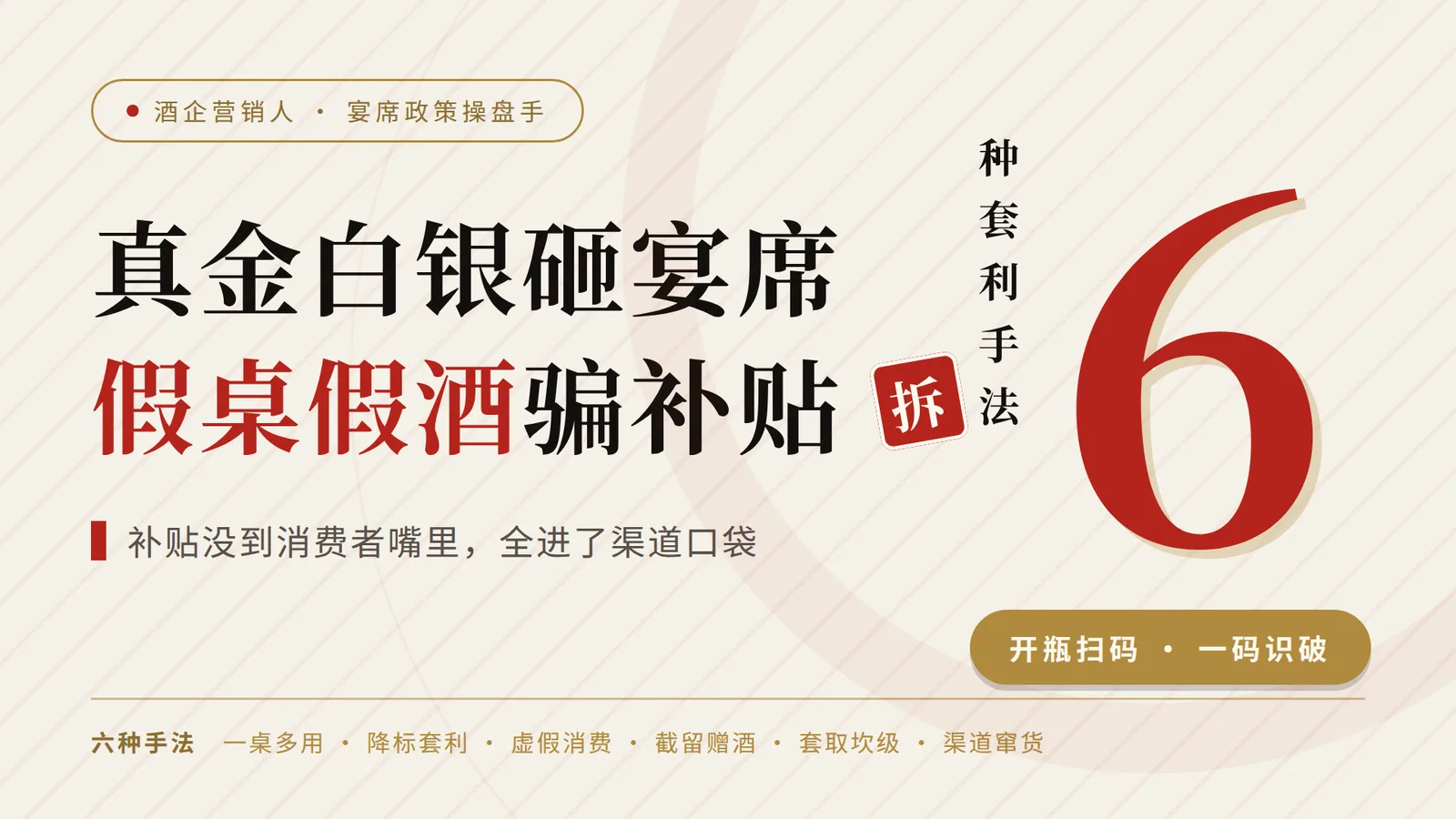
Distilleries are collectively throwing subsidies at the banquet market, but most of the money never reaches consumers' mouths. This article breaks down six arbitrage tactics—one table used multiple times, under-reporting the catering standard, fake consumption, diverting gifted baijiu, gaming tier thresholds, and cross-region channel flooding—and argues the root cause isn't greedy distributors but distilleries' inability to see the terminal. Five-code integration leaves a data trail on every bottle from factory to uncapping, replacing photo-and-stamp verification with real bottle-opening scans, paired with three-tier instant profit sharing, so subsidies actually land on consumers.
Introduction: The Budget Was Spent—So Where Are the Results?
During the industry downturn, distilleries have collectively turned their gaze to the banquet market. Gift baijiu, cash rebates, scan-based red packets, free baijiu for a full table—each policy is more aggressive than the last, as if they want to throw the entire budget at it.
But the money is out the door. So where are the results?
Many distillery marketing leads vent privately: after pushing banquet policies for over half a year, terminal sell-through hasn't improved, yet wave after wave of low-priced goods keeps surfacing. The subsidy never reached consumers' mouths—it all went into the channel's pockets.
One regional distributor put it more bluntly: "Who isn't running banquet policies these days? Without them you have no customers. But honestly, once the policy lands in our hands, how we use it is our business."
Where exactly is the problem?
Six Arbitrage Tactics—How Many Have You Fallen For?
Let's start with the conclusion: arbitrage on banquet policies is no longer an isolated phenomenon—it's the industry's open secret. The tactics are endlessly inventive, but the core is one word: "cheat." Cheat what? Cheat the subsidy.
One table used multiple times. This is the most basic play. A wedding banquet sets 20 tables; the distributor photographs the same table of dishes from three angles and submits claims to three different brands. One banquet earns three subsidies—and consumers have no idea they "attended" three banquets.
Under-reporting the catering standard. The brand requires a banquet catering standard of no less than 800 yuan per table; the distributor and hotel collude to drop it to 400 yuan, and the 400-yuan difference goes into their own pockets. When verifying, the distillery only looks at photos and the hotel's stamp—it can't find the real catering standard at all.
Fake consumption. The brand requires a banquet of at least 15 tables to qualify for the policy; the distributor rounds up relatives and friends to fill seats, sets a few empty tables, and photographs them to make up the numbers. Some even set up a few tables in a warehouse—no dishes needed—snap the photos, and clear out.
Diverting gifted baijiu. The distillery allocates gift baijiu based on the number of banquet tables, intending for consumers to drink more and experience the product. Instead, the gift baijiu flows straight from the distributor into other channels and gets dumped at low prices. Consumers never see a single bottle, while the market gains a batch of low-priced goods of unknown origin.
Gaming tier thresholds. Banquet policies are usually tiered by table count: 10 tables gets 5% back, 20 tables gets 8%, 30 tables gets 12%. The distributor actually hosts 10 tables, reports 30, and takes the 12% rebate. The surplus rebate covers the profit loss from dumping, making it a sure win.
Cross-region channel flooding. Goods obtained through banquet policies cost less, so distributors dump them into other regional markets, destabilizing local price systems. The distillery spends its banquet subsidy money—and buys itself the collapse of a regional pricing structure.
These six tactics are nothing complicated. Yet distilleries simply can't stop them.
It's Not That Distributors Are Too Clever—It's That Distilleries Are Blind
Some would say this is distributors lacking integrity. But flip the perspective: the problem isn't human malice—it's that distilleries simply can't see what's happening at the terminal.
What does verification rely on? Photos, stamped application forms, consumption receipts issued by hotels. How cheap is it to fake these materials? A phone, a piece of photo-editing software, and a hotel front-desk clerk willing to play along—that's enough.
Do distillery salespeople know? They do. But salespeople are evaluated on payment collection and purchase volume—not on whether the banquet actually happened or whether consumers actually drank. As long as the distributor is willing to pay and order, what incentive does a salesperson have to dig in? Some salespeople even actively help distributors forge materials—after all, if targets aren't met, they take the hit too.
The three parties' interests are completely misaligned: the manufacturer wants market share, the distributor wants cash flow, the store wants per-transaction profit. Everyone watches their own abacus, and the banquet policy becomes a shared "ATM."
This isn't one distillery's problem—it's a structural pain point for the entire industry: distilleries can't penetrate the channel and can't obtain real terminal sell-through data. If you can't see it, you can't manage it; if you can't manage it, the money is wasted.
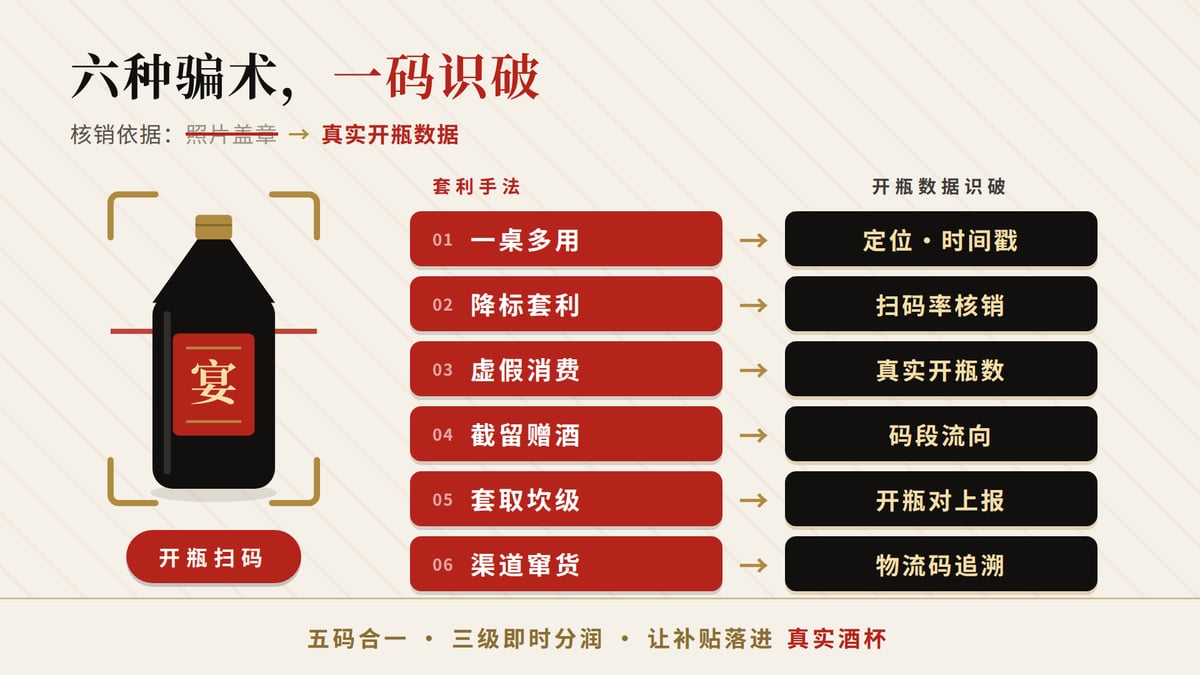
Five-Code Integration: Letting Every Bottle "Speak" for Itself
To plug the arbitrage, adding more reviewers and more approval steps treats the symptom, not the cause. What truly solves it is making the product itself the source of data.
The logic of five-code integration isn't complicated: the inner cap code, box code, case code, pallet code, and logistics code are all linked, so every stage from factory to uncapping leaves a data record. This isn't a new concept—most leading distilleries are already doing it. The key is how to genuinely combine five-code integration with the banquet scenario.
How does it work in practice?
Consumers scan the code when they open the bottle. This is the starting point of the entire loop. Consumers open a bottle at the banquet and scan to claim a red packet or enter a draw. That single scan gives the system three critical pieces of information: scan time, scan location, and the scanner's identity.
The system automatically verifies whether the banquet is real. The distillery pre-enters approved banquet information into the system—time, location, table count, and baijiu brand. After a consumer scans, the system compares the scan time and location against the banquet record. If a wedding "reported" in Zhengzhou shows all scan locations in Chengdu, or if scan times cluster two hours before the banquet starts—the system flags an anomaly directly and rejects the claim.
Instant rebates with three-tier profit sharing. Once verification passes, red packets or rebates are issued instantly. The key is the three tiers: consumers get bottle-opening red packets, stores get sell-through rebates, and sales associates get promotion commissions. All three parties have a stake, so all three are motivated to drive real consumption rather than collude in arbitrage.
Once this mechanism is running, the six arbitrage tactics above are essentially dead:
One table used multiple times? Scan location and timestamps expose it instantly—the same table of people can't appear in three places at the same time.
Under-reporting the catering standard? The consumer scan rate is the verification basis, unrelated to the catering standard—there's nothing to fake.
Fake consumption? Without real consumers opening bottles and scanning, the verification data is zero—inflating table counts is meaningless.
Diverting gifted baijiu? Gift baijiu and regular baijiu are bound to the same code segment—one check reveals the flow.
Gaming tier thresholds? Actual bottle opens don't match the reported table count—the system raises an automatic alert.
Cross-region channel flooding? The logistics code traces the entire journey—where the goods went is crystal clear.
Banquet Policies Can't Run "Naked"
Ultimately, the banquet policy itself isn't wrong. With the industry cooling, distilleries wanting to use subsidies to stimulate banquet consumption is the right direction. What's wrong is at the execution level—subsidies without data support are just handing out "red packets" to the channel.
Five-code integration isn't a panacea. It solves the "visibility" problem, giving distilleries the ability for the first time to penetrate the channel and reach the terminal. But visibility alone isn't enough—it must be paired with adjustments to the evaluation mechanism, a reshaping of salesperson incentives, and a redistribution of distributor interests.
Digitalization isn't about "controlling" the channel—it's about giving distilleries the ability to "trust" the channel for the first time. When every bottle is traceable from factory to uncapping, and every subsidy can be traced to a real consumer, banquet policies can return to what they should be—letting consumers drink the baijiu, letting the channel earn what it deserves, and letting the distillery's spending land where it matters most.
Instead of one fake banquet, three parties splitting the loot.
Conclusion
Is your company also exploring digitalization? Leave a comment below to receive the Banquet Baijiu Solution.
[Note: The images in this article were AI-generated; the information is drawn from public reports and is for reference and discussion only. For factual discrepancies or infringement matters, please contact the author for removal.]
Related Reading
How Can Local Alcohol Instant Retail Enterprises Enhance Their Operating Capabilities Through Banquet Baijiu Services?
Banquet Baijiu Digital Solution: Turning One Banquet into a Business Lead
Instant Retail 2.0, Supporting Banquet Baijiu Business and Private Domain Live Streaming
Breaking Down Distillery Consumer Operations: Why Can Wuling Liquor Go Deep in Banquet Baijiu?
Leading Distilleries Are All Doing Scan-Based Marketing, but What Truly Separates Them Is Banquet Scenarios, Social Gameplay, and Private Domain Repurchase