
Don't Let "Dark Store" Scare You Off: A Lightweight Playbook for Small Shops Entering Instant Retail
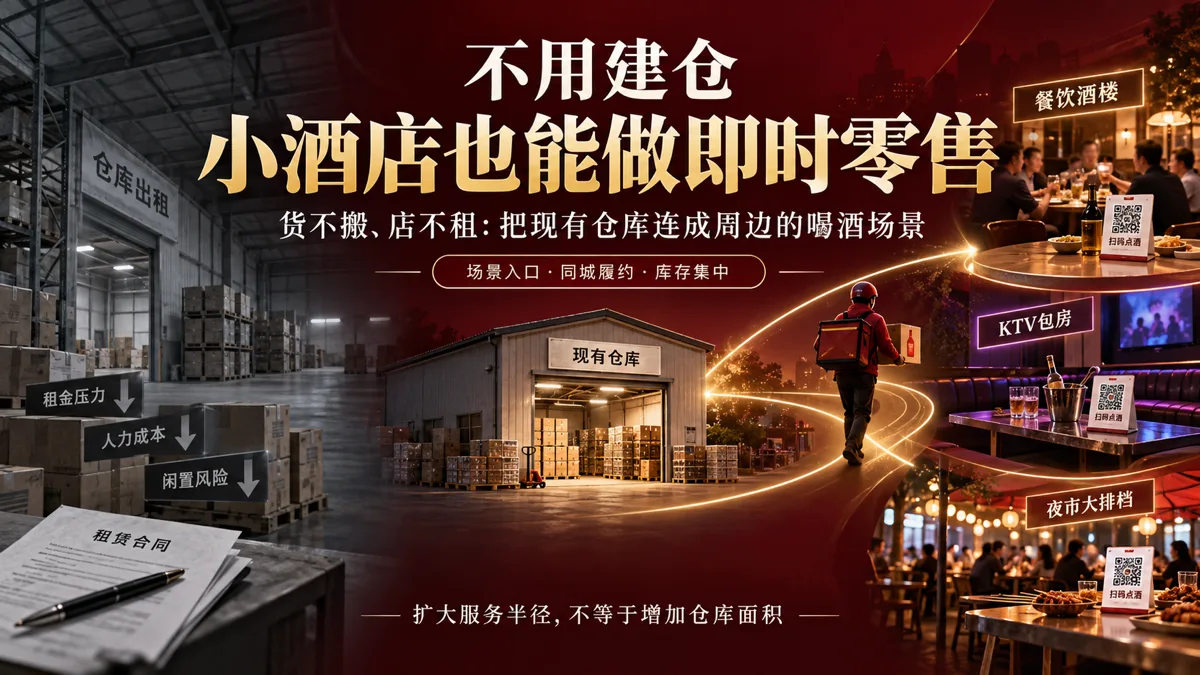
Instant retail is described as a heavy-asset game of "building a warehouse plus a delivery fleet," and individual tobacco & alcohol shops back off the moment they hear it. But a warehouse isn't the only answer. Make your existing warehouse the center, project drinking scenarios into nearby restaurants, KTVs, and late-night food stalls—goods don't move, no store is rented—yet your alcohol sales entry points can multiply dozens of times. This article lays out this lightweight playbook clearly.
Introduction: One Sentence That Shuts the Door
"Doing instant retail? Better set aside 200,000 yuan to build a warehouse first." How many tobacco & alcohol shop owners has that line shut out?
That's how industry articles put it. Either build your own dark store—heavy upfront investment, requiring a store network and logistics team, suited to leading distilleries and well-capitalized major distributors. Or have a single store join a platform—light investment, low cost, suited to individual small shops. Two paths, and it sounds complete.
But both paths share one premise: you must first have a "warehouse" or first "join the game." Either build your own warehouse, or hand your store to a platform as a fulfillment point. After hearing this, small owners quietly go back to tending their counters.
I don't see it that way.
The Misread Dark Store Isn't a Small Shop's Entry Ticket
Why has the dark store been elevated to a standard requirement? Because it solves the address problem of same-city instant fulfillment. Goods must be close to consumers, deliverable within three kilometers. That logic is sound.
What's wrong is equating "close" with "build more locations."
A dark store is a heavy asset because it needs rent, staff, and separate stocking. Players running dark stores in the industry push rent below 2,500 yuan and staff the location with just one person—all to save on this cost. Giants can afford this playbook; individual small shops cannot.
But an individual tobacco & alcohol shop already has a warehouse in hand. Your own storeroom—it's right there. What you need isn't to build another one, but to throw out its service radius.
Goods Don't Move, No Store Is Rented—Move the Scenario into Someone Else's Venue
Ask a different question: without building a warehouse, how does the alcohol reach consumers?
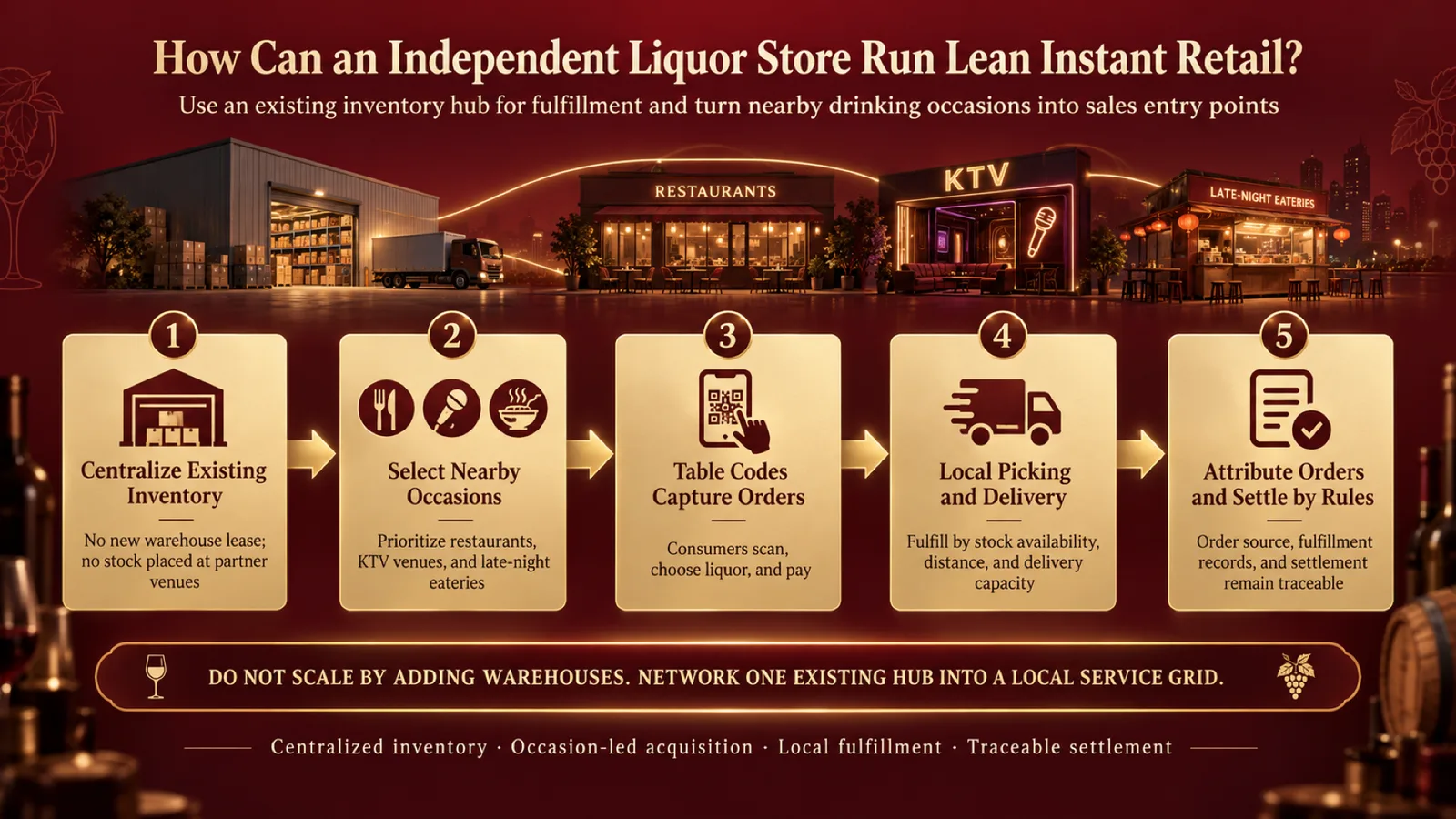
The answer is to stop making goods go find people—let people order within the scenario. With your warehouse as the center, project products through a single table QR code into concrete drinking scenarios: restaurants, KTVs, late-night food stalls. Consumers scan on the spot, choose on the spot, pay on the spot, and your warehouse ships and delivers from nearby.
The goods are still in your warehouse, in the same place. They aren't moved, distributed, or stockpiled at the partner's site. The partner venue doesn't purchase stock, rent a store, or tie up capital.
This is a virtual store. It adds no physical warehouse, yet extends the service radius from your doorstep to every scenario with a code stuck on it.
We call this networking, not warehouse-building. The former uses the warehouse you already have; the latter requires you to spend new money. The same-city delivery and multi-store dispatch capabilities of an alcohol instant retail system sit on top of this network; the scan-based marketing system handles in-scenario scanning and channel profit sharing.
What You Save Isn't Warehouse Rent—It's the Capital Locked Up in Stock
The most expensive part of building a warehouse usually isn't rent—it's inventory.
Traditional cross-industry cooperation often requires you to distribute goods into the partner's venue. Once the goods are out, capital is tied up, and if they don't sell, you have to haul them back. Small shops fear this most.
The virtual store reverses it. Inventory stays concentrated in your warehouse and only ships after a sale. You're not stocking separately for dozens of scenarios—just one. Warehouse rent is saved, and so is the bigger item: capital locked up in distributed stock.
Our judgment: the barrier for an individual small shop entering instant retail isn't opening a new warehouse—it's whether you have a system that can connect the warehouse you already have into a network.
Entry Points Go from a Few to Dozens—Through Radius, Not Floor Space
Count your current alcohol sales entry points. Regular customers, group buys, the occasional walk-in. A few.
After adopting a virtual store, the restaurants, KTVs, and late-night food stalls within three kilometers of your warehouse can each become a new entry point. From a few, to dozens. Your warehouse's floor space hasn't changed; its service radius has.
Once an order is completed, customer information stays in the system. Where they bought, what they bought, how much they spent—you can see it all. Next time they come back, you can directly drive repurchase. Customers shift from one-time visitors to assets you can reach a second time.
This isn't a fantasy. The business design discussed in our meetings uses the warehouse as the center and the table code as the radius, connecting drinking scenarios one by one. As of now, this model has been pilot-tested in multiple locations; specific order and profit-sharing data are still being compiled, and this article won't draw conclusions on your behalf.
Three Steps Without Building a Warehouse—Start with the One in Your Radius
Step one: Survey scenarios. Don't rush to expand stores. First count how many restaurants, KTVs, and late-night food stalls are within three kilometers of your warehouse. Those with high late-night order volumes go first.
Step two: Bind people. Talk to the venue's waitstaff or manager and bind the table code to them personally. One person can bind multiple codes. If they leave, the backend swaps person and venue—the relationship isn't lost.
Step three: Set profit sharing. Ratios are set according to the actual scenario, configured and settled uniformly by the platform. When rules are transparent, all four parties are willing to push long-term.
Conclusion
The dark store is the giants' game; the virtual store is the small shop's path. You don't need to build a warehouse first for instant retail—you just need to connect the one you already have into a network.
Within three kilometers of your warehouse, which store should get the first code?
Drink responsibly, in moderation.
Data Sources
[1] Sohu, "How the Alcohol Industry Can Embrace the Instant Retail Trend" (2025-08-06): proposes two paths—building your own dark store (heavy asset, leading major distributors) and single-store platform onboarding (light investment, individual tobacco & alcohol shops).
[2] Tencent, "Traffic: The Key to Success or Failure in Alcohol Merchants' Instant Retail" (2025-01-15): interviews a 120㎡ tobacco & alcohol shop in Chengdu that joined a leading instant retail platform, averaging about 40 orders a day at roughly 300 yuan per order (company self-reported, materials disclosed); mentions dark store rent control and single-person staffing practices.
[3] Zhejiang Provincial Alcohol Circulation Association, "6 Billion Yuan in Transaction Volume Squeezes Living Space" (original date as in the source): instant retail platform transaction volume and store scale data.
[4] Tencent Cloud Developer Community, "Instant Retail Dark Stores vs. Store Flash Delivery" (2025): the view that small shops should not build their own dark stores and should start with zero-investment store flash delivery, aligned with this article's "light-asset start" direction, but stopping at the "platform flash delivery" layer.
[5] Our own business design (meeting-based account): warehouse as center, table codes into scenarios, four-party profit sharing—company self-reported, pending verification.