
How to Build a Cross-Industry Alliance "Virtual Store": Make the Warehouse the Center, Put Baijiu on Every Dining Table

Traditional cross-industry alliances are often sustained by coupons, personal referrals, and month-end manual reconciliation—short-lived, with unclear responsibilities and hard-to-sustain cooperation. A virtual store concentrates inventory in the alcohol merchant's warehouse and captures orders through exclusive table QR codes in consumption scenarios like restaurants, KTVs, and late-night food stalls. The alcohol merchant handles stocking and same-city fulfillment, while partner venues and key referrers earn profit shares according to set rules. This article breaks down the inventory, order, settlement, and user-retention logic, and offers a three-step launch method.
Introduction: 500 Coupons, Not One Redeemed
Lao Zhang stubbed his cigarette into the ashtray and said, "I've tried cross-industry alliances too. Last year I printed 500 coupons and handed them to the restaurants and KTVs next door, begging the owners to give them out. Three months—not one was redeemed."
He gave a bitter smile. That was his lowest stretch.
Many owners have walked this path: hand out coupons, ask people to push, rely on goodwill. It's hot for three days, then the coupons sink into a drawer and the other party forgets. Why doesn't Old Wang help push? He's busy with his own business—why would he remember you?
An Alliance Held Up by Goodwill Can't Survive One Peak Season
"So how do you actually do it?" Lao Zhang asked me.
I told him to look at the table at the late-night food stall.
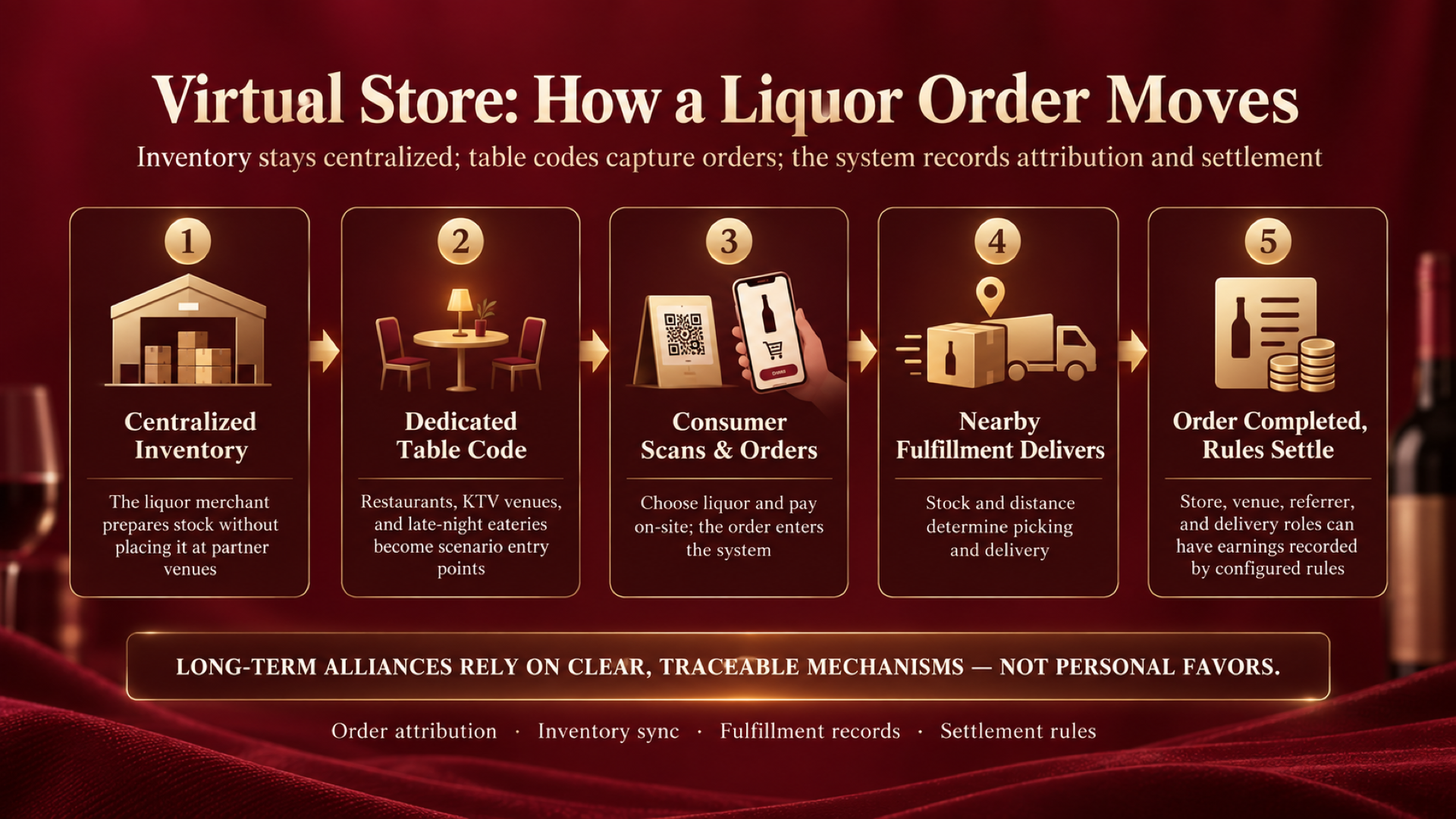
Friday, 9 p.m., Old Wang's place is packed. Three tables call out at once: "Two bottles of baijiu!" No one sends a voice message to order. Each table has an exclusive QR code stuck on it. Customers scan it themselves, pick their baijiu, and pay; a nearby fulfillment point stocks up and delivers it to the table. Old Wang doesn't need to hold inventory, and the backend automatically credits him a scenario-based profit share.
This is a virtual store.
It's not duplicating a physical store, nor turning a restaurant into an alcohol distributor. It turns a specific drinking scenario into an identifiable, orderable, fulfillable, and settleable sales entry point.
No Store Rental—Just One Code
The core is centering on your warehouse or store inventory. The goods stay in your warehouse, in the same place—they aren't moved or stockpiled at the partner's site. What you do is project products through table QR codes into specific drinking scenarios: restaurants, KTVs, late-night food stalls. Consumers scan on the spot, choose on the spot, pay on the spot; once the order enters the system, the alcohol merchant handles stocking and same-city delivery.
Goods don't move, which means you don't need to stock separately for every new scenario. Traditional cross-industry cooperation often requires distributing goods into the partner's venue—capital gets tied up first, and you bear the pressure of slow sales, spoilage, and inventory counts. The virtual store reverses this: inventory stays concentrated in the warehouse or fulfillment store, and only ships after an order is completed.
In this business design, the instant retail system handles same-city delivery and multi-store or multi-fulfillment-point dispatch; the scan-based marketing system handles in-scenario scan identification, order attribution, and channel profit sharing. The goal of both isn't to make one more QR code, but to make "who brought the order, who completed fulfillment, who earns the revenue" verifiable.
Lao Zhang's eyes lit up: "Why would Old Wang push for me long-term? Goodwill would have faded by now."
If Profit Sharing Isn't Automated, the Alliance Breaks Up
Whether Old Wang is willing to push depends on whether the accounts are clear. The traditional approach is often month-end reconciliation, manual calculation, and repeated verification. Partners can't see the orders, key people can't get their earnings, and the pushing cools off after a while.
A virtual store needs to write profit-sharing rules into the order system. A completed alcohol order can map to different roles according to preset rules:
The alcohol merchant's physical store or fulfillment store earns payment settlement and fulfillment-related revenue;
Partner venues, such as Old Wang's restaurant, earn scenario-traffic or order-attribution profit shares;
Key referrers, such as waitstaff or managers, can link an exclusive code to themselves and earn referral profit shares;
The delivery party earns fulfillment service fees.
Whether all four parties "get paid" depends on actual business rules, cost structure, and compliance arrangements; but the responsibilities, trigger conditions, and order records of all four must be clearly visible in the system. Automatic calculation upon order completion, with refunds, cancellations, and exception orders rolled back or adjusted under the same rules, is what reduces manual reconciliation and profit disputes.
"So it's not how much you share—it's whether the mechanism is stable." Lao Zhang nodded.
Right. Whether an alliance lasts depends on the mechanism, not on goodwill.
Scenario Entry Points Go from a Few to Dozens—Through Networking, Not Storefronts
Lao Zhang used to sit and wait for customers, or rely on salespeople visiting one by one. After adopting a virtual store, the alcohol sales entry point can extend to multiple real drinking scenarios nearby: restaurants, KTVs, late-night food stalls, night snack shops, or other partner locations confirmed by both sides.
Sitting and waiting becomes proactive outreach. Because partner venues carry no inventory and bear no delivery burden, they're more willing to keep maintaining the scenario entry point.
After orders are completed, information such as the products purchased, source scenario, consumption amount, and time can be retained in the system—provided necessary authorization is obtained and personal information protection requirements are observed. Only then do follow-up repurchase reminders, scenario-based recommendations, and membership benefits have a clear basis. Customers stop being one-time visitors and gain the chance to become a sustainably served user relationship.
This isn't a fantasy. The business design presented here uses the warehouse as the center and the table QR code as the radius, connecting nearby drinking scenarios one by one. As of now, the model is said to have been pilot-tested in multiple locations; specific order volumes, conversion rates, profit-sharing ratios, and operating results still await material compilation and independent review—this article does not draw definitive conclusions from them.
"So how do I get started now?" Lao Zhang lit another cigarette—this time out of excitement.
Three Steps to Stand Up a Virtual Store
Step one: Choose scenarios. First survey the restaurants, KTVs, and late-night food stalls within three kilometers of your warehouse or fulfillment store. Prioritize venues with higher late-night demand, frequent alcohol use, and owners willing to cooperate—rather than spreading wide from the start.
Step two: Bind key people. Confirm code ownership and service responsibilities with the venue's waitstaff, managers, or owners. One person can be linked to multiple codes; when personnel or venues change, the backend should handle permission, attribution, and relationship migration—avoiding order attribution that depends on personal WeChat accounts or verbal promises.
Step three: Set profit-sharing rules. Set ratios based on actual gross margin, fulfillment costs, refund rules, and cooperation responsibilities, configured and settled uniformly by the platform. Only when rules are transparent and settlement traceable will all four parties be willing to cooperate long-term.
Lao Zhang put out his cigarette and stood up: "That late-night food stall near me—I'm going to talk to them tonight."
Conclusion
The essence of an alliance isn't exchanging customers—it's sharing a table. Coupons sink to the bottom; table codes don't. Rather than sitting and waiting for customers to walk in, put the store into the customer's dining table.
Which type of venue near you is best suited to lay down the first code?
Drink responsibly, in moderation.