
Platform Subsidies Are Breaking Through Premium Liquor Pricing: Is Instant Retail a Lifeline or a Poison Pill?
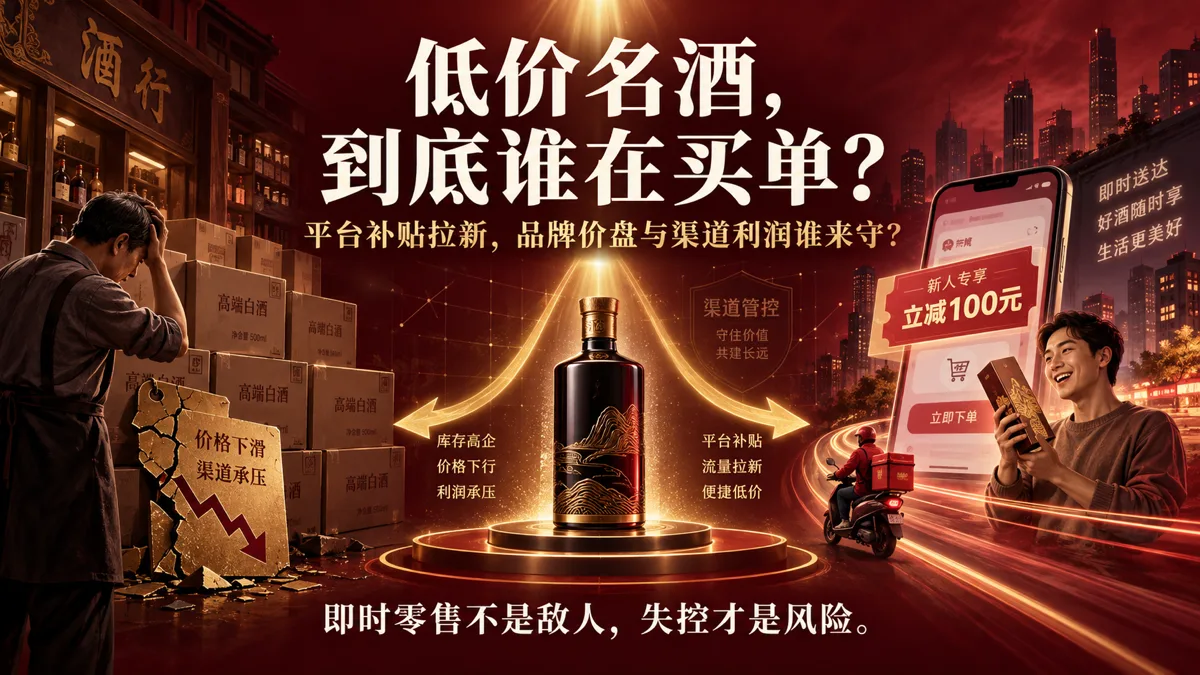
Instant retail is pulling premium liquor into a more transparent competitive environment defined by lower consumer prices, faster delivery, and platform-led demand. Subsidies and traffic strategies may expand consumer reach, but they can also pressure established pricing discipline, distributor margins, and brand premium. This article examines instant retail’s dual effect on premium liquor channels: it can open new occasions and capture consumer data, while also amplifying diversion, price inversion, and channel conflict when authorization, pricing, and profit-sharing rules are weak. The issue is not whether a brand enters instant retail, but who controls product data, channel rules, and consumer relationships.
1 a.m., Nanshan, Shenzhen.
You see a bottle of Feitian Moutai priced at RMB 1,499 on your phone. Thirty minutes later, a rider knocks at your door.
At the same time, the owner of a nearby liquor store is staring at inventory. The real anxiety may not come from one fixed wholesale price. It comes from working capital, warehousing, rent, and price inversion piled into one operating model. A common industry line captures the tension: I am waiting for customers to walk in; customers are waiting for delivery riders.
This is not a joke. It is the channel split that liquor instant retail is creating.
The Undercurrent Behind Growth Is Not Just More Orders
During major shopping festivals, low-priced premium liquor has become an acquisition tool for multiple platforms. A public research note cited RMB 1,499 Feitian Moutai as a flash-sale traffic driver for Meituan Flash Buy in 2025. Actual transaction prices vary by platform, city, campaign, and time. Market claims such as “70-fold growth in baijiu sales” or “Crystal Sword as low as RMB 369” do not have sufficiently consistent primary public evidence in the sources reviewed here, so this article does not treat them as established industry facts.
One point is clear, however: instant retail is changing the occasions on which liquor is bought.
Liquor purchasing used to be planned. If you were hosting someone, you picked up bottles from a liquor store or supermarket in advance. Now, if a gathering runs short, a gift is needed at the last minute, or someone wants a drink late at night, a consumer can open an app and wait for a nearby fulfillment node to deliver. Public reporting indicates that late-night consumption accounts for a meaningful share of instant liquor orders, precisely when most traditional physical stores cannot serve demand.
Platforms can therefore argue that they are creating incremental occasions, rather than merely taking existing orders. That argument is not entirely baseless: night-time, urgent, and nearby consumption does create demand that traditional stores may not capture.
But once consumers become accustomed to getting premium liquor faster and at a lower effective price, traditional stores must defend their footfall, pricing explanation, and service relationship all over again. Consumers may not continue paying dramatically more for the same product offline. Once a purchasing habit is formed, it is expensive to reverse.
Beneath the “Anti-Counterfeiting” Argument Lies a Fight Over Pricing Authority
As discounted premium liquor kept appearing on e-commerce and instant-retail pages, leading producers began publishing authorized-channel and unauthorized-store lists.
Ahead of the 2025 Singles’ Day campaign, Moutai, Wuliangye, Xijiu, Guotai, Shui Jing Fang, and other producers issued consumer notices or authorized-channel lists. Wuliangye publicly named 46 unauthorized online stores for the first time, covering Douyin, JD.com, Kuaishou, Meituan, Pinduoduo, Tmall, and Taobao. Shui Jing Fang also published official authorized-store information and warned consumers about potential quality and rights risks in unauthorized channels.
These actions are certainly related to anti-counterfeiting and consumer protection. Whether a product is included in an official traceability system, whether its source is clear, and whether after-sales service is available all affect consumer risk.
But treating the move purely as anti-counterfeiting misses the deeper issue: who has the authority to define premium liquor prices, and who bears the cost when channel pricing loses order.
The difference between selling a bottle at RMB 1,499 and RMB 3,000 is not simply the per-bottle margin. Premium baijiu pricing also carries scarcity, gifting value, social expression, and brand-value expectations. When a platform lowers the consumer-paid price through subsidies, coupons, or traffic campaigns, it can pressure more than distributor gross margins. It can pressure the value narrative a brand has built over years.
Instant retail is therefore a double-edged sword for producers. Stay out, and consumer occasions and orders may move to competitors. Enter without discipline, and distributor economics and pricing architecture may come under pressure. The real danger is not entering the platform; it is entering without rules.
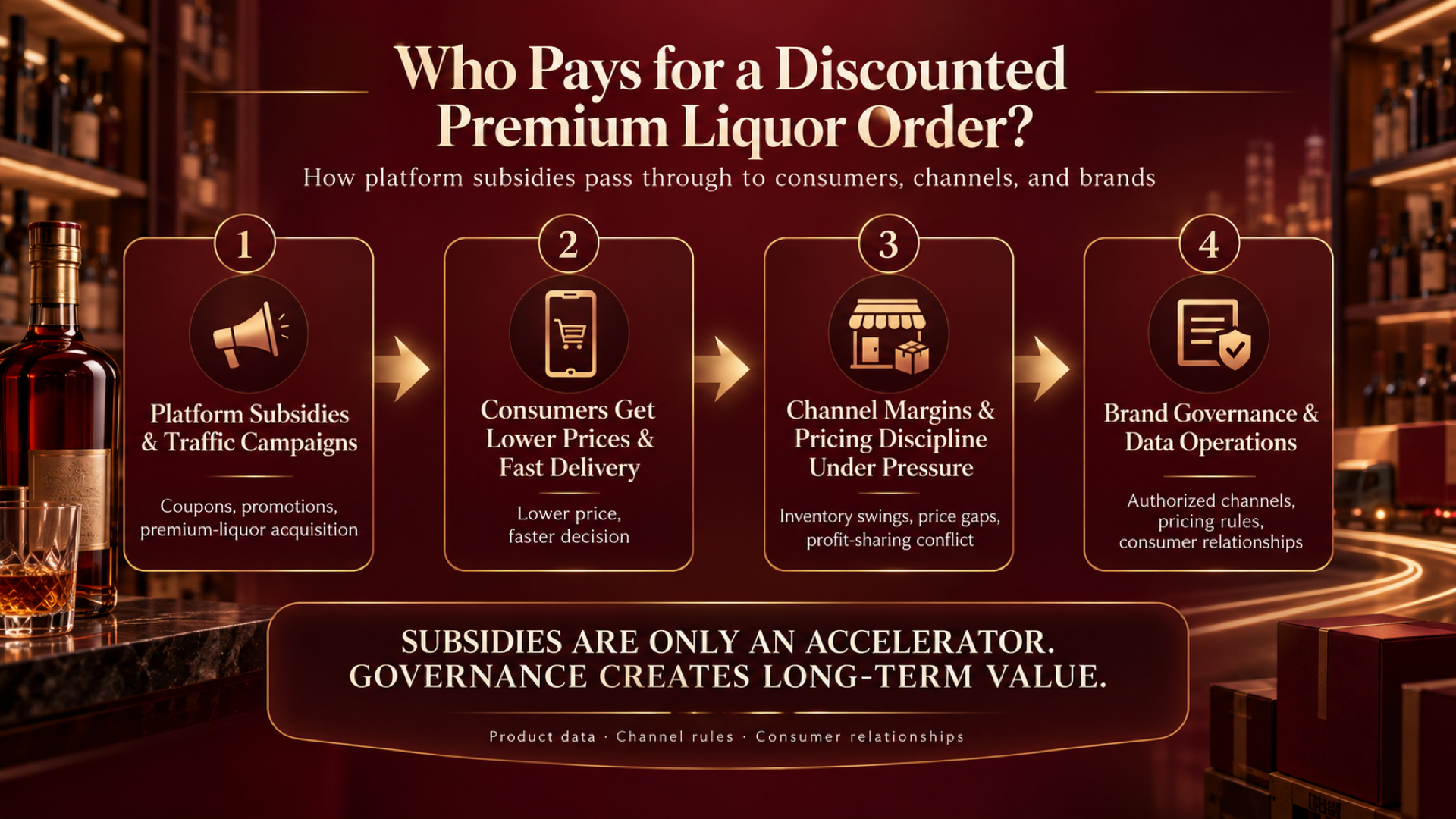
Who Subsidizes, and Who Ultimately Pays?
Discounted premium liquor often serves as a traffic hook on platforms.
Platforms may use subsidies, coupons, promotional campaigns, or joint marketing to lower the final consumer price of heavily watched premium brands. Exact subsidy amounts, cost-sharing arrangements, and unit economics are usually not public and vary by platform, brand, region, campaign, and supply source. Claims that a platform subsidizes RMB 100 to RMB 200 per bottle should therefore be treated as market estimates, not universally applicable facts.
Why might a platform accept some promotional cost? Premium liquor can acquire new users, raise visit frequency, and trigger basket attachment in snacks, beverages, and daily necessities. The liquor itself does not always need to generate the largest profit on a given order. It can function as a tool for user acquisition and habit formation.
In the short term, consumers may get lower prices, platforms may gain users and transaction frequency, and brands may gain broader online visibility. The cost does not disappear; it is distributed differently.
Distributors often feel the most direct operating pressure: inventory-value volatility, customer migration, difficulty explaining regional prices, and conflict between online and offline channels. For producers, the longer-term cost may appear as weaker premium, lower channel confidence, and less enforceable pricing rules.
Platforms spend on acquisition and habits. Brands and channels may be spending on pricing discipline and margin expectations. Those costs run on different timelines.
There Is No Perfect Answer, Only Three Routes Being Tested
No single playbook fits every producer, but three common routes are emerging.
Route one: build direct brand channels. Wuliangye operates official-commerce and new-retail channels, while Moutai has digital consumer touchpoints such as iMoutai. The benefit is direct: price, channel authorization, and consumer data are easier to keep in the brand’s hands. The difficulty is equally clear: fulfillment still depends on outside logistics, and an official app does not automatically create user traffic or habitual use.
Route two: negotiate rules with platforms. A brand can allow only selected standardized products to serve as acquisition items, reducing direct conflict with core offline premium SKUs. It can also vary strategy by city, authorized store, inventory, and price band. The challenge is that platforms do not lack substitute liquor products. Competition among brands for shelf space and demand can weaken any one brand’s negotiating power. Rules work only if both sides are willing to trade some short-term volume for long-term order.
Route three: develop instant-retail-specific products. Different sizes, packaging, bundles, or drinking occasions can reduce direct comparability with offline core SKUs. Beer brands have tested this approach more extensively. Whether baijiu can replicate it depends on whether consumers recognize the value of new formats in self-drinking, lighter-drinking, and immediate-consumption occasions.
All three routes hit the same obstacle. Technology is not the only problem. Cost is not the only problem. The real difficulty is commitment and governance.
Producers should no longer reduce the question to “Should we embrace instant retail?” Consumers opening an app late at night to buy liquor is not controlled by any one producer’s preference. The meaningful distinction is whether that bottle leaves through a channel the brand can see and govern, or through a grey route the brand cannot even identify.
Instant retail is neither an enemy nor an unconditional friend of liquor producers. It is a new channel species. It cannot be refused, but it cannot be embraced without boundaries either.
Whose data runs through whose pipe, who controls pricing rules, and who owns the consumer relationship: these three questions define the endgame.
Subsidies are only an accelerator. Even without them, occasion migration and channel digitization would continue; the pace might simply be slower.