
80,000 Lightning Warehouses × 2,800 Counties and Cities × 70% Night Orders: Is the Countdown Starting for Traditional Liquor Stores?
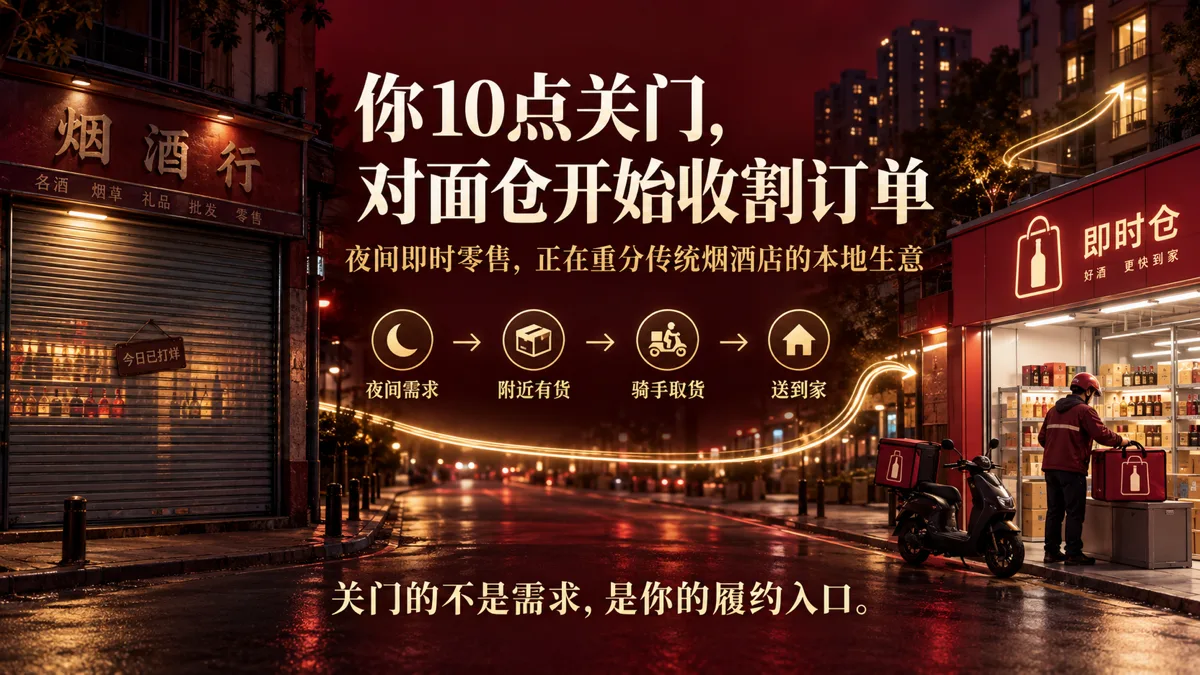
Instant liquor retail is shifting alcohol purchases from planned shopping to late-night replenishment, at-home gatherings, outdoor occasions, and last-minute gifting. Publicly reported data show that around 70% of liquor instant-retail orders on Meituan Flash Buy occur between 6 p.m. and 6 a.m., while 73% are delivered to residential communities. Liquor lightning-warehouse operations are also expanding quickly. This article does not treat “80,000 warehouses” as a universally verified current count. It treats the number as a signal of continuing expansion: for traditional liquor stores, the real challenge is not one more online channel, but a redistribution of local orders, authenticity trust, fulfillment efficiency, and consumer data.
Do you know what liquor stores fear most?
A phone vibrating at 11 p.m. Not because a customer has placed an order, but because a rider is picking up another order at the lightning warehouse across the street.
A warehouse can operate around the clock and serve immediate demand nearby. Your store closes at 10 p.m.; a customer opens an instant-retail app, and the bottle arrives on their coffee table 30 minutes later. While you sleep, someone else begins to capture your neighborhood’s night-time orders.
Public reporting shows that around 70% of Meituan Flash Buy’s liquor instant-retail orders in 2025 occurred between 6 p.m. and 6 a.m.; 73% were delivered to residential communities, while orders to parks and scenic areas rose 108% year on year. During the hours when traditional liquor stores are closed, lightning warehouses remain open. They may not immediately replace every liquor store, but they are changing who can capture late-night, nearby, and unplanned consumption.
“80,000 lightning warehouses across 2,800 counties and cities” should be read as a market expectation rather than a single, uniformly verified current figure. Public industry reporting has cited more than 50,000 Meituan lightning warehouses covering more than 2,800 districts and counties, with projections of more than 100,000 by 2027. Meituan itself set a target in 2024 of more than 100,000 warehouses by 2027. The precise count will change, but the direction is clear: fulfillment nodes are spreading into more cities, counties, and consumer radii.
Platforms Are Not Simply Selling Liquor; They Are Rebuilding the Fulfillment Entry Point#
During the China Food & Drinks Fair period, Meituan Flash Buy promoted a combination of official brand stores, authenticated liquor stores, distributors, retailers, and lightning warehouses to expand instant liquor retail. Market communications contain different versions of the platform’s specific three-year sales targets. This article does not cite them as independently verified operating commitments.
What matters is not the number of targets announced. It is that the platform is placing four kinds of resources into one network: official brand supply, distributor inventory, retail-store fulfillment, and platform traffic.
Some called it a pitch deck. Looking back, the platform has already started to fill in key capabilities.
On July 22, 2026, Meituan Flash Buy and China Light Industry Testing & Certification upgraded their cooperation and introduced a verify-before-shipping service for premium liquor sold through Meituan Authenticated Liquor Stores. The initial coverage included 53% ABV Feitian Moutai. Consumers could scan to access inspection reports and traceability information. Instant retail was moving from “delivered quickly” toward “delivered with verified authenticity.” The traditional liquor store’s claim—“our liquor is guaranteed authentic”—was no longer only a store-level advantage.
In May 2026, under the guidance of the China Alcoholic Drinks Association and at a Meituan Flash Buy event, nine leading baijiu producers—including Moutai, Wuliangye, Fenjiu, Luzhou Laojiao, Yanghe, Gujing Gongjiu, Langjiu, Guizhou Xijiu, and Jiannanchun—jointly launched 50 ml Sipping Bottles. The products were designed to reach younger consumers through instant-retail occasions. Brands were no longer treating instant retail merely as an inventory-clearance channel. They were designing products for immediate, smaller-format, lighter-drinking occasions.
The largest players are not merely watching. They are laying rail.
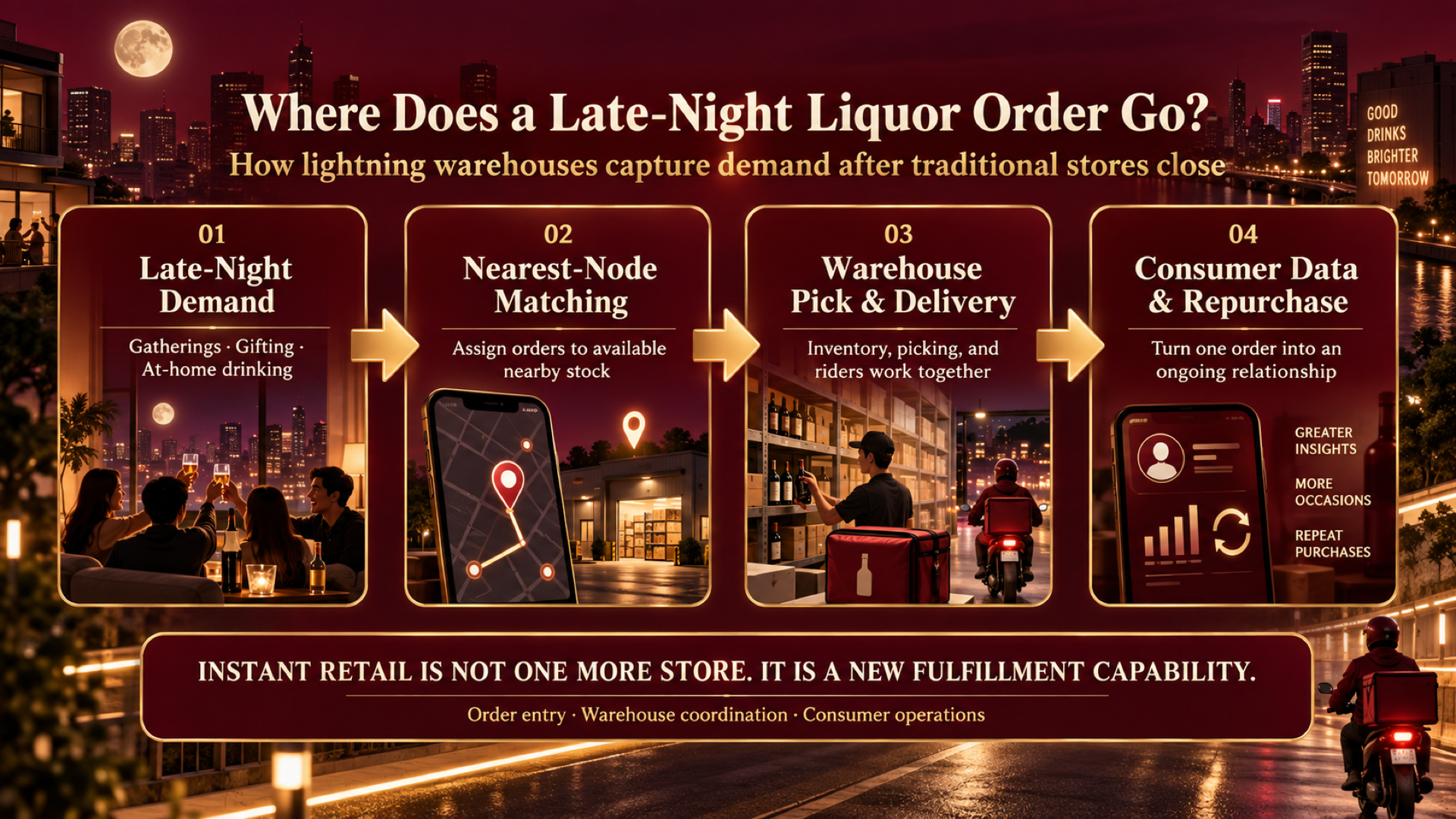
Why Platforms Put Liquor in a Strategic Position#
Platforms are not acting out of generosity. They are calculating a category that fits instant retail unusually well.
First, growth. Public event materials indicate that Meituan Flash Buy’s liquor business maintained strong growth in 2025, and industry materials indicate significant growth in liquor lightning warehouses. Statistical definitions and time periods differ across sources, so no single platform figure should be generalized to the entire sector. Still, liquor instant retail is clearly in a rapid expansion phase.
Second, occasions. About 73% of instant liquor orders are delivered to residences; around 70% occur at night; and orders to parks and scenic areas have risen meaningfully. Liquor consumption is extending beyond the traditional banquet table to living rooms, camping grounds, late-night meals, and solo-drinking occasions on the couch. As occasions change, orders naturally seek fulfillment nodes that are closer to consumers and open longer.
Third, basket value and repeat potential. Compared with low-ticket everyday goods, liquor has a higher average order value, meaningful gifting demand, and multiple recurring occasions: holidays, gatherings, banquets, self-consumption, and last-minute replenishment. For platforms, it is a category that can carry high-value orders and potentially build recurring purchase behavior.
Instant retail is not simply another online storefront. It is the attempt to make “available nearby, delivered now, authentic, and worth returning for” one service.
Which Route Should Brands, Distributors, and Chains Take?#
Different starting points call for different routes.
Premium liquor brands can build official instant-retail flagship stores and use platform and partner fulfillment nodes to deliver orders. This is a relatively asset-light way to protect pricing discipline and reinforce authenticity. Moutai Prince Liquor’s cooperation with Meituan Flash Buy, beginning with more than 1,000 certified stores and an authenticity alliance, is one example of the model being explored.
Distributors and regional brands can participate in authenticated-liquor-store systems or build, operate, or partner with lightning warehouses. Liquor lightning warehouses are growing quickly, but opening a warehouse does not guarantee success. Location, SKU mix, replenishment cadence, batch management, and shelf-life control determine whether a warehouse is genuinely efficient.
Liquor retail chains can explore a combination of official stores and lightning warehouses. Platforms may favor high-quality supply, but “quality” is more than a signboard. It includes authenticity assurance, assortment depth, inventory accuracy, fulfillment speed, after-sales capability, and consumer ratings. The window for earning traffic simply by putting up a sign is narrowing.
Whichever route is chosen, three questions become more urgent in instant retail: Where did the product go? Who is drinking it? Why are they drinking it?
Without that digital operating foundation, instant retail merely moves inventory from a warehouse shelf to a phone screen. It is not fundamentally different from old-style distribution.
Five Questions to Answer Before You Get On Board#
First, can omnichannel orders run through one operating system? Opening a platform store does not complete the system. ERP, inventory, delivery, point of sale, pickup, after-sales service, and settlement must work together. Otherwise, higher order volume only amplifies overselling, missed orders, and fulfillment errors.
Second, can consumer data be retained? Every order contains signals about who bought, when, where, what they purchased, and in what context. Whether those signals can be retained and used for membership, repeat purchase, and service—subject to applicable consent and privacy rules—determines whether platform orders become your own consumer asset.
Third, will online and offline channels compete destructively? Who fulfills the order? Who bears delivery costs? How are proceeds shared between stores and distributors? How are price conflicts across channels avoided? These questions must be resolved before the business begins. Otherwise, internal incentives can break down before external orders scale.
Fourth, can marketing keep pace with the occasion? Scan-based rewards, banquet bundles, sipping bottles, member coupons, and private-community outreach should serve genuine consumption occasions. Copying offline posters directly onto a platform page rarely creates conversion or repurchase.
Fifth, is warehouse fulfillment treated as a precision operation? A 30-minute delivery promise depends on location, SKU choice, replenishment, batches, shelf life, picking, delivery capacity, and exception handling. A poorly located or poorly managed warehouse can become a cash-consuming asset.
If these questions are not answered, instant retail becomes just another expensive channel rather than a growth engine.
What Is Really Counting Down for Traditional Liquor Stores?#
The warehouse may belong to the platform. The inventory may belong to you. But consumer data should not be surrendered lightly.
As lightning warehouses spread across more districts and counties, physical stores close for the night while new fulfillment nodes begin taking orders. Traditional liquor stores will not disappear overnight. But the old operating model—waiting for walk-ins, relying on familiar customers, and trading only in daytime hours—is being diluted by night-time demand, nearby inventory, and rapid delivery.
What is truly counting down is not the life of any single liquor store. It is the traditional liquor retailer’s old understanding of consumers, orders, and fulfillment.
How many countdowns can your store still wait through?