
Baijiu’s Half-Year Export Report: Exports Rose 30%, Yet 90% of Exported Baijiu May Never Reach Overseas Consumers

China’s baijiu exports reached US$530 million in the first half of 2025, up 30.9% year on year. Export volume reached 8.31 million liters, up 7.4%, while the average export price rose 21.9% to US$63.7 per liter. The figures point to simultaneous volume and price growth. Yet rising imports of China-origin spirits, re-imported exports, and weak cross-border channel discipline suggest that export value alone is not a reliable measure of internationalization quality. The next phase of baijiu globalization will depend on whether producers can build traceable pricing systems, operable consumer relationships, and coordinated overseas distributor networks.
China’s baijiu export figures for the first half of 2025 are undeniably eye-catching: US$530 million in export value, up 30.9% year on year; 8.31 million liters in export volume, up 7.4%; and an average export price of US$63.7 per liter, up 21.9%. The immediate headline is clear: both value and price increased.
Companies are accelerating their overseas expansion as well. Public reporting indicates that 63.9% of baijiu producers have already entered, or are actively developing, overseas markets. Kweichow Moutai reported RMB 2.893 billion in overseas revenue for the first half of 2025, up 31.29% year on year, and added 11 overseas distributors to reach 115. Baijiu exports to Hong Kong were reported at roughly US$220 million, up 105.2%.
The picture becomes more complicated when imports are considered alongside exports. Industry reporting cites imports of China-origin spirits of about US$210 million in the first half of 2025, up 63.4% year on year. A meaningful portion is widely understood to be baijiu exported and then re-imported into China. Some market estimates put the share above 90%. This does not mean the products never crossed the border. It means that a meaningful share may not have developed into genuine, sustained overseas consumption.
Export tax rebates, import-related taxes, and price gaps between markets can create room for round-tripping. Exact tax treatment, eligibility for rebates, and profitability vary by product, trade route, and tax treatment; an estimated ten-percentage-point spread should not be treated as a universal rule. Still, the phenomenon makes one point clear: growing export value does not automatically mean a healthier international business.
Overseas activity can look lively. Market cases cite channel expansion in Russia, stronger sell-through in Southeast Asia, lighter Highball-style serves in Korea, and broader market coverage by leading Chinese distillers. Yet a substantial part of demand remains within overseas Chinese communities. Brand familiarity, drinking occasions, and repeat purchase among local consumers have not yet reached sufficient scale.
Good-looking data does not necessarily mean healthy growth. Baijiu’s current overseas journey resembles the early stage of Chinese smartphone expansion: scale is growing, while brand understanding, channel discipline, and user operations are still catching up.
Leading producers and producing regions have begun to respond. Moutai continues to strengthen overseas channel governance and traceability capabilities. In its 2025 government work report, Renhuai set a target of more than RMB 50 million in local baijiu foreign-trade exports and outlined export guidance, certification standards, and overseas-market connections. Guizhou has also used initiatives such as Guizhou Baijiu Goes Global to help producers understand international-market rules. Policy is moving and companies are moving. But the hard part is not going abroad; it is managing the business once it gets there.
The First Challenge: Pricing Discipline Can Break Down Once Products Cross Borders
Re-imported exports are only the visible symptom. The deeper issue is cross-market channel diversion.
A distributor in one market may resell inventory into neighboring markets, undermining local price architecture. Counterfeit products can also exploit opaque channel information. For brands operating across many countries and regions, manually checking global product flows, retail prices, and inventories is both inefficient and slow.
The core problem is visibility. Once a bottle leaves the factory, the brand often cannot see where it is stored, who received it, at what price it was sold, or whether it was ultimately consumed.
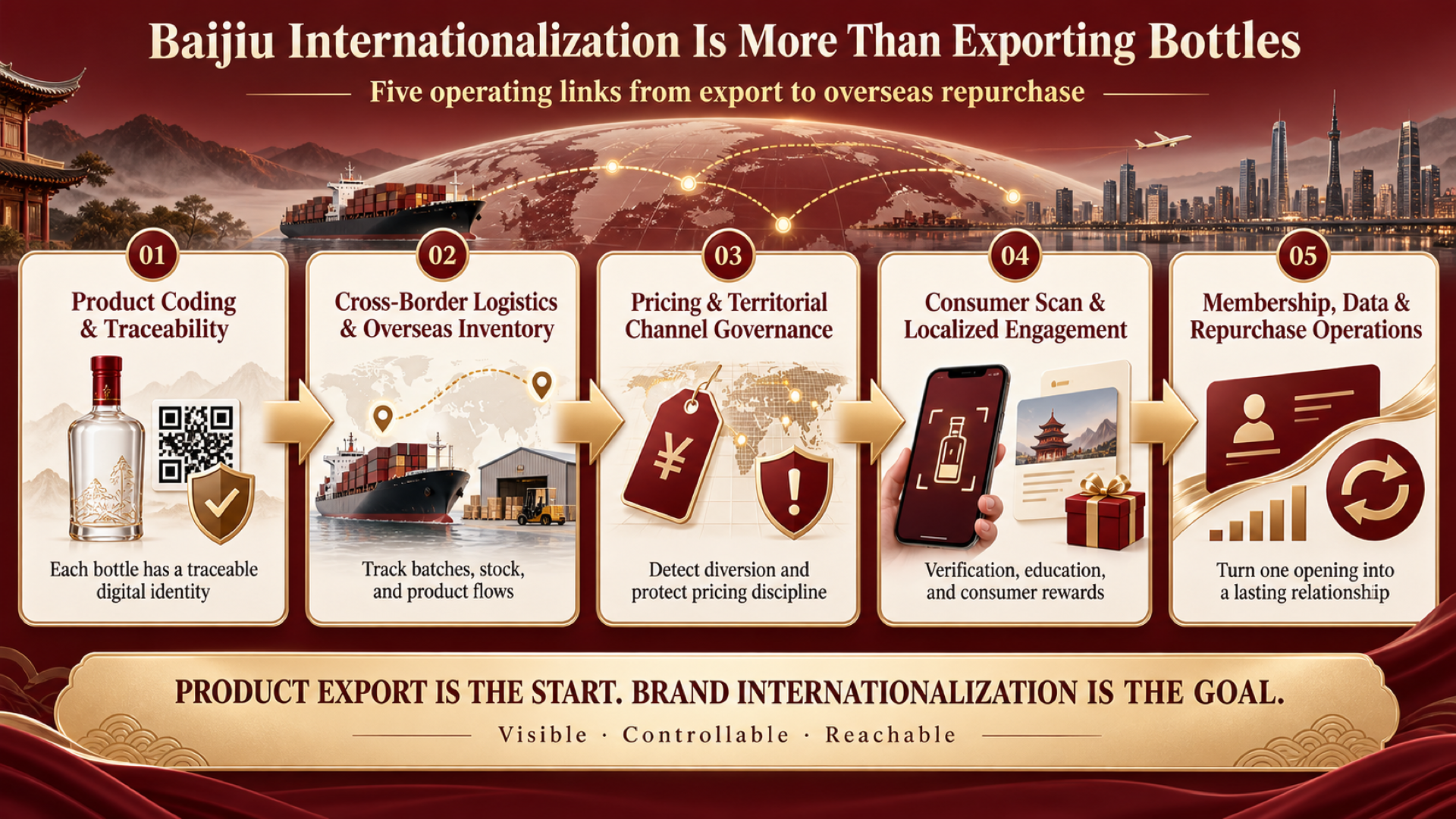
That is why a one-bottle-one-code traceability system has greater value overseas than at home. Each bottle can receive a unique digital identity at production. Warehousing, export, customs clearance, distributor receipt, retail scanning, and consumer opening can all be logged. If a distributor’s inventory appears in an unauthorized market, the system can generate an alert. If a batch reappears in China, it can help identify potential re-import risk.
China’s baijiu sector already has experience with end-to-end coding systems, including five-code integrated traceability. In cross-border markets, traceability is not merely an anti-counterfeiting tool. It is infrastructure for pricing discipline, territorial authorization, and brand credibility. Domestic diversion may damage the pricing of a few regions; cross-market diversion can undermine a brand’s reputation across an entire country or region.
The Second Challenge: Overseas Consumers May See the Product but Still Not Understand It
Consumer awareness of baijiu remains limited in many overseas markets. High alcohol strength, unfamiliar flavor profiles, and the absence of established drinking occasions can all discourage first trial. For many consumers, there is no ready answer to basic questions: What food does baijiu pair with? When is it consumed? Why is it worth buying?
Producers are usually attempting localization in two directions.
The first is product and serve localization: lower-alcohol options, cocktail-friendly formats, and flavor experimentation that better suits local preferences. The second is digital cultural education: scan-based content, local-language explainers, tastings, and interactive displays that lower the barrier to understanding.
The problem is that these touchpoints are often fragmented. A consumer who scans a bottle to verify authenticity completes a one-time task. But if that scan becomes a brand interaction, its value changes. Subject to appropriate consent and data-compliance requirements, a brand can understand where and when a consumer engaged with a product, what content they viewed, which benefits they claimed, and whether they registered as a member. These signals can then support future service.
Overseas consumers are not one homogeneous audience. Singapore and Malaysia have different consumption contexts; Japan and the United States have entirely different routes to adoption. A producer cannot simply translate domestic advertising into English and expect it to work. It must understand who is drinking, where they drink, on which occasions, and why they might buy again.
In practice, many producers have not yet fully consolidated consumer data even in China. Overseas data is even more likely to be scattered across platforms, events, and local partners. Without unified consumer-data and consent management, scanning, membership, content, and repurchase cannot form a closed loop.
The Third Challenge: Distributor Networks That Work at Home Are Harder to Coordinate Abroad
Overseas distributor networks differ materially from domestic ones. Partners are more dispersed, individual distributors may be smaller, and it is common for one sales representative to cover several countries or territories. Orders may be tracked in spreadsheets, inventory confirmed through messaging apps, and sell-through data reported by distributors themselves.
Regional warehouses, local teams, order collaboration, and digital service platforms can improve execution. A regional distribution center can reduce delivery time; unified dashboards for orders, inventory, rebates, and sell-through can help overseas partners operate with a level of coordination closer to domestic distribution systems.
Cross-border channel management comes down to three capabilities:
1. Visibility: Real-time orders, inventory, batches, and product flows can be tracked.
2. Control: Territorial authorization, anomalous flows, and pricing discipline can be monitored and addressed.
3. Reach: Brand policies, training, and campaign materials can reach retail outlets directly rather than becoming distorted through several layers of intermediaries.
These capabilities already have many proven domestic applications. Overseas, however, the system must also address cross-border logistics, multi-currency settlement, language localization, data compliance, and alcohol regulation in different countries. Complexity rises significantly.
The Next Chapter of Baijiu Internationalization
Baijiu internationalization is approaching a dividing line.
The first half was about who could get overseas first. Moutai, Wuliangye, Luzhou Laojiao, Fenjiu, Shede, and others have all expanded beyond China. The second half will be about who can build a viable, sustainable business after arriving.
To “survive” abroad means at least four things: pricing remains orderly, channel discipline can be governed, consumer data can be retained compliantly, and brand understanding can take root in local markets. None of these can be managed across a large international footprint through people alone. They require a digital operating foundation.
Leading producers are strengthening traceability and channel-governance capabilities, while producing regions are improving export services and certification systems. The next 12 to 18 months may be a key window for moving from product export to genuine brand internationalization. Producers that can make product traceability, cross-border channel governance, and consumer operations work together in overseas markets will be better positioned to move beyond overseas Chinese consumer circles and into broader local consumption occasions.
Those that cannot may still report rising export figures. But they will keep confronting the same old question of growth quality: impressive does not always mean healthy.
Baijiu does not lack ambition, products, or channels. What is scarce is a digital operating foundation that makes critical links visible, controllable, and reachable.