
Prices Can Be Adjusted Weekly—Is Your Price System Still Run on Manual Spreadsheets?

Moutai raised prices for the sixth time this year, with Feitian at its self-operated stores climbing to 1,766 yuan. Most analysis stops at the price-signal layer. The real question is: changing a price takes one second—how long does it take to synchronize every terminal nationwide? The more frequent the adjustments, the more price-gap windows channel execution errors create. The barrier to dynamic pricing lies in transmission, not in pricing itself.
Introduction: Notified Only on the Day of the Change
On September 8, a staff member at a Moutai self-operated store in Beijing received a notice: the price of Feitian 53% ABV 500ml Kweichow Moutai was moving from 1,753 yuan to 1,766 yuan. A reporter called that same day posing as a consumer and got this answer: "We were only notified on the day of the change too." Prices, they said, were being adjusted dynamically in line with the market. This was Moutai's sixth dynamic adjustment to Moutai liquor's market price this year.
The same day, iMoutai announced that six vintages of near-new Feitian from 2019 to 2024 would shift from concentrated releases on the 9th, 19th, and 29th of each month to normalized daily sales in two sessions. On one hand, online release frequency is opening up; on the other, offline prices keep climbing—both lines moving at once. The baijiu circle calls this combination "managing volume online, managing price offline," saying Moutai's price management has moved from rigid price hikes of the past into an era of refined operations.
That judgment is correct—and it's where most analysis stops. Push it one step further, and you hit a question relevant to everyone in the baijiu business: if prices can be changed at any time, can the channel keep up?
I. Adjusting Once a Year and Six Times a Year Are Not the Same Game
Start by unpacking the cost structure of a price change. For headquarters, a single adjustment is just changing one number. But transmission through the channel passes through at least four layers: distributors, wholesale, retail terminals, and online stores. Each layer must reconfirm its own quote, recalculate its own margin, and redecide whether to release or hold the stock in hand.
Adjust once a year, and the transmission process has ample time to digest. Even if brief price inconsistencies appear between levels, the market self-corrects quickly. Adjust six times a year, and the situation is entirely different. Each adjustment tears open a new price-gap window in the channel, and the size of that window depends on how fast each level responds. If headquarters changes the price today and a terminal in some region updates its quote two days later, a two-day arbitrage gap exists. Someone smart enough will buy from the low-price region and sell where the price hasn't updated yet.
Six Moutai price adjustments a year means such windows appear six times a year. The more frequent the adjustments, the greater the losses from channel execution errors. This isn't about whether the pricing model is accurate—it's about whether the execution layer can keep up.
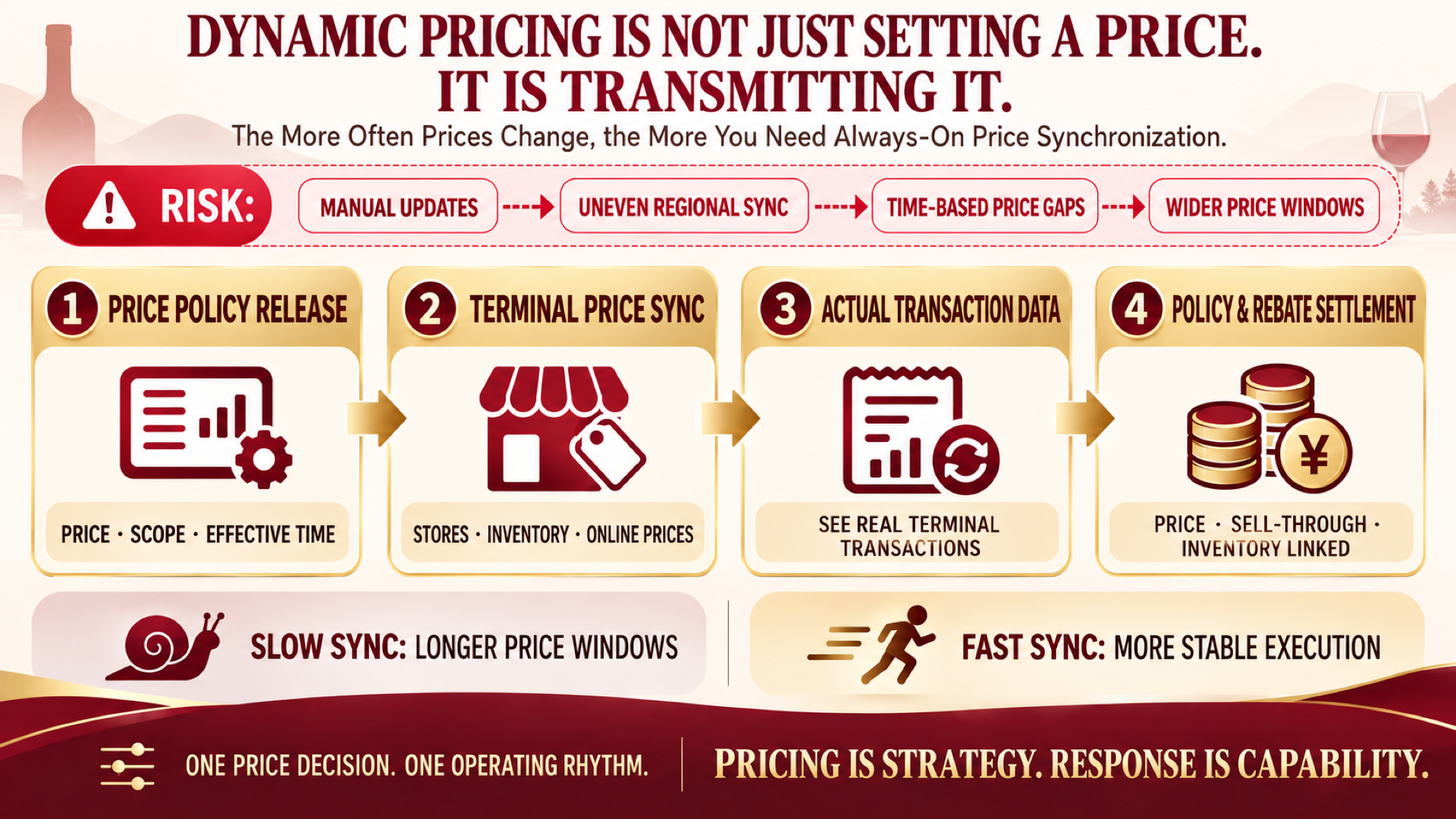
The real barrier to dynamic pricing isn't pricing—it's transmission. Headquarters changes a price in one second; synchronizing thousands of terminals nationwide takes an entire system.
II. Faster Price Cadence Multiplies the Incentives for Channel Flooding
The industry habitually attributes channel flooding to regional price gaps and distributor greed. But in an environment of frequent price changes, the incentive structure shifts. Prices used to be stable, and regional gaps came from differences in distributor policy; now prices are dynamic, and gaps also come from time lags. The same product may carry two different prices at two terminals simply because they update at different speeds.
Problems from time lags are harder to manage than regional price gaps. Regional gaps can be defined by contract—cross-region selling is easy to trace. Gaps caused by time lags are differences within the same region, between the same tier. Everyone looks compliant, yet the pricing system has already been shredded. Feitian Moutai shows "a different price every day" at offline tobacco & alcohol shops, and average terminal retail prices can differ by hundreds of yuan across channels. Behind these phenomena is the shadow of inconsistent transmission speed.
For brand owners, this leads to a counterintuitive conclusion: the more refined the pricing, the more demanding the precision required of the execution system. You can make the optimal pricing decision, but if terminal quotes, inventory data, and rebate settlement aren't synchronized, the optimal decision loses more than half its value in transmission. At that point, what truly separates companies isn't whose pricing model is smarter—it's whose terminals respond faster.
III. Making Response Speed a Standing Capability
Looking at moves already underway in the industry, some answers emerge. Shanxi Fenjiu's "five-code integration" traceability system and "Fenxiang Liyu" channel incentive program tie distributor rebates directly to wholesale price stability, sell-through targets, and bottle-opening scan rates. The value of this design isn't just a changed incentive direction—more critically, it lets the manufacturer see in real time where products went and how many bottles were opened. Only when you can see it can you be fast.
In practical terms, this kind of capability must solve three links. Terminal quotes must synchronize with headquarters immediately—not through salespeople calling one by one or stores logging in to update manually, or every price change leaves behind a period of chaos. Actual terminal transaction prices must flow back to headquarters, not just the distributor's payment price. Many instances of price distortion originate here: headquarters sees the wholesale price and assumes all is well, while terminals have long been quietly discounting. Rebate and pricing-policy settlement must also keep pace, or after each adjustment, finance and the channel accumulate ever more unreconciled accounts.
The capability formed by these three links is exactly what tools like a scan-based marketing system are meant to carry. One bottle, one code gives every bottle an identity from the moment it leaves the factory. Consumers scan to verify authenticity and claim rewards, while the manufacturer simultaneously obtains real bottle-opening and circulation data. Every action by terminals and distributors leaves a trace, and policy adjustments propagate along the same system. Its significance isn't only on the promotion side—it's about keeping price policy from dropping frames during transmission.
IV. This Isn't Moutai's Problem—It's a Problem for Everyone Running a Price System
Back to the beginning. Moutai can adjust prices six times a year because its brand power and direct-sales system can sustain that cadence. The vast majority of distilleries don't have that condition—but the lesson here is universal: once the refinement of price adjustments increases, channel response capability must keep pace. Otherwise what you gain isn't revenue, it's chaos.
The industry is in a window of price-system rebuilding. In the first half, 21 listed baijiu companies saw combined revenue fall about 6.65%, with the sub-premium price band under broad pressure. Before the Mid-Autumn Festival, name-brand wholesale prices rebounded, but channel stocking remained cautious, with more than 80% of alcohol merchants expecting flat or declining sales during the two holiday periods. At a time like this, every price adjustment is a balancing act on a knife's edge—one extra unit of error in the transmission chain gets amplified into real profit loss at the terminal.
Conclusion: Three Questions
The ancients said, "A difference of a hair's breadth leads to an error of a thousand miles"—precisely describing transmission. What headquarters adjusts is a number precise to the yuan, yet it may arrive at terminals as several different prices. Every cent lost in between is ultimately borne by channel profit.
Price is strategy; response is capability. Strategy can be copied; capability can only be built. Next time you prepare to adjust prices, ask yourself three questions first: after the change, how long until every terminal nationwide is synchronized; how often can I see the real terminal transaction price; and will this adjustment leave a new price-gap window in the channel? The answers to these three questions matter more than how much you adjust.
References
[1] "Liquor Bureau | Six Feitian Moutai SKUs Switched to Normalized Release on iMoutai, Moutai Self-Operated Stores Raise Prices Again," The Beijing News (reposted via Tencent Search), September 8, 2026, https://so.html5.qq.com/page/real/search_news?docid=70000021_9946aa00ad766252
[2] "iMoutai Adjusts Release Rules for Six Feitian Moutai SKUs, Switching to Two Normalized Daily Sessions," Phoenix Finance / Tencent News, September 8, 2026, https://new.qq.com/rain/a/20260908A0DLV300
[3] "Selling Freely on One Side, Raising Prices on the Other: What's Behind Moutai's 'Left Hand Fighting Right'?" 36Kr, September 10, 2026, https://36kr.com/p/3975567068681862
[4] "Distilleries Battle for Mid-Autumn: Prices Heat Up, Channels Still Watching," Nanfang Plus / Toutiao, September 11, 2026, https://www.toutiao.com/article/7684156039994622504
[5] "Looking at the Structural Changes in the 2026 Baijiu Half-Year Reports Through This Series of Data," Sina Finance, September 2026, https://cj.sina.cn/articles/view/1668899380/6379623400101vee0
[6] "The Baijiu Chessboard Assembled from 21 Half-Year Reports: Revenue Down 6.64%, Industry Shifts from Stock-Pressing to Volume Control and Price Defense," Tencent, September 8, 2026, https://new.qq.com/rain/a/20260908A03NZF00
[7] "Two-Holiday Liquor Market Survey: Baijiu Shows Structural Recovery, Channels Stock Cautiously with 'Small Orders, Fast Replenishment,'" Jiushuo, September 2026, https://jiu.cn/en/news/