
Only 30,000 of 57 Million Members Are "Being Served"—What About the Rest?

Langjiu's membership has surpassed 57 million, but only 30,000 can enter the estate to enjoy its services. The cost of high-end experiences rises with headcount, while the cost of reaching the silent majority is nearly zero—two curves heading in opposite directions, which means "something for everyone" is impossible by design. The solution: let a system take over tiering.
Introduction: Two Numbers Side by Side
At the membership festival in late August, Langjiu invited 30,000 members nationwide back to the left bank of the Chishui River. Over three days, members attended lectures by economists, played in a golf tournament, and sealed fengtan jars at the estate. Langjiu Group Chairman Wang Junlin took the stage to release the four membership values—"quality, estate, experience, service"—and announced an upgrade of the Qinghua Lang membership system and an expansion of the Honghua Lang system.
In the same announcement was another number, cited more often and understood less: Langjiu's digital membership platform "Langjiu PLUS" has been live for six years, and its membership has surpassed 57 million.
Put these two numbers side by side, and the problem surfaces. Of the 57 million, those who can walk into the estate and be cared for by a person-to-person service are 30,000. The remaining 56.97 million get scans, points, coupons, and a membership tier sitting idly in their phones.
When the industry talks about membership, it habitually says "tiered operations." The phrase isn't wrong, but it stops at the conclusion level and doesn't answer a more critical question: if tiering is the only answer, who pays for the tiering—and can they afford it?
I. The Two Cost Curves Point in Opposite Directions
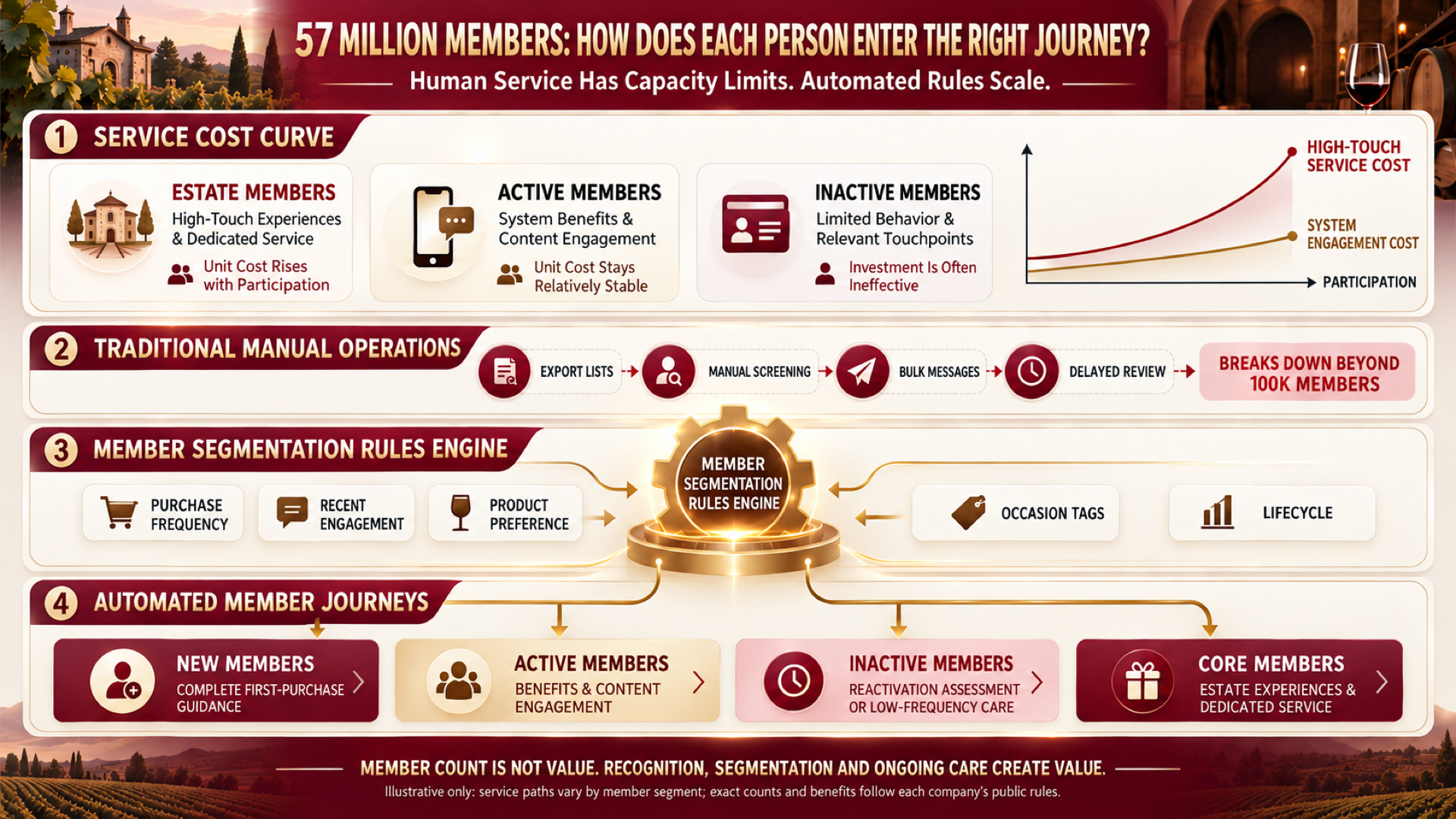
Break it down and it's clearer. In Langjiu's service offering, the parts people genuinely find "worth it" almost all share one trait: they require a physical space and require someone present. Chartered trains, golf, the membership festival, the estate teaching base—the unit cost of each rises as participation grows. To serve 30,000 people, how many events must be held, how many staff assigned, how many reception resources occupied—this is a steep upward curve.
On the other end is the silent majority. A member who scanned a code once and claimed a red packet once—if they take no further action this year—costs the distillery nearly nothing. Not because the distillery doesn't want to invest, but because it can't: no real consumption records, no interaction behavior, not even a valid reason to reach out. The marginal service cost of these 56.97 million people hugs the ground.
Member Tier
Reach Method
Unit Cost vs. Headcount
Estate members (approx. 30,000)
Events, on-site experience, dedicated service
Rises with headcount
Active members (millions)
Systematic benefit distribution, content outreach
Roughly flat
Silent members (tens of millions)
No effective reach currently
Near zero, and near useless
These two curves point in opposite directions, meaning one brutal fact: as the headcount and experience of high-end service visibly improve, the silent majority's situation won't improve in step—it will fall relatively further behind. Not because management doesn't care, but because the resource structure makes it inevitable.
The real ceiling of a membership system is never the member count—it's the high-value service that can only be driven manually. It can't be replicated, so it can't be scaled outward.
II. Why "Something for Everyone" Is Impossible by Design
There's an easily overlooked detail that reveals this system's self-awareness. Tangjiu Kuaixun put it bluntly in its report: the 57 million members settle naturally through QR codes on products, while the 30,000 core members who enjoy estate-level service are maintained through benefits, service handbooks, and on-site experiences.
These two sentences describe two entirely different businesses. QR code accumulation is about "collecting"—extremely low cost, enormous scale, essentially recording who has bought the baijiu. Service handbooks and on-site experiences are about "cultivating"—extremely high cost, limited scale, essentially deepening relationships with a few. An enterprise can make the former very large, but cannot scale the latter proportionally.
Someone in the industry has already called this out. In a recent article, "Jiuye Liangcang" wrote: "Tag-based tiering—stop sending the same coupon to everyone." It divided members into three categories—newly joined, active, and silent—and noted that for silent users, you must judge whether there's still value in reawakening them. The value of this statement lies in admitting one thing: for silent members, what an enterprise should do isn't invest more resources, but make a judgment about "whether it's worth investing."
But judgment itself has a cost. Who judges, based on what, and how often—if these questions aren't solved, tiering never lands. In reality, many distilleries do this: operations staff export a list quarterly and manually pick a batch of people to message. This model still works at the 100,000-member level, but fails completely at the tens-of-millions level. Not for lack of will—manpower simply can't cover it.
III. What Should Be Reined In Isn't the Service—It's Letting the System Take Over Judgment
Let's be clear: the problem isn't that Langjiu did something wrong. On the contrary, using an estate that took eighteen years to build as the carrier of high-end membership value is an asset in the baijiu industry that's very hard to replicate. What's truly worth learning is its boundary awareness: it didn't pretend it could serve 57 million people well—it explicitly directed resources to 30,000.
For other distilleries, the more realistic path isn't "build an estate too"—it's handing judgment over from people to systems. The logic is simple: once membership reaches the 100,000-plus level, any step requiring manual intervention becomes a bottleneck. Tiering rules must become rules that execute automatically—whoever's purchase frequency hits a certain band automatically receives certain benefits; how long without interaction automatically enters a certain sequence; which behaviors appear automatically trigger an upgrade. The human role shifts from "deciding who gets what" to "designing the rules," rather than "manually picking lists every day."
This is exactly what a consumer operations management system is meant to solve. Member tiering, automatic benefit distribution, automatic lifecycle transitions—these capabilities sound very technical. But in business terms, they come down to a plain question: can an enterprise, without adding headcount, ensure that millions or even tens of millions of members are all cared for by one stable set of rules? Fail at this, and the member count is just a string of numbers with no repurchase significance; succeed, and 57 million means something.
Conclusion: Rules Can Keep Running
Back to membership. Laozi said, "Less brings gain; more brings confusion." Applied to membership operations, this is surprisingly apt: the scale of member data doesn't itself create value—only the portion that is identified, differentiated, and continuously cared for creates value. 57 million is a number on the scorecard; 30,000 are the people being served. And the stretch of road connecting the two is what truly determines private domain success or failure.
Gifted baijiu will eventually be drunk dry; rules can run forever. The value of member assets doesn't depend on how many people you've accumulated—it depends on how many are continuously cared for by a system that actually works. At the membership festival, Wang Junlin said: "Let every member feel that every purchase at the estate is worth more than they paid." [4] In that sentence are the words "every member." To honor those three words across 57 million people, what's needed won't be more events or more staff—but a tiering mechanism that runs without anyone watching it. This is the stage private domain competition has truly entered: on the surface, it's about whose benefits are more attractive; in reality, it's about who can, at the lowest unit cost, move the most people into the right track.
Members are not tags. This line, said in the industry for many years, now carries more concrete meaning: a tag is a line of text an operator pastes in the backend; a track is the path members walk into themselves—and are willing to keep walking.
References
[1] "When Baijiu Starts Running 'Estate Memberships,' What Lesson Does Langjiu Teach the Industry?" Jiuye Times, August 2026, https://www.thewinetimes.com/gongsi/12018
[2] "The Sixth Langjiu Estate Membership Festival Held, Upgrading Services for 30,000 Members," Tangjiu Kuaixun, August 19, 2026, https://www.tjkx.com/news/show/1112445
[3] "Behind 48 Million Members, What Did Langjiu Get Right," WeChat public account "Jiuye Liangcang," September 2, 2026
[4] "Estate-Level Service Value Released! Langjiu Estate Is Capturing Entrepreneurs' Important Moments," China Economic Times, August 2026, https://www.cet.com.cn/xwsd/10521798.shtml