
Don't Just Forward the Policy Text: What This Opinion Really Rewrites Is "Who Gets to Stay at the Table"

Introduction: Lao Li's Weekend
On the first weekend of September, Lao Li, a baijiu distributor in Zhoukou, Henan, stared at his phone for a long time. He forwarded the "Opinions on Promoting the High-Quality Development of Historical Classic Industries" to his business group chat with one line: "State support—good news." But after hitting send, he felt empty inside. He holds distribution rights for six brands, three of which are regional distilleries with annual sales of around 30 million yuan. He read the line "cultivate 50 leading enterprises with 10-billion-yuan scale by 2028" three times.
The policy text has been forwarded endlessly, and interpretation pieces have piled up. The vast majority speak from the distillery's position on one thing: how to ride this tailwind to upgrade. But few answer the question on behalf of distributors like Lao Li: after this document lands, what will the brands in my hands become?
I. The Phrase "Classified Cultivation" Is Actually Three Gates
First, the facts. On September 7, six ministries jointly issued this opinion: the Ministry of Industry and Information Technology, the Ministry of Human Resources and Social Security, the Ministry of Agriculture and Rural Affairs, the Ministry of Commerce, the Ministry of Culture and Tourism, and the State Administration for Market Regulation. Brewing was included in the category of historical classic industries, alongside silk, tea, porcelain, traditional Chinese medicine, arts and crafts, and the four treasures of the study [1]. The document proposes cultivating 50 leading enterprises with 10-billion-yuan scale and shaping 100 Chinese consumer famous products by 2028, building several characteristic industrial clusters with 100-billion-yuan scale; and by 2030, cultivating a group of world-class enterprises and renowned brands [1].
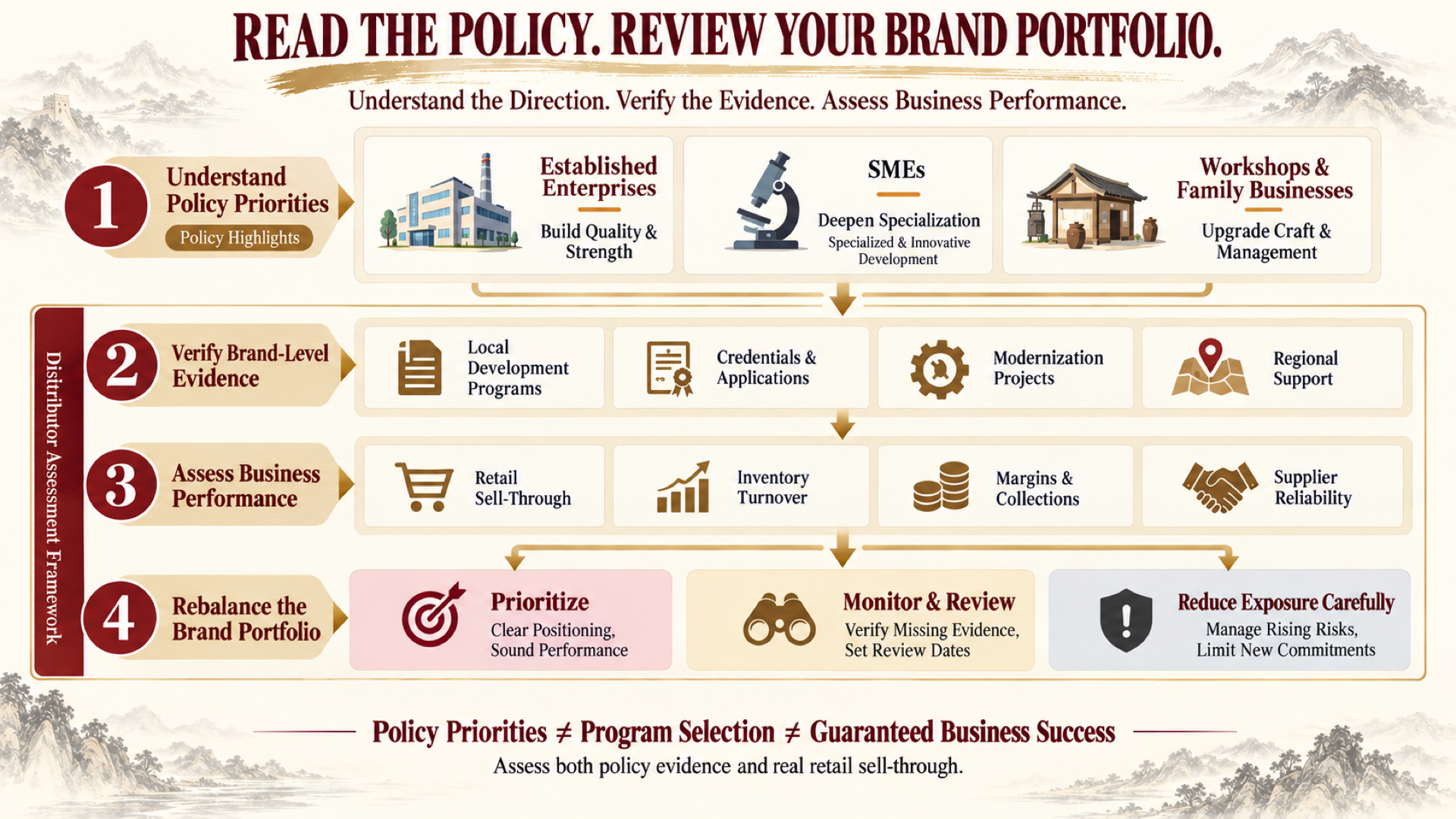
These numbers are cited most often and are most easily read as pure good news. But the real mechanism hides in the supporting language. On the clause "accelerate classified cultivation of enterprises," the document is clear: leading enterprises, specialized and sophisticated (SRDI) enterprises, and time-honored workshops each belong to different tracks. Leaders aim for 10-billion-yuan scale and world-class status; SRDI enterprises dig deep into niches; family workshops and local time-honored brands don't blindly chase scale but focus on refining craftsmanship [2].
Our judgment: these aren't three parallel encouragements—they're three gates pointing in different directions. Once a distillery is assigned to a track, how it obtains resources, what actions it's required to take, and what price band it's permitted all follow that track's rules. And the position outside the gates does not exist.
Translated into a version Lao Li can understand: the three brands in his hands with annual sales of 30 million yuan—which neither meet the 10-billion-yuan threshold nor qualify as protected time-honored brands—sit in the most awkward gap. They're ineligible for priority policy resource support, yet unlike time-honored workshops, they aren't explicitly protected for cultural heritage value. Their future isn't gradual shrinkage—it's rapidly losing market support after resources are siphoned away directionally.
One more detail worth noting. The document explicitly calls to "accelerate intelligent upgrading of industries," proposing to compile an implementation guide for AI-empowering historical classic industries and support advantageous production regions in exploring the construction of "industry brains." It also requires building high-quality datasets covering parameters like recipes, patterns, and craftsmanship [2]. Such resources will only flow to entities on the cultivation list. The gap between production regions and between distilleries will be amplified again at the data capability layer. Whether the brands Lao Li represents can obtain this support directly determines whether they're still on the shelf three years from now.
II. A Change Never Seen Before: This Round of Elimination Comes with Policy Resources in Hand
Clearing in the baijiu industry is nothing new. Over the past few years, small and mid-sized distilleries have been exiting continuously, with the pace set by the market: can't sell, cash chain breaks, doors close naturally. Distributors understand this rhythm and can usually stall with "let's wait and see." The half-year reports make it clearer: 21 listed baijiu companies posted combined H1 revenue of 200.441 billion yuan, down about 6.65% year-over-year, with 13 companies seeing both revenue and profit decline [3]; industry-wide, 74.8% of surveyed distilleries saw revenue shrink, and 56.6% of distributors reported that price inversion worsened year-over-year [4].
The contrast appears here. As resources concentrate into classified tracks, elimination is no longer entirely determined by market rhythm. Enterprises on the cultivation list have dedicated support, production-region backing, and policy preference—they can hold out longer and cut prices with more confidence. Meanwhile, those who can neither enter the list nor claim time-honored status face an accelerating sieve. At the same time, distributors across the country are already doing the same thing: proactively cutting partner brands and focusing on a few products with real consumer bases [5]. A trading company head in Zhengzhou with twelve years in baijiu distribution shrank his brand portfolio from nearly ten to five [5]. This move is more honest than any analysis: the channel is voting with its feet, and policy signals only make the process faster.
The direct impact on Lao Li is concrete. The distribution rights for his three regional brands were built up bit by bit over eight years, and in recent years they've contributed the thicker slice of his profits. If these brands accelerate their exit within the next two years, he loses not just sales revenue but also the channel development already invested, terminal relationships, and the unsold inventory still in his warehouse. Worse, distribution rights contraction and inventory clearing won't happen in sync. Brands fall behind faster than he can clear stock.
III. Three Paths, but Only One Can Be Taken Early
Facing this situation, distributors' responses fall roughly into three types.
The first is to keep casting a wide net, diversifying risk across many brands. This was right in the growth era—more brands, more opportunities. But in an environment where resources are allocated directionally, the flaw in this configuration starts to show: the more brands you hold, the higher the probability of holding one that falls behind. And with capital and manpower thinned out, when any one brand runs into trouble, there's no spare hand to save it.
The second is to bet on one, concentrating all resources on the single brand you're most optimistic about. This approach can indeed amplify returns in an upcycle. But with classified tracks already drawn, the cost of a wrong bet becomes unbearable: if that enterprise happens to fall in the gap between two tiers, the distributor is the one directly bearing the loss.
The path that can truly be taken early is the third: rearranging the distribution portfolio according to policy tiers. This isn't simply shrinking the number of brands—it's a structural reconfiguration. Which brands belong to the explicitly supported first tier and can serve as the long-term foundation; which brands have clear cultural heritage positioning and can find a place in the time-honored track; and which brands occupy neither end—those should see gradually reduced payment scale and accelerated inventory clearing over the next year, redirecting freed-up capital and energy toward directions with genuine policy support.
The information needed for this judgment happens to be what distributors have been least good at. Judging whether a brand sells well relies on visiting terminals, on relationships, on watching inventory—these are the Lao Lis' house specialties. But judging whether a brand will be accelerated out by policy requires looking at its production capacity, production-region position, whether it's on local cultivation lists, and whether it has obtained intelligent transformation resources. This information is scattered across policy documents, production-region bulletins, and industry announcements—it isn't passed around over the baijiu table.
The channel's information advantage is switching tracks. It used to win by knowing whose goods sell well; now it must also win by knowing who will be kept.
Conclusion: The Return on Looking Up
As the old saying goes, without far-sightedness, one soon faces trouble. The channel has suffered so much these past few years that many people only watch when this batch of goods will clear, without looking up at the road. But in a year when policy explicitly draws the tiers, the return on looking up may exceed the return on clearing stock with head down.
Back to Lao Li. After sending that message in the group, he opened the document again—this time reading the "accelerate classified cultivation of enterprises" section. He sent a message to a distillery owner he'd worked with for six years. What he asked wasn't this year's quota—it was a sentence he'd never asked before: which direction are you registering your factory under?
These questions may matter more than how much baijiu can be sold by Mid-Autumn Festival. Industry adjustment has entered its third year, the wind is already shifting, and this time what's changing isn't just the market—it's a document that clearly writes out the tiers. Whether Lao Li can read it determines what he'll have left in three years. As the saying goes: when the tide goes out, you find out who's been swimming naked. The same goes for channels—when times are good, you can't tell the difference; when the market turns, those who picked the right track and those who picked the wrong one separate immediately.
References
[1] "Six Ministries Issue Document to Promote High-Quality Development of Historical Classic Industries," The State Council of the PRC (Xinhua News Agency), September 7, 2026, https://www.gov.cn/lianbo/202609/content_7080328.htm
[2] "Six Ministries Issue Major Document! Policy Dividends Released! How Can the Baijiu Industry Break Through?" NetEase / Jiutong News, September 8, 2026, https://www.163.com/dy/article/L6A2AKC00556C3HT.html
[3] "The Baijiu Chessboard Assembled from 21 Half-Year Reports: Revenue Down 6.64%, Industry Shifts from Stock-Pressing to Volume Control and Price Defense," Tencent, September 8, 2026, https://new.qq.com/rain/a/20260908A03NZF00
[4] "Looking at the Structural Changes in the 2026 Baijiu Half-Year Reports Through This Series of Data," Hithink RoyalFlush Finance, September 3, 2026, https://news.10jqka.com.cn/field/20260903/679563651.shtml
[5] "Baijiu 'Offense and Defense': Distributors Proactively Cut Brands, Distilleries Control Supply to Protect Prices," Dahe Cube, September 8, 2026, https://www.dahecube.com/article.html?artid=286159