
Inventory 38 Days vs Industry 52: How Guojiao 1573 Rewrote Channel Rules with "Bottle-Open Rate"
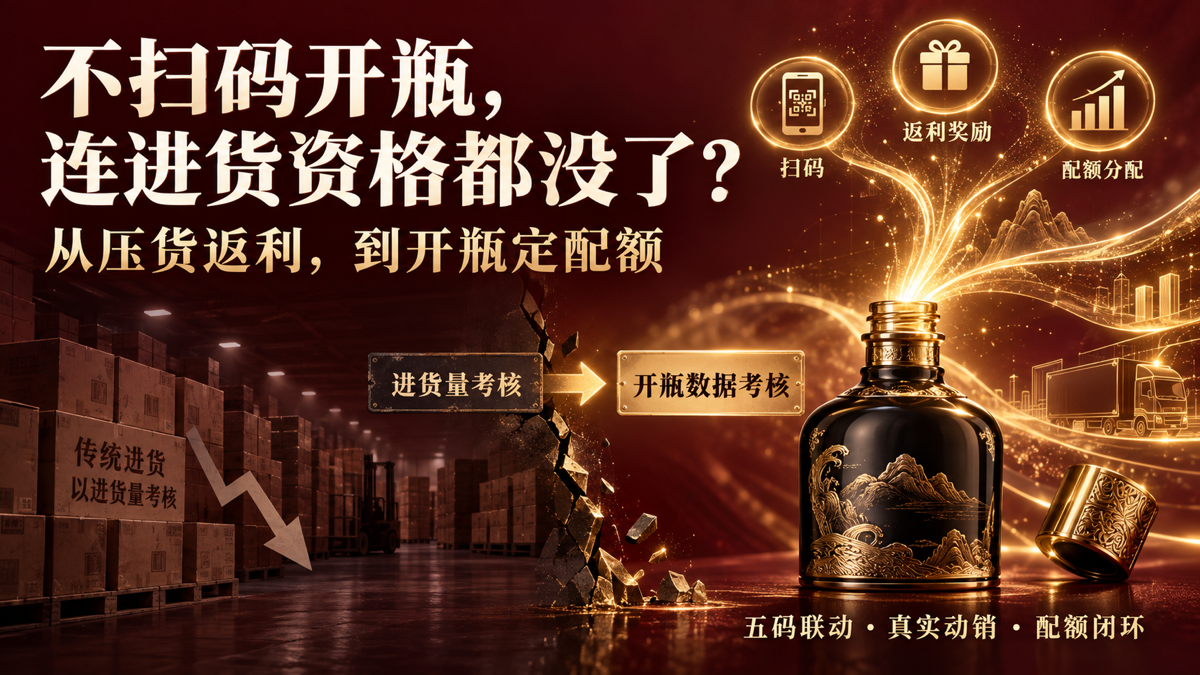
China Alcoholic Drinks Association data shows 58% of distributors still have growing inventory, and the industry average inventory turnover has soared to 900 days. But Guojiao 1573 is an outlier: distributor inventory compressed to 38 days (industry average 52), price stability rate at 89%, 52% ABV wholesale price steady at 840-860 yuan, and channel efficiency up 40%. The core shift: changing the KPI from "purchase volume" to "bottle-open rate"—if consumers don't open bottles and scan, distributors can't get rebates, increase quotas, or even order goods. Five-code integration has deployed over 50 million cases, with 110 million bottles opened, 40% scan rate, and 50 million members accumulated. Bottle-open data has become the new currency of channel power—whoever completes this transformation earlier holds a card that keeps them at the table in the second half of the zero-sum game.
I. Industry Status: Painful Data
The baijiu industry has some data that's pretty painful right now.
According to China Alcoholic Drinks Association statistics, 58% of distributors still have growing inventory, and the industry average inventory turnover has soared to 900 days. Talk to distributors—five out of ten will tell you about price inversion, fronting their own money to sell baijiu.
But Guojiao 1573 is an outlier.
Distributor inventory was compressed to 38 days, versus an industry average of 52. Price stability rate reached 89%, with the 52% ABV Guojiao wholesale price steady at 840-860 yuan. While same-tier competitors were all inverted, it didn't budge. Channel efficiency increased by 40%.
How?
II. One Sentence Flipped Decades of Profit Distribution Logic
At the distributor conference in late 2024, Guojiao's General Manager Zhang Liang dropped a line I still remember.
"With bottle opens comes the right to quota growth and ordering. No bottle opens, no quota."
What makes this sentence devastating is that it flipped the baijiu industry's decades-old profit distribution logic on its face.
What were distributors evaluated on before? Payment and purchase volume. How much you bought in, how much rebate you got—whether you actually sold it or not. So the manufacturer pressed stock, distributors hoarded, terminals passively accepted, and eventually prices collapsed and everyone died together.
Starting in 2025, the rules changed. The evaluation metric shifted from "purchase volume" to "bottle-open rate." If consumers don't open bottles and scan, distributors can't get rebates, can't increase quotas, and can't even order goods.
Distributors went from being inventory reservoirs to sell-through engines.
III. Where Does Bottle-Open Data Come From: Five-Code Integration
Where does bottle-open data come from? You can't rely on distributors self-reporting.
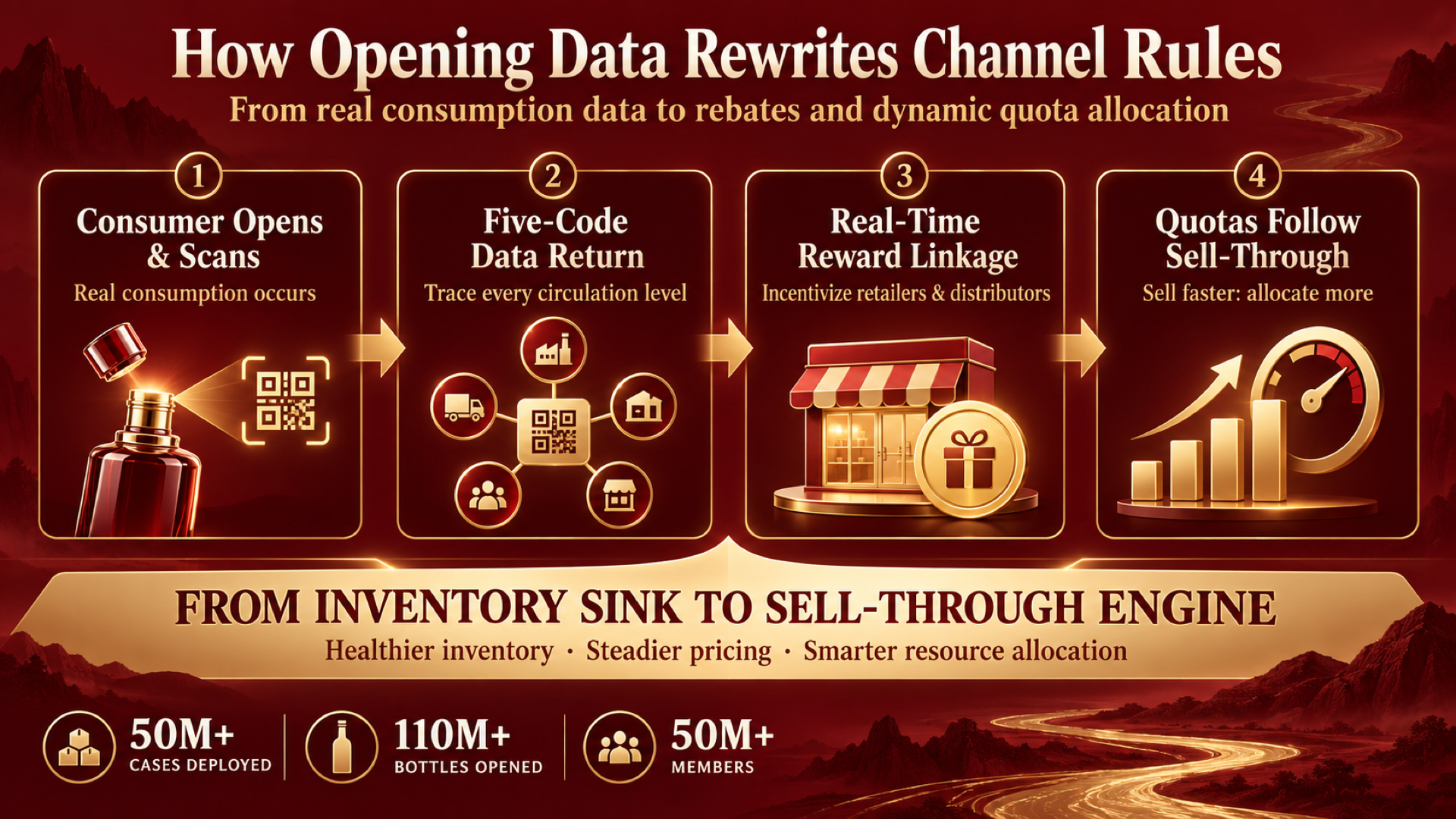
In 2023, Luzhou Laojiao did something: upgraded the original three-code integration to five-code integration. Pallet code, case code, box code, bottle code, and inner cap code—five-level linkage. Every bottle of baijiu, from factory to consumption, has a complete digital logistics record throughout.
Here's what makes this powerful—let me give you some numbers.
Over the entire 14th Five-Year Plan period, five-code products deployed exceeded 50 million cases, core single-SKU bottle opens exceeded 110 million, and members accumulated over 50 million. In 2025 alone, 12 million cases of five-code products were deployed, consumers scanned 56 million bottles, and scan users broke 13.6 million.
Overall scan rate hit 40%, with core single SKUs exceeding 50%.
Many people think scanning is just about sending red packets. It's not. Red packets are just C-side pull; the real flywheel is on the B-side.
Terminal stores push consumers to scan, and store rebates are credited in real time. Distributors push terminals to push, and distributor rebates are also credited in real time. Consumers get money for scanning, and channels get money for pushing. Both sides push together—that's how scan rates go from single digits to 40%.
IV. The Real Problem Solved: "Lying"
Let me be honest with you. The real problem this system solves isn't scanning—it's lying.
Where did goods actually go, who's drinking your baijiu, which stage was marketing budget spent on, who's responsible for cross-region channel flooding, how much quota should actually be allocated—before, the answers to all these questions came from a single distributor's mouth. Now they're all in the system.
So the effects were immediate.
The 38-day inventory number—its core logic is make-to-order. Bottle-open data feeds back in real time: where baijiu is consumed fast, quotas increase; where it's not moving, quotas decrease. This choked the impulse to stockpile at the source. In Q4 2025, they proactively cleared a wave of inventory, and in Q1 2026, operating cash flow surged 37% year-over-year.
Why is the price stable? Because quotas are precise, supply and demand are matched, and distributors don't need to cut prices to dump stock and recover cash.
Channel efficiency up 40%? That comes from turning resources from scattered sprinkling to precision drip irrigation. In 2026, Luzhou Laojiao launched the "100 Cities, 1,000 Counties, 10,000 Stores" project, planning to add no fewer than 600,000 new terminals. Where to open, where to place, how much to supply—all driven by bottle-open data.
V. From Digital Tool to Channel Operations Infrastructure
My own sense is that five-code integration is no longer a digitalization tool—it's the new infrastructure for channel operations.
Luzhou Laojiao is well aware of this. 2026 is defined as their "Digital Application Year," with marketing work fully entering phase 3.0. General Manager Lin Feng's exact words: "Using bottle-open or case-open to exchange for quotas as the underlying logic, upgrading digitalized price control and profit sharing."
From a department-level project to a company-level strategy.
VI. Can Other Distilleries Replicate This: Four Steps, None Optional
Can other baijiu distilleries replicate this playbook? I think yes, but these four steps are all indispensable.
Step one: Code infrastructure must be solid. Full-link coding across bottles, boxes, cases, pallets, and stacks. Five-level linkage logic and scan experience directly determine the floor of your scan rate.
Step two: Profit-sharing mechanism must be right. Distributor rebates must be linked in real time to consumer bottle-open scans. The recommended direction is a four-layer incentive: mark-up profit plus bottle-open rebate plus action-based payment plus tier-based benefits. Just sending red packets isn't enough.
Step three: Consumers need deep operations. Scanning isn't the endpoint—it's the starting point of member relationships. You need a complete tag system, tiered operations, and benefits design. 50 million members weren't built by red packets alone.
Step four: Form a quota closed loop. Replace gut-feeling with bottle-open data. Adjust dynamically, adjust in real time.
VII. Three Common Pitfalls
Let me share some honest closing thoughts.
Over the past year, I've seen many distillery digitalization projects—far more failures than successes. The three most common pitfalls:
First: Slap on a code, send a red packet, and call it done. Channel profit-sharing design wasn't kept up, and scan rates stay stuck.
Second: Scan data collected but nobody knows how to use it. It sits in the database gathering dust.
Third: Only doing consumer scans without channel scans. The B-side push leverage was never set up.
Conclusion
The most ruthless thing about Guojiao 1573's system is that it embedded technology into the very bones of profit distribution. It's not about how fancy the technology is.
When bottle-open data becomes the new currency of channel power, whoever completes this transformation earlier holds an extra card. A card that lets them stay at the table in the second half of the zero-sum game.