
100 Distilleries Expected by Year-End: Why Is Zunyi Pushing "Six-Code Integration"?
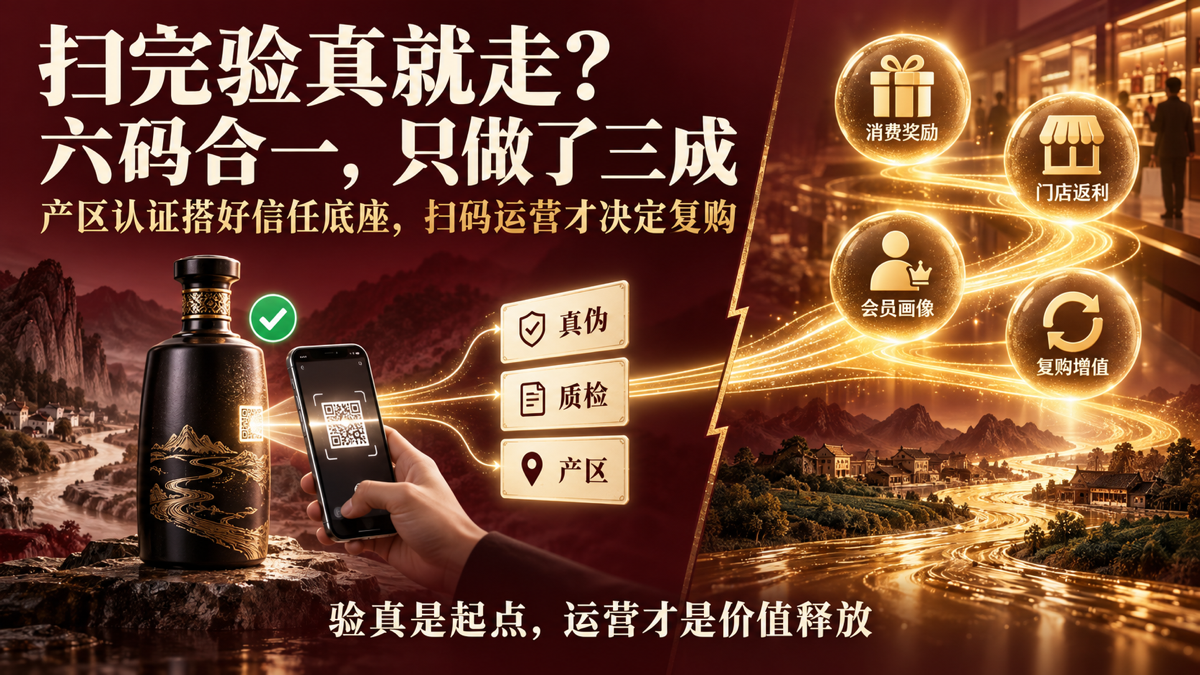
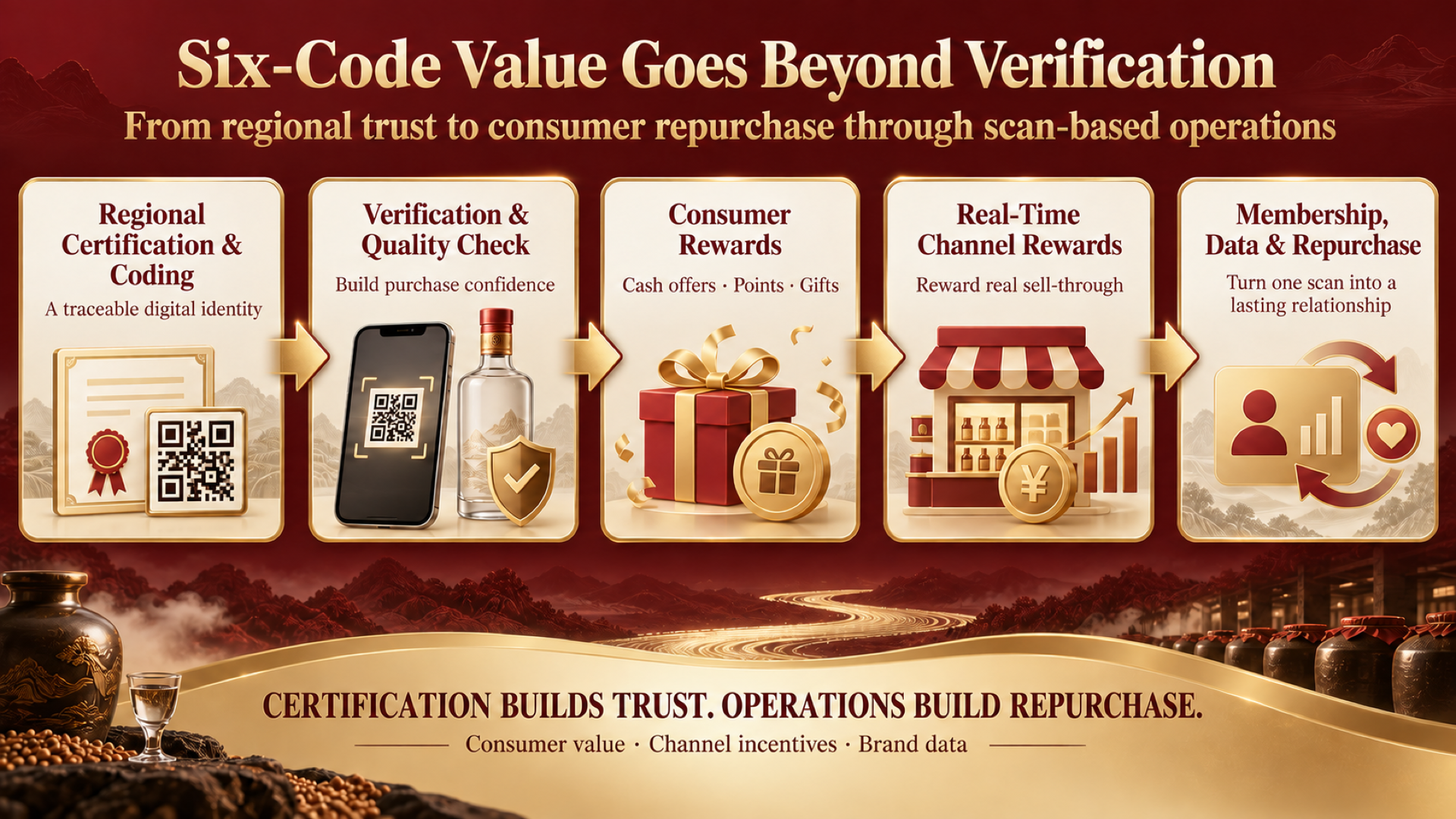
Zunyi is building a region-level product certification and coding system, led by the Zunyi Product Certification Alliance, with technical support from China Classification Society Quality Certification and the Municipal Product Quality Inspection Institute. Over 100 distilleries are expected to join by year-end. The sixth code isn't just another label—it bundles certification, quality inspection, and brand culture into one scan entry, upgrading the proposition from "proving it's real" to "proving it's worth buying." But scan-based verification is only the first step. The true value of one-item-one-code lies in post-scan operations: consumers get tangible benefits, channels get incentives, brands get data, and members are retained. Zunyi built the trust foundation; how high the building rises depends on each distillery's operational capability.
Introduction
Take a trip to Hengchang Shaofang's 10,000-ton storage base in Renhuai, Zunyi. Pick up any bottle in the finished goods warehouse, and you'll find a green label on the packaging. Scan it with your phone, and everything comes up: product information, authenticity verification, quality inspection report, and the distillery's cultural story.
This bottle has an "ID card."
This isn't some minor product launch experiment. Zunyi is building a region-level product certification and coding system, led by the "Zunyi Product Certification Alliance" and its certification and coding platform, with China Classification Society Quality Certification Co., Ltd. and the Municipal Product Quality Inspection and Testing Institute providing technical support. Currently, 17 distilleries have joined, 35 companies have signed certification contracts in the first batch, and the number of integrated enterprises is expected to exceed 100 by year-end.
100 distilleries means the core production capacity of Zunyi's sauce-aroma baijiu is essentially fully covered.
This is worth discussing.
I. Five-Code Integration Is No Longer Enough
The baijiu industry has been doing one-item-one-code for years. From the earliest anti-counterfeit labels to later "three-code integration" and "five-code integration," codes keep multiplying and the chain keeps getting longer. Case codes, box codes, bottle codes, inner codes, outer codes—connecting every stage from factory to uncapping.
What does five-code integration solve? Just two things. Letting consumers scan to confirm the baijiu is real, and letting brand owners know where the bottle went.
But this has a ceiling.
The consumer scans to verify authenticity, closes the page, and leaves. The brand gets a scan record—and then what? Nothing. Verification is inherently one-time. You don't check every day whether the same bottle is real.
Distilleries spend heavily on coding, only to get a "verify and leave" page. That money feels a bit wasted.
II. What Is the Extra Code in Six-Code Integration?
In public reports, Hengchang Shaofang's production scheduling lead Li Zhi put it bluntly: their six-code integration product lets consumers scan to see the full product profile, authenticity verification, quality inspection report, and the distillery's cultural heritage.
The extra layer isn't another code—it's packing certification, quality inspection, and brand culture into the same scan entry.
Think about the weight of that.
Before, consumers scanned and saw "this baijiu is real." Now they scan and see "this baijiu is real, here's its quality inspection report, here's the region it comes from, here's the distillery's story."
From "proving it's real" to "proving it's worth buying"—that's a significant leap.
And this system is government-endorsed. A single distillery claiming its code is impressive—nobody believes it. But Zunyi's municipal government built a certification alliance, set up a certification and coding platform, and brought in authoritative third-party institutions for technical support. The quality inspection report consumers see is produced by the Municipal Product Quality Inspection and Testing Institute. This level of trust is unattainable through corporate self-promotion.
Hengchang Shaofang's sales in the first half of this year reached 200 million yuan. Li Zhi said the trust boost from certification coding was indispensable. That's not an exaggeration. In a sauce-aroma baijiu market where quality varies wildly, an entry point where consumers can verify quality themselves is worth real money.
III. But Scan-Based Verification Is Only the First Step
I know what you're thinking.
Another government-driven digital project, another batch of distilleries joining a platform—and then what? After scanning and reading the quality report, consumers leave and forget, same as always.
You're right.
Six-code integration solves the trust problem. But trust is only the starting point of a transaction. A consumer believing your baijiu is real doesn't mean they'll buy another bottle, let alone recommend it to friends.
Most distillery digitalization makes the same mistake. Codes are deployed, systems are up, data is collected—but it all sits in the backend unused. The scan page forever stays at "verification successful." Consumers scan and leave; the brand doesn't even know who they are.
Distributors and retail terminals have it worse. They sell the goods, consumers open the bottles, but all the data and value from scanning has zero connection to them. Why would they actively promote your baijiu?
So many distilleries' one-item-one-code projects show no change in sell-through, no channel enthusiasm, no member retention. The codes are fine—what's missing is the operations behind the codes.
IV. One-Item-One-Code Should Be a Chain, Not a Page
Think it through, and the logic of one-item-one-code is clear.
A consumer opens the bottle and scans. In that single moment, at least four things can happen simultaneously.
First, the consumer gets something. Cash red packets, points, physical gifts—scanning must deliver tangible benefits, or why would they scan?
Second, the retail terminal and distributor get paid. The moment the consumer scans, the terminal and distributor's rebate is credited in real time. Sell a bottle, earn a bottle—no waiting for quarterly settlements, no chasing the brand for payments.
Third, the brand gets data. Who's drinking, where, which product, what time. This data used to come from distributor reports—wildly inflated. Now it comes from bottle-opening scans—real consumption behavior.
Fourth, the consumer becomes a member. While claiming a red packet, they register as a member with one tap. Future new product launches, holiday campaigns, tasting event invitations—all have a reach channel.
These four things linked together form a complete chain: product verification to consumer incentives, to channel rebates, to member registration, to user profiles, to repurchase operations.
But if you separate these four into four systems, four vendors, four teams—the data scatters across four places, and nobody can piece together the full picture.
V. What Do Distilleries Actually Lack?
I've spoken with digitalization leads at many distilleries, and a common pattern emerges.
The coding part—they've already done it. Third-party coding systems can link case codes, box codes, bottle codes, inner codes, and outer codes. It runs smoothly on production lines. This doesn't need to be rebuilt.
What they truly lack is everything after the scan.
After a consumer scans, how do you send them a red packet? How much? What triggers it? How is the retail terminal's rebate calculated? How is the distributor layer split? How are incentive policies flexibly configured across products, regions, and campaigns? How do scanned users become members? How are members tiered and managed? How is repurchase triggered?
These questions can't be answered by third-party coding systems. They manage "how codes are generated and linked"—they can't manage "how to operate after scanning."
It's like building a highway. The road, lane markings, and toll booths are all built. But what vehicles run on it, what cargo they carry, and who receives it—the toll booth can't manage that.
The one-item-one-code coding system is the highway. The scan-based marketing system is the fleet and logistics dispatch running on it.
VI. What Does the Brand Need?
From the brand's perspective, the needs are quite specific.
New product launch—needs to reach retail terminals quickly, needs consumers willing to try. How? Scan to claim benefits, pulling in the first batch of users.
Terminal sell-through is weak—stock is stuck in the channel. How? Deploy incentives based on real bottle-opening scans. Whoever sells and opens gets paid; no more stockpiling-reward schemes.
Channel management needs data—where did products actually go, which region has good sell-through, which terminal is pushing. How? Through scan and rebate data, product flow and terminal performance are crystal clear.
Member retention—can't rely solely on store staff adding WeChat contacts. How? Scan for one-tap registration, auto-generate consumer profiles, then do tiered outreach by product preference, consumption region, and campaign participation.
All of these require a system to support them. A sticker code alone won't solve it.
VII. What Does the Channel Need?
I've always felt the biggest waste in distillery channel management is incentive misalignment.
Brand rebates to distributors and retail terminals are mostly calculated by purchase volume. Buy more, get more rebate. Whether those goods actually reached consumers—nobody knows.
The result: distributors stockpile to earn rebates, terminals hoard baijiu in warehouses. The brand sees great shipment numbers, but the goods haven't moved. By the time they realize it, channel inventory has already exploded.
What if rebates were tied to bottle-opening scans?
The moment a consumer opens a bottle and scans, the terminal and distributor's rebate is credited in real time. Goods must actually reach the consumer before anyone gets paid. Unsold stock earns zero rebate.
Distributors and terminals can directly see the revenue from each bottle opened. Sell one, earn one—crystal clear. This instant feedback is far more powerful than settling accounts once a year.
Channels shift from "passive stocking" to "active promotion." Slogans don't work—incentive mechanisms do. Show them the money, and they'll push naturally.
VIII. What Does the Consumer Need?
Consumer needs are the simplest, and the most easily overlooked.
Can scanning get them something? Red packets, points, gifts—there must be a tangible benefit. Give consumers a code that only shows a quality report, and they'll scan once and never again. Let them scan for cash, and they'll scan every bottle in their house.
After claiming something? Member registration. No complex forms—one-tap registration. After registering? Continuing to have things to claim. New product trials, holiday red packets, tasting event sign-ups, distillery tour invitations.
Honestly, consumers aren't scanning to help you collect data. They scan because they get something. Provide the benefits, and the member relationship naturally forms. Give them a code that only shows a verification page, and they'll forget who you are after scanning.
IX. Implementation: Don't Try to Swallow Everything at Once
After talking with several distilleries, my sense is: this can't be rushed, but it also can't be delayed.
Step one: Connect products and data. The third-party coding system is already running—don't start over. What you need is to connect the post-scan marketing operations system, turning the scan page from "verification successful" into an entry with benefits and content. First, nail the fundamentals: consumers can understand it, channels can check it, brands can manage it.
Step two: Get channel incentives running. Set rebate rules for distributors and retail terminals first, using real bottle-opening scans as the trigger. Different products and regions can have different policies, but rules must be transparent and payouts timely. Let the channel taste the sweetness first, and active promotion will follow naturally.
Step three: Retain consumers. Launch red packets, points, and gifts first to drive scan rates. Then member registration, tiered operations, and repurchase outreach—step by step. It can't be rushed; a membership system can't be built in a month.
X. Three Judgments
First, QR codes will become more widespread, but "post-scan operational capability" is the real differentiator. A code without marketing follow-through only proves the product was viewed. A code with a complete operational loop helps brands acquire users, channel data, and sell-through data. These are completely different in magnitude.
Second, channel rebates must shift from "stockpiling rewards" to "real consumption incentives." Tie rebates to bottle-opening scans. Spend marketing budgets on real sell-through, not on channel stockpiling. For distilleries suffocating under inventory pressure, this shift is a matter of survival.
Third, regional certification creates trust; member operations turn trust into repurchase. Zunyi's six-code integration solves "whether consumers dare to buy." The brand's own scan-based marketing and membership system solves "whether consumers want to keep buying." The government did half of the first part; the second part is on you.
Conclusion
Your distillery's code—what's left after the scan? Let's chat in the comments.
Zunyi's push for six-code integration has more signaling significance than technical significance.
It shows the baijiu industry has moved past the "should we digitalize" debate. The question now is "how to use it after digitalization is done." Codes are applied, certifications are in place, quality reports are accessible—all good. But if it stops here, one-item-one-code has released less than 30% of its value.
The remaining 70% is hidden in post-scan operations. Did consumers get benefits? Did channels get incentives? Did brands get data? Were members retained? Was repurchase driven?
These are the truly valuable parts.
Zunyi built the trust foundation for distilleries. How high a building goes on that foundation depends on each distillery's operational chops.