
Stop Confusing O2O, Chain New Retail, and Instant Retail: How Should Alcohol Stores Choose a System?
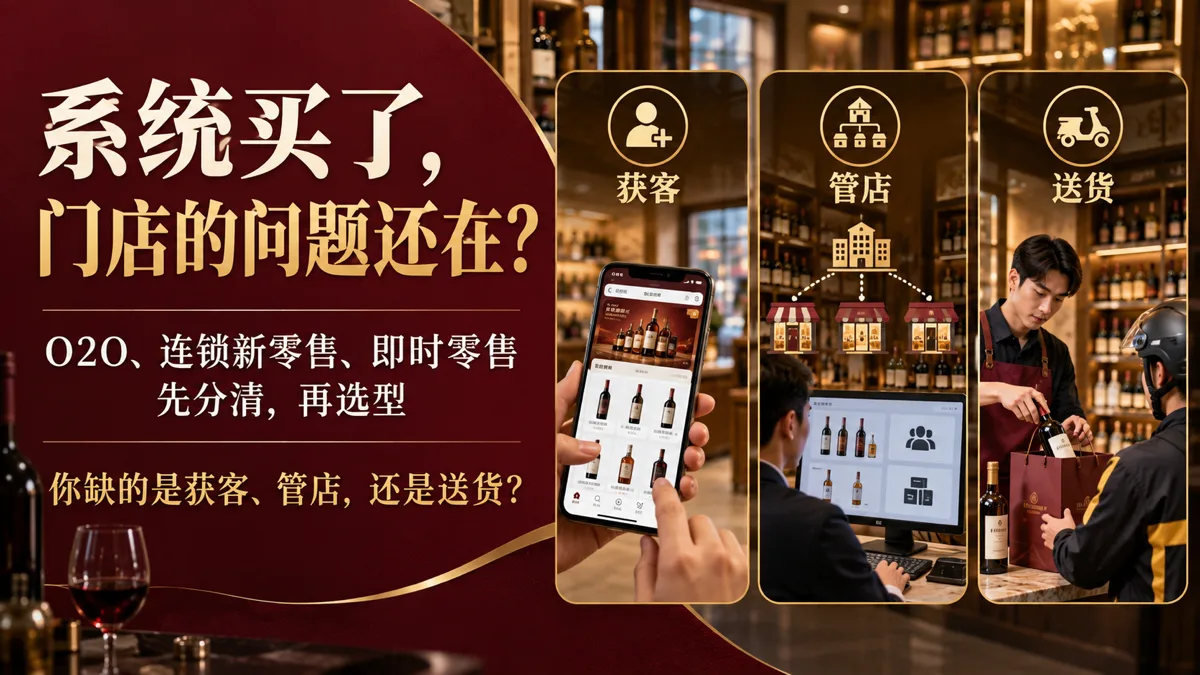
People in the alcohol business have all heard terms like O2O, chain new retail, and instant retail, but they solve different problems: O2O solves "how customers find you," chain new retail solves "how to manage multiple stores together," and instant retail solves "how to get baijiu to customers as fast as possible." This article breaks down the core logic, applicable scenarios, and system capability differences of each concept, helping alcohol stores figure out whether they're stuck on customer acquisition, store management, or delivery before choosing a system—fix the shortest plank first.
I. O2O: Bringing Online Traffic to Offline Stores
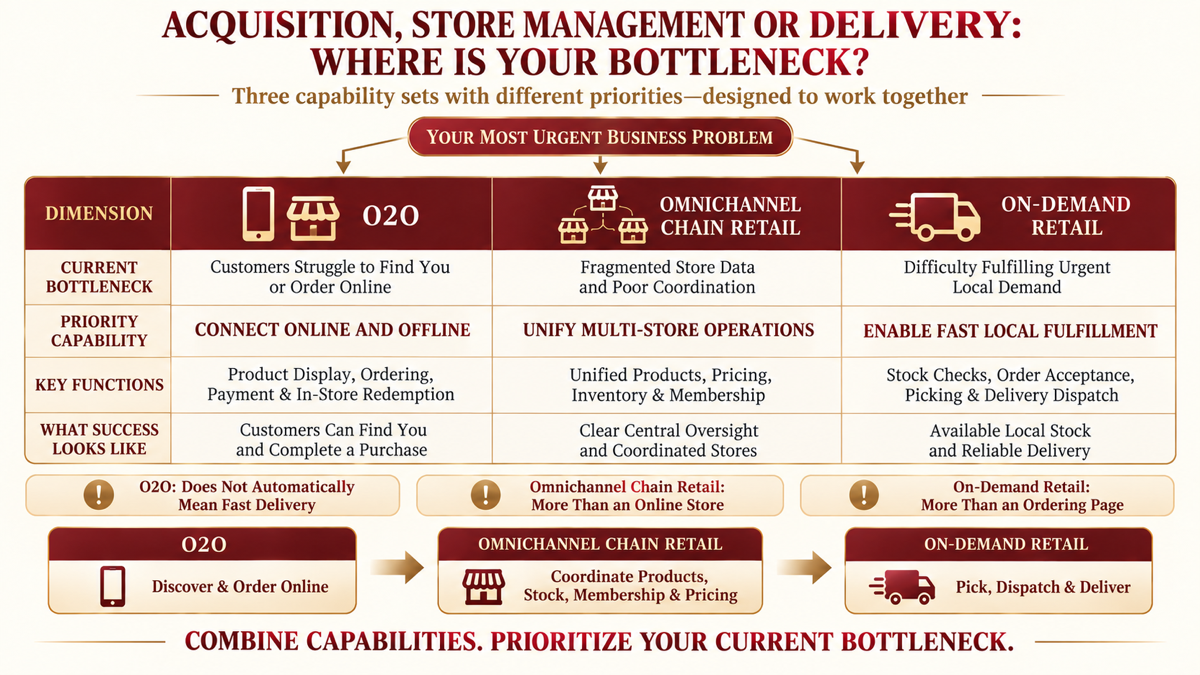
The core of O2O is the connection between online and offline.
For example, a customer sees an alcohol store on a mini-program, group-buying platform, or map, can browse products, claim coupons, place orders, pick up in-store, or redeem a group-buy voucher at the store. All of these are O2O.
For alcohol stores, common O2O features aren't complex: product display, online ordering, coupons, payment, in-store redemption, and membership registration. Its value lies in letting stores that previously relied only on walk-in traffic and regular customers be visible to more nearby consumers.
But O2O doesn't equal instant delivery.
A customer ordering online and picking up at the store the next day is also O2O; a customer buying an alcohol package voucher and redeeming it in-store is equally O2O. It's more like an online entry point—not necessarily carrying the task of "delivering in 30 minutes."
For a standalone tobacco & alcohol shop whose most pressing need is an online display and ordering entry point, O2O is usually sufficient. Letting customers find you and complete a purchase is more practical than piling on complex features from the start.
II. Chain New Retail: Not Just Opening More Stores, but Managing Multiple Stores as One Business
When a store grows from one to three or ten locations, the challenge goes beyond "adding a few more cash registers."
For the same bottle of baijiu, is the headquarters-set price consistent with what the store actually charges? If one store is out of stock, can you check whether another store has inventory? Can loyalty points earned at Store A be used at Store B? How does a promotional campaign land across all stores simultaneously?
These problems are hard to handle with a single-store system. What a chain new retail system solves is the coordination between headquarters and stores.
It typically covers multi-store POS, product and pricing management, loyalty points, stored value, marketing campaigns, inventory management, stock transfers, procurement, and business reporting. The focus isn't just selling goods—it's unifying products, inventory, members, and data.
The alcohol industry particularly needs these capabilities. Alcohol SKUs are numerous, specifications vary, and gift boxes, single bottles, and full cases are managed differently; some products have sensitive pricing structures. Once stores multiply, if product, inventory, and member data operate independently, the business picture headquarters sees easily becomes distorted.
So the essence of chain new retail isn't "opening an online mall"—it's building a management foundation that supports multi-store operations.
III. Instant Retail: The Focus Isn't Online Ordering, but Nearby Stock and Fast Delivery
The instant retail scenario is familiar to the alcohol industry.
Evening gathering, running low on baijiu; friends drop by unexpectedly, need a few more beers; holiday gifting, remembering you're short a case of baijiu just as you're heading out. Customers don't care how complete your system is—they care about one thing: if they order now, how soon can they get it?
What instant retail handles is fulfillment.
The system needs to know where the customer is, which nearby store has stock, whether inventory is accurate, whether the delivery range covers the area, who at the store picks the order, how the rider accepts the order, and the estimated delivery time. If out of stock, it also needs to handle refunds, substitute products, or customer communication.
This logic differs from a standard online mall. A mall solves "can you sell"; instant retail also solves "can you deliver immediately."
Therefore, instant retail depends on three foundations: real-time inventory, store order-accepting capability, and delivery dispatch. Inaccurate inventory means customers order only to find out there's no stock; if no one at the store picks orders, more orders just mean more delays; without proper delivery coordination, "instant" remains only on the page.
IV. The Three Aren't Replacements—They're Different Layers of Capability
Let's break down a single alcohol instant order.
The customer finds the store online, views products, and completes the order—this is the O2O part. The system determines which store has sufficient stock, whether the customer can use loyalty discounts, and what price the product sells at—this is the chain new retail part. The store picks the order, the rider collects it, and it's delivered to the customer—this is the instant retail part.
A single store can do only O2O, or it can do instant retail on top of chain management.
For single stores, having a stable online entry point first, then smoothing out nearby delivery, is usually more practical. For multi-store alcohol chains, unifying products, inventory, members, and pricing first is more important. Without the data foundation connected, rushing into omni-channel delivery often amplifies existing management problems.
V. Before Choosing a System, Ask Yourself a Few Questions
Do your orders mainly come from walk-in customers, regular customer WeChat, platform traffic, or group-buy clients? Is your store a single-location operation, or do you already have multiple stores? Do customers frequently have "need baijiu now" demands? Can inventory be reflected in real time? Can stock be transferred between stores? Is your more urgent priority customer acquisition, or improving repurchase and store management efficiency?
Different answers mean different system priorities.
Don't pay for concepts like "O2O," "new retail," or "instant retail." For alcohol merchants, first look at whether you're currently stuck on customer acquisition, store management, or delivery. Fix the shortest plank, and the system will truly help your business.