
An Instant Retail System for Regional Alcohol Chain Enterprises: Localized Dark Stores, Restaurant Alliances, Hotel Banquets, and Private Domain Live Streaming
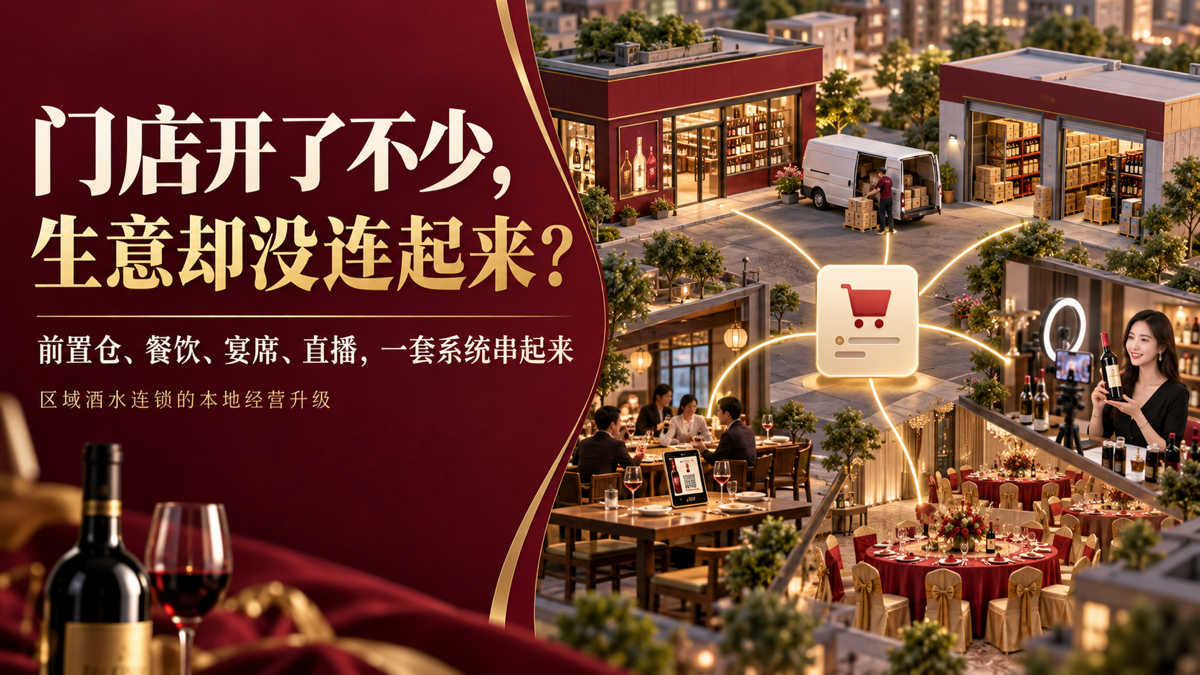
The local resources of regional alcohol chain enterprises—stores, loyal customers, restaurant and hotel relationships, delivery capabilities—become more valuable in the instant retail era. This article breaks down how a single instant retail system turns scattered local resources into an operating network: localized dark stores bring orders closer to customers, restaurant alliances turn dining venues into alcohol entry points, hotel banquet processes no longer rely on manual tracking, private domain live streaming helps customers understand before buying, and unified headquarters management keeps stores running smoothly. Six types of enterprises are suited for this model, the core being transforming relationship- and experience-based business into clearer, more stable, and replicable operations.
Introduction
What did regional alcohol chains rely on in the past?
Store locations, loyal customers, salespeople, restaurant and hotel relationships, local delivery, and the reputation the owner built up over years in the area.
Are these things still important? Absolutely.
You could even say that the further into the instant retail era we go, the more valuable local resources become.
National instant retail platforms like Meituan Shangou, JD Miaosong, Taobao Instant Delivery, and Douyin Hourly Delivery have their strengths. They excel in traffic, SKU variety, delivery networks, and extreme service standardization.
But the alcohol business isn't just about delivering baijiu to a user's hands.
Often, what users truly need is differentiation: Is this baijiu suitable for hosting? Is the price competitive locally? Is this choice dignified enough for a banquet? Can restocking be delivered in time? Is it shipped from a nearby familiar store? Can I reach someone if there's a problem later?
National platforms can solve some of these, but going deep is hard.
The opportunity for regional alcohol enterprises lies right here.
Local merchants better understand local drinking habits, know which baijiu suits local banquets, are familiar with which restaurants have alcohol demand, and find it easier to build trust with existing customers.
These resources may be scattered. The store belongs to the manager, the warehouse to the warehouse keeper, restaurant relationships to the salesperson, banquet customers to manual follow-up, and live streaming and private domain to yet another team.
If these resources can be connected, a regional alcohol enterprise becomes more than "a few stores opened"—it gains its own local alcohol operating network.
This is exactly what an instant retail system is meant to solve.
It's not about giving the alcohol enterprise another online mall. It's about helping the enterprise organize local resources: stores, dark stores, restaurant alliances, hotel banquets, and private domain live streaming.
I. Localized Dark Stores: Bringing Orders Closer to Customers
When doing instant retail, the first thing to figure out is: where does the baijiu come from once a customer places an order?
If all orders ship from the central warehouse, it obviously doesn't work for local instant consumption. Users at a dinner gathering who need two more cases of beer can't wait for express delivery. A customer hosting a last-minute banquet who's short one bottle of baijiu won't wait until tomorrow.
So for local alcohol businesses doing instant retail, the key is organizing nearby inventory first.
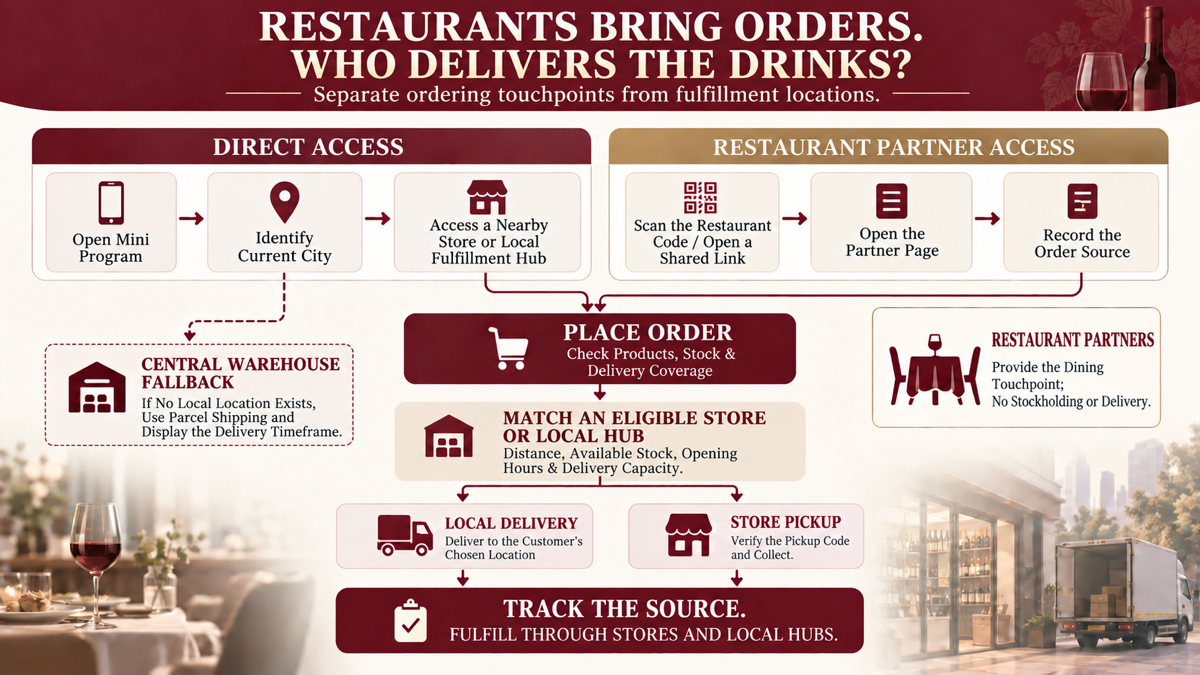
Physical stores are close to customers—they can deliver or offer in-store pickup. Dark stores don't need to handle walk-in customers and can focus entirely on stocking, sorting, outbound, and delivery. The central warehouse serves as backup—when there's no local store or dark store in the current city, it ships via express.
When customers open the mini-program, the system automatically directs them to the nearest physical store or dark store based on their location. Customers don't need to understand the logic behind it—they just need to know: there's stock nearby, they can order, and delivery is available.
At this point, the enterprise isn't building an online shelf—it's building a local alcohol fulfillment radius.
Whoever is close to the customer, whoever has stock, can fulfill orders faster.
That's the true value of dark stores.
Dark stores aren't for looking "technologically advanced"—they ensure that when customers need baijiu, the enterprise can truly deliver.
II. Restaurant Alliances: Turning Restaurants into Alcohol Entry Points
Alcohol consumption has a natural scenario: the dining table.
Much of the baijiu isn't purchased in advance at home—it's needed during a meal.
Friends gathered for dinner, dishes arrive, and they realize there isn't enough baijiu. A client banquet where the original baijiu's quality isn't quite right, and they want to switch. A late-night BBQ where everyone keeps drinking and needs more.
Restaurant owners want to serve customers well, but not every restaurant wants to hold heavy alcohol inventory. Too much stock ties up cash; too few options dissatisfy customers; slow-moving items pile up.
So restaurant alliances hold real potential for local alcohol enterprises.
A restaurant doesn't need to become an alcohol distributor—it can first become an entry point.
For example, a store QR code on the table lets users scan and enter the alcohol page for that restaurant. Users can browse beer, baijiu, red wine, spirits, or even pre-made gathering bundles.
But the restaurant itself doesn't need to stock or deliver.
After a customer places an order, the nearest physical store or dark store handles delivery.
This way, the restaurant provides the scenario and traffic, while the alcohol enterprise provides the products and fulfillment.
This is much lighter than traditional distribution.
In the past, entering the restaurant channel meant negotiating placement, display, payment terms, inventory, and returns. Now, restaurants can first become alliance entry points—orders come in, and nearby stores or dark stores deliver.
For restaurants: no inventory pressure, plus an added alcohol service. For alcohol enterprises: an additional local consumption scenario. For customers: no leaving the table, no phone calls to find baijiu—just scan and buy.
There's a crucial design detail here: alliance stores aren't recommended by location.
When users normally open the mini-program, they see nearby physical stores or dark stores. Only when they scan a restaurant's store QR code or click a shared restaurant shop link do they enter the alliance store.
This avoids logic confusion.
Alliance stores aren't for fulfillment—they're for capturing scenarios.
Restaurants don't hold inventory, but they generate orders. Nearby stores with stock handle delivery.
That's what makes restaurant alliances genuinely useful.
III. Hotel Banquets: Taking Banquet Baijiu Beyond Manual Tracking
Anyone in the alcohol business knows that banquet baijiu is good business.
Weddings, birthday banquets, baby showers, graduation celebrations, housewarmings, corporate entertaining—these scenarios involve large volumes, high average order values, and tend to drive future repurchases.
But banquet baijiu also tests management.
Customers ask about packages; salespeople chat on WeChat. Deposits are confirmed manually. Delivery times are communicated by phone. On-site shortages require ad-hoc restocking. Final payment collection relies on people keeping track.
For one or two banquets, manual handling works. But once stores multiply, hotel partnerships grow, and salespeople increase, problems gradually emerge.
Different people quote different prices for the same baijiu. Package terms are inconsistent. After a customer pays a deposit, it's unclear who follows up. On the banquet day, temporary restocking can't find the nearest store. Final payment collection relies on memory.
These issues may not cause major problems daily, but they erode efficiency bit by bit.
So for banquet baijiu to scale, it can't rely solely on individual salesperson capability—processes need to be streamlined.
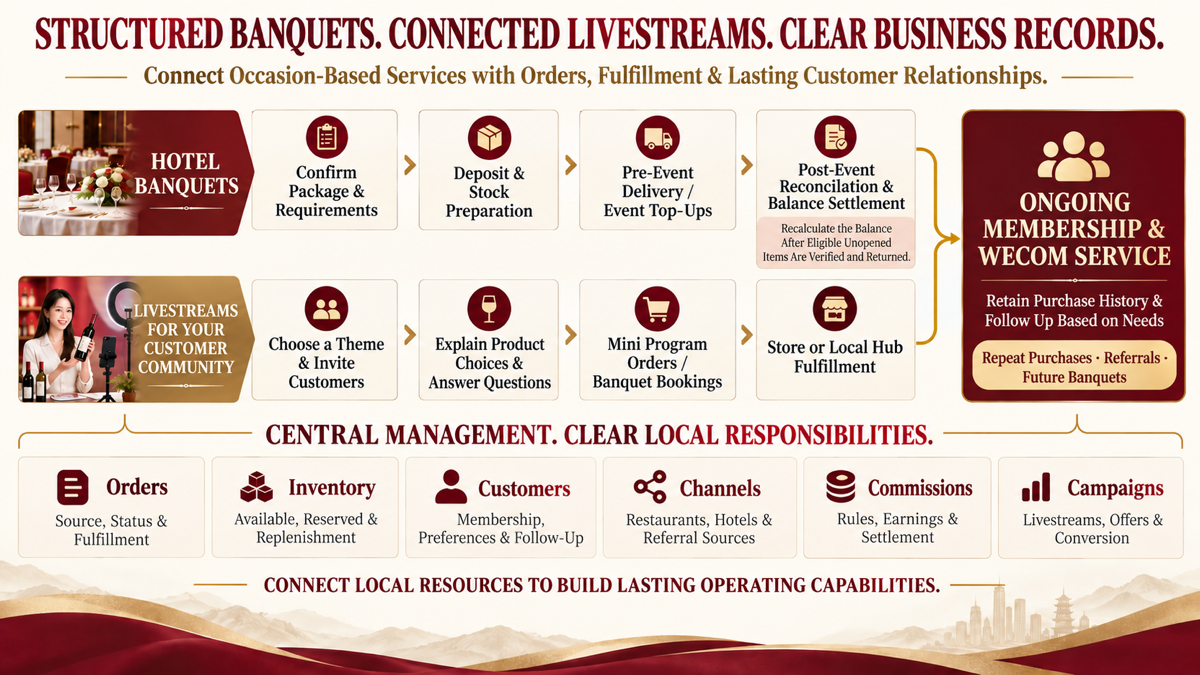
Customers can view banquet packages in the mini-program. For example: wedding packages, birthday packages, graduation packages, corporate entertaining packages. What the main baijiu is, what complementary products are included, total price, deposit ratio, and when the balance is due—all can be clearly stated upfront.
Customers pay a deposit first, and the enterprise prepares stock in advance. At banquet time, the nearest physical store or dark store delivers.
If the banquet runs short on baijiu, restocking continues. The system finds nearby stores or dark stores with stock based on location and delivers promptly.
If the banquet ends with unused baijiu, unopened bottles can be scanned for verification and returned, with the balance automatically recalculated.
The value here goes beyond convenient ordering.
More importantly, banquet high-value customers can finally be retained.
In the past, after a banquet ended, many customers were lost. Customer data lived in salespeople's WeChat, purchase records in chat histories, and follow-up repurchase relied on individual memory.
But if banquets are handled from start to finish in the mini-program—booking, deposit, delivery, restocking, balance payment—customer information and order records are retained.
Future baby showers, birthday banquets, housewarmings, holiday gifts, or business entertaining can all be followed up.
Banquet baijiu isn't a one-time deal.
Done well, it's an entry point to a family, a social circle, a network of friends and relatives.
IV. Private Domain Live Streaming: Helping Customers Understand Before Buying
Alcohol products differ from ordinary goods.
A piece of clothing—users check the style, size, and price, and can basically decide whether to buy.
But alcohol is different.
Customers care about origin, taste, brand, tier, authenticity, price, and suitable occasions. Especially for baijiu and red wine, many customers aren't unwilling to buy—they just don't know how to choose.
This is where private domain live streaming adds value.
Not every livestream needs to chase hundreds of thousands of viewers. For regional alcohol enterprises, private domain live streaming is more like an online tasting event, a customer engagement session, or a banquet baijiu selection fair.
Existing customers are in groups, store members are in enterprise WeChat, restaurant owners are in partnership groups, and banquet customers are in inquiry lists. Organize these people, run regular livestreams, talk about a few products, discuss scenarios, explain how to choose—and conversions will follow.
For example: a wedding baijiu selection session can cover how to pair baijiu with different budgets. A corporate entertaining session can discuss which baijiu suits hosting. A family gathering session can recommend everyday drinking options. A holiday gifting session can highlight baijiu that's both presentable and reasonably priced.
The value of live streaming isn't the host shouting about cheap prices—it's clearing up the questions customers have in mind.
When customers understand, they're more likely to place orders.
But for live streaming to be truly effective, the backend must be able to catch the demand.
Can customers place orders immediately while interested in the livestream? After ordering, can nearby stores deliver? Can banquet customers pay deposits directly? Can existing customers claim coupons for repurchase? Can orders from restaurants, group leaders, and waitstaff be settled clearly?
If none of these are connected, live streaming is just a brief burst of excitement.
The approach that truly suits regional alcohol enterprises is putting live streaming, mini-program, stores, dark stores, membership, and banquet packages together.
Live streaming explains clearly. The mini-program captures orders. Stores and dark stores deliver. Membership and enterprise WeChat handle repurchase.
This way, live streaming becomes part of local operations, not an isolated event.
V. Headquarters Needs Visibility for Stores to Run Smoothly
When regional alcohol enterprises reach a certain scale, the biggest fear isn't having no business—it's having unmanageable business.
More stores, but inventory is unclear. More warehouses, but who has stock is unclear. More orders, but who delivers is unclear. More restaurant partnerships, but who brought which orders is unclear. More banquet customers, but who paid a deposit and who hasn't paid the balance is unclear. More livestreams, but which one was effective is unclear. More promoters, servers, and partners participating, but how commissions are calculated is unclear.
If all of this is handled through WeChat groups, phone calls, and spreadsheets, it works at first but becomes exhausting over time.
The boss coordinates every day. Stores confirm every day. Salespeople ask every day. Finance struggles with month-end reconciliation.
So for regional alcohol enterprises doing localized instant retail, headquarters must have a unified management approach.
Headquarters needs to see products, inventory, orders, stores, members, campaigns, banquets, livestreams, and promotion effectiveness.
Stores need to know which orders to process, which customers want pickup, and which orders need delivery.
Dark stores need to know which goods to ship and which orders to deliver.
Restaurant alliances need to know how many orders they've brought in.
Promoters need to know their performance and earnings.
Finance needs to know which orders should be settled, which commissions should be paid, and which balances are still outstanding.
This isn't about giving the enterprise another complex backend—it's about reducing gut-feeling decisions and reducing person-to-person oversight.
Often, management doesn't lack people—it lacks clear accounts.
Order accounts, inventory accounts, customer accounts, channel accounts, commission accounts, and campaign accounts.
When these accounts are clear, the enterprise knows where it makes money, where it's inefficient, and where it's worth investing more.
VI. Which Alcohol Enterprises Are Suited for This?
Not every alcohol enterprise should jump into such a comprehensive model right away.
If you just want a display page with a few products and occasional orders, there's no need for something this heavy.
But if the enterprise already has a local foundation—several stores, a central warehouse, restaurant partnerships, banquet customers, or active private domain and live streaming efforts—then it's worth serious consideration.
These types of enterprises are particularly suited:
Type 1: Regional alcohol chain enterprises. They have stores and local customers but need to connect in-store orders with online orders.
Type 2: Local alcohol delivery enterprises. They already have delivery capabilities but need more front-end order entry points and member retention.
Type 3: Alcohol distributors with central and dark store layouts. The warehouses exist; the key is making them fulfillment points, not just storage.
Type 4: Alcohol enterprises wanting to build restaurant alliances. Not every restaurant needs inventory—they can start as scan-to-order entry points.
Type 5: Alcohol brands or regional operators wanting to do banquet baijiu. Banquet baijiu can't rely on salespeople running around—it needs to connect packages, deposits, balances, delivery, restocking, and customer retention.
Type 6: Local alcohol merchants already doing private domain live streaming, community operations, and enterprise WeChat customer management. They have customers, content, and livestreams but lack a tool to capture orders and fulfillment.
These enterprises all have resources.
They're just scattered across different places.
Stores have store customers. Salespeople have their WeChat contacts. Restaurants have dining scenarios. Banquets have high order values. Live streaming has audience attention.
Without connecting them, each piece only contributes a fraction of its potential.
Once connected, they form a local alcohol operating network.
Conclusion
So, regional alcohol business, in the end, is still about local operations.
What regional alcohol enterprises truly need to do is reorganize their local resources.
Stores handle service and fulfillment. Dark stores handle efficiency. Restaurants handle scenario entry points. Hotel banquets handle high order values. Live streaming explains products clearly. Private domain handles long-term repurchase. Headquarters handles visibility and management across all of it.
National platforms have their advantages; regional enterprises have their opportunities.
Don't assume that instant retail is necessarily a big-platform business.
Deep operations in local alcohol markets have always been something regional enterprises do better.
The key is transforming business that relied on personal relationships, experience, and WeChat group communication into a clearer, more stable, and replicable way of operating.
For regional alcohol chain enterprises, instant retail isn't simply adding an online mall—it's an upgrade of local operating capability.
If you're in alcohol chain operations, local delivery, restaurant alliances, banquet baijiu, or experimenting with private domain live streaming, leave a comment below to try the "Instant Retail System" test site.
You can also share: in your city, how far has alcohol instant retail progressed? What opportunities between restaurants, banquets, stores, and private domain haven't been truly connected yet?