
How Can Local Alcohol Instant Retail Enterprises Improve Operations Through Banquet Baijiu Service?
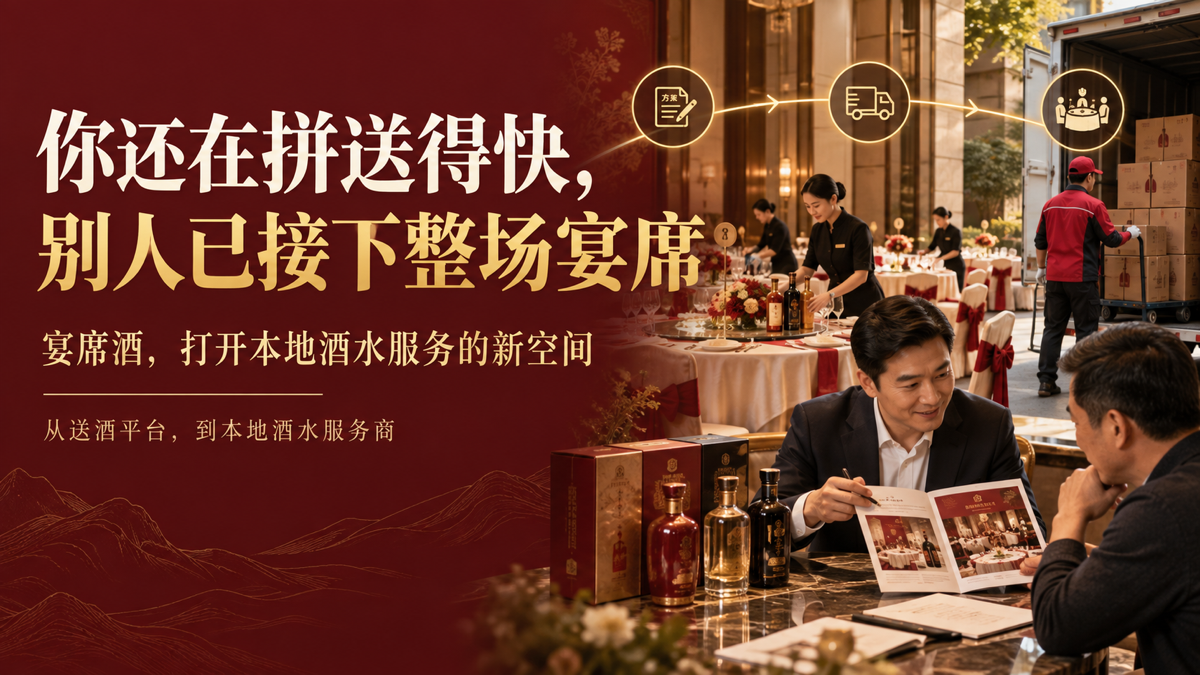
Many local alcohol instant retail enterprises used to focus on one word: fast. But relying only on ad-hoc orders makes you vulnerable to platform traffic and price competition. This article argues that banquet baijiu is a scenario worth attention for local enterprises, outlines four core pillars of banquet baijiu business—locking in demand early, providing scenario solutions, coordinating fulfillment, and completing settlement reviews—and explains that digitalization doesn't replace offline relationships but unifies processes scattered across WeChat and spreadsheets, helping enterprises grow from a delivery platform into a true local alcohol service provider.
I. Speed Alone Isn't Enough—You Need to Understand Local Scenarios
Many local alcohol instant retail enterprises used to focus on one word: fast.
The user needs baijiu on short notice, the store takes the order, and the rider delivers—this model solves immediate demand. But the longer you're in business, the more you realize that relying only on ad-hoc orders makes you easily dragged around by platform traffic, price competition, and delivery costs. What truly sets companies apart usually isn't who delivers faster, but who better understands local scenarios.
Banquet baijiu is one such scenario worth taking seriously.
In county-level cities, townships, and community markets, demand for weddings, birthday banquets, housewarming celebrations, and business banquets has always existed. These aren't simple one-time orders—they're a complete process of advance communication, advance stocking, on-site service, and post-event settlement. For local alcohol instant retail enterprises, banquet baijiu isn't about selling a few extra cases. It's about upgrading from "instant baijiu delivery" to "local alcohol service."
This is also where local enterprises have an opportunity.
National platforms like Meituan Shangou, JD Miaosong, Waima Songjiu, and 1919 have traffic, systems, and delivery networks, but they're better at standardized orders. Banquet baijiu is hard to fully standardize. Customers care about budget, table count, and drinking preferences; hotels and wedding planners have their own partnerships; goods need to be confirmed before the banquet, mid-banquet restocking may be needed, and unused products must be reconciled afterward. There's extensive offline communication and local coordination involved—one online entry point can't solve it all.
The advantage of local alcohol instant retail enterprises lies precisely here: close to customers, close to stores, close to hotels, and more familiar with local relationships, pricing, and service customs.
II. Four Core Pillars of the Banquet Baijiu Business
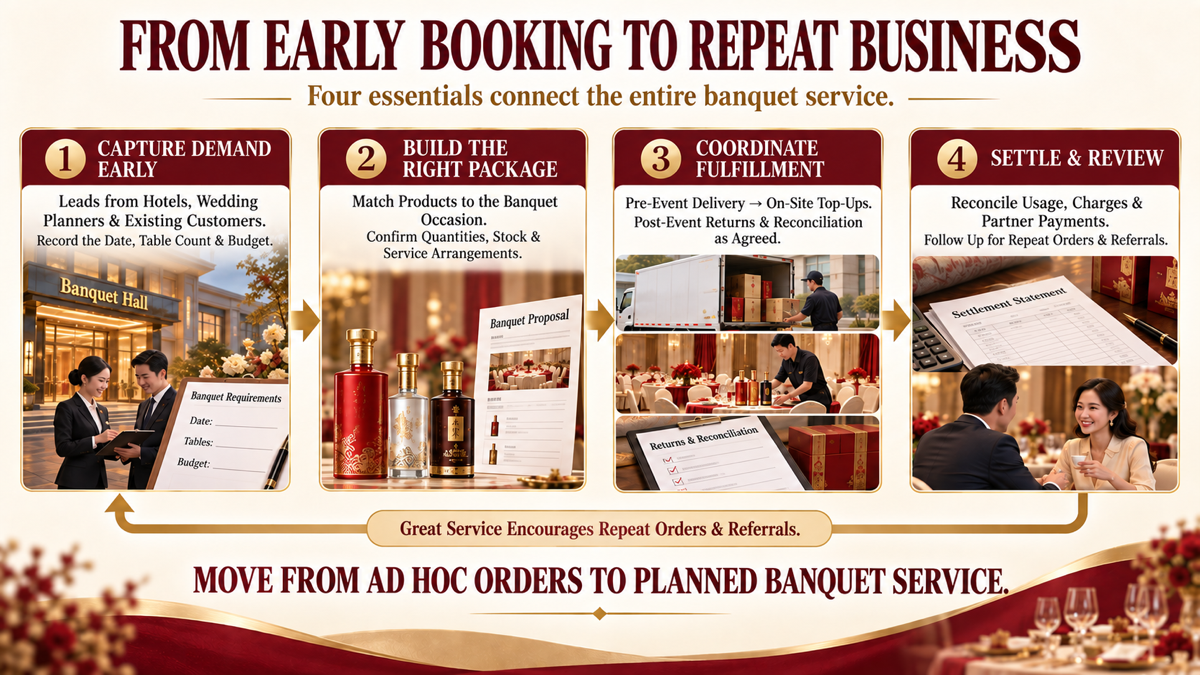
The core logic of the banquet baijiu business can be summarized in four points.
First, lock in demand early. Banquets usually aren't decided on the day of. Enterprises need to enter the conversation during the customer's planning stage—getting leads through hotels, wedding planners, existing customer referrals, and community channels.
Second, provide scenario solutions. Customers care about more than price—they want authentic products, dignity, peace of mind, and service. Alcohol merchants need to provide appropriate product combinations and stocking recommendations based on banquet type, budget, and headcount.
Third, coordinate fulfillment. Pre-banquet delivery, mid-banquet restocking, and post-banquet return and reconciliation—every link needs someone responsible. If any link breaks once, the customer experience suffers.
Fourth, complete settlement reviews. Banquet baijiu orders involve channel partnerships, inventory commitments, delivery tasks, reconciliation records, and customer repurchase. Manual bookkeeping is error-prone and hard to replicate.
III. More Roles Means Greater Need for Systems
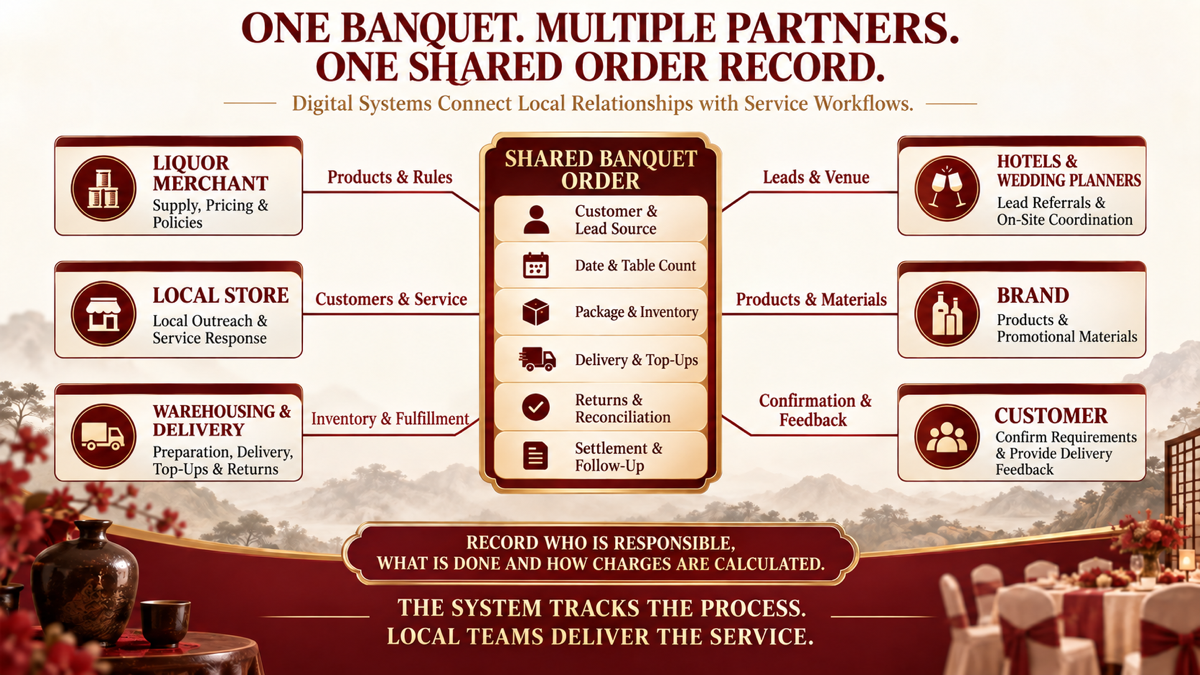
So banquet baijiu business isn't about the boss running relationships alone, or the store taking a few ad-hoc orders. It requires a full set of role coordination.
The alcohol merchant handles supply, pricing, and policies; the store handles local reach and service response; warehousing and delivery handle stocking, delivery, restocking, and returns; hotels, wedding planners, and other channels serve as lead entry points; the brand provides product and material support; and the customer ultimately cares about reliability, peace of mind, and service certainty.
The more roles involved, the greater the need for a system.
The value of a digitalization system isn't replacing offline relationships—it's unifying processes that were previously scattered across WeChat, phone calls, spreadsheets, and ledger books. Where customer leads come from, what date the banquet is, how many tables are expected, what product combination is used, whether inventory is locked, who's responsible for delivery, whether restocking is recorded, how unused products are reconciled, how channel fees are settled, and how customers are maintained afterward—all should have clear records.
The benefits are straightforward.
For managers, orders no longer rely on memory—business processes become visible. For stores, service actions are more standardized, reducing ad-hoc disputes. For warehousing and delivery, stocking and delivery become more planned. For channel partners, partnership settlements are clearer. For customers, the experience is more stable, and they're more willing to refer others.
IV. From "Delivery Platform" to "Local Alcohol Service Provider"
For local alcohol instant retail enterprises to grow through banquet baijiu, the key is turning scattered orders into planned orders, increasing average order value and service radius.
To strengthen, the key lies in authentic supply, stable fulfillment, channel coordination, and digital management—forming a local service capability that others can't easily replicate.
More importantly, banquet baijiu lets enterprises truly embed themselves in the local market. Behind every banquet lies a network of families, friends, hotels, wedding planners, and community relationships. Done well, it brings not just the current order but follow-on reputation and repurchase.
The value of alcohol instant retail shouldn't stop at "delivering fast." For local enterprises, a better direction is: use instant retail capabilities to handle daily demand, use banquet baijiu service to manage local relationships, and then use digital systems to consolidate these capabilities.
This is how an enterprise can grow from a baijiu delivery platform into a true local alcohol service provider.