
Banquet Baijiu Digitalization Solution: Turning Every Banquet into a Business Lead

I. Where Traditional Banquet Baijiu Business Usually Goes Wrong
The banquet baijiu business isn't short on market demand—the problem is that the process easily gets messy.
Incomplete customer information. Many requirements only exist in chat records: table count, budget, banquet date, hotel address, whether custom baijiu is needed. Without clear registration upfront, repeated confirmations become inevitable later.
Inconsistent pricing. Different stores and salespeople have different understandings of prices, gifts, and promotion policies. When customers compare, price disputes easily arise.
Uncontrolled follow-up. Owners don't know which customers are in negotiation, which have closed, which have dropped out, and which need urgent follow-up. When salespeople get busy, leads can easily fall through the cracks.
Opaque inventory and delivery. Banquets have fixed times. If stock runs out, the wrong items are shipped, or delivery is late, it affects not just one order—it impacts the customer's entire banquet experience.
Poor hotel coordination. When baijiu is delivered to the hotel, who signs for it? Who arranges the on-site display? What happens to unopened bottles? Without records, disputes are hard to resolve later.
Confusing final payments and profit sharing. How much deposit was collected, when is the final payment due, how are sales commissions calculated, how are hotel referral fees settled, how is store profit confirmed—if all of this is calculated manually, efficiency is low and errors are likely.
These problems ultimately boil down to: processes aren't standardized, data isn't retained, and incentives aren't systematically recorded.
II. How a Complete Digital Banquet Baijiu Process Should Work
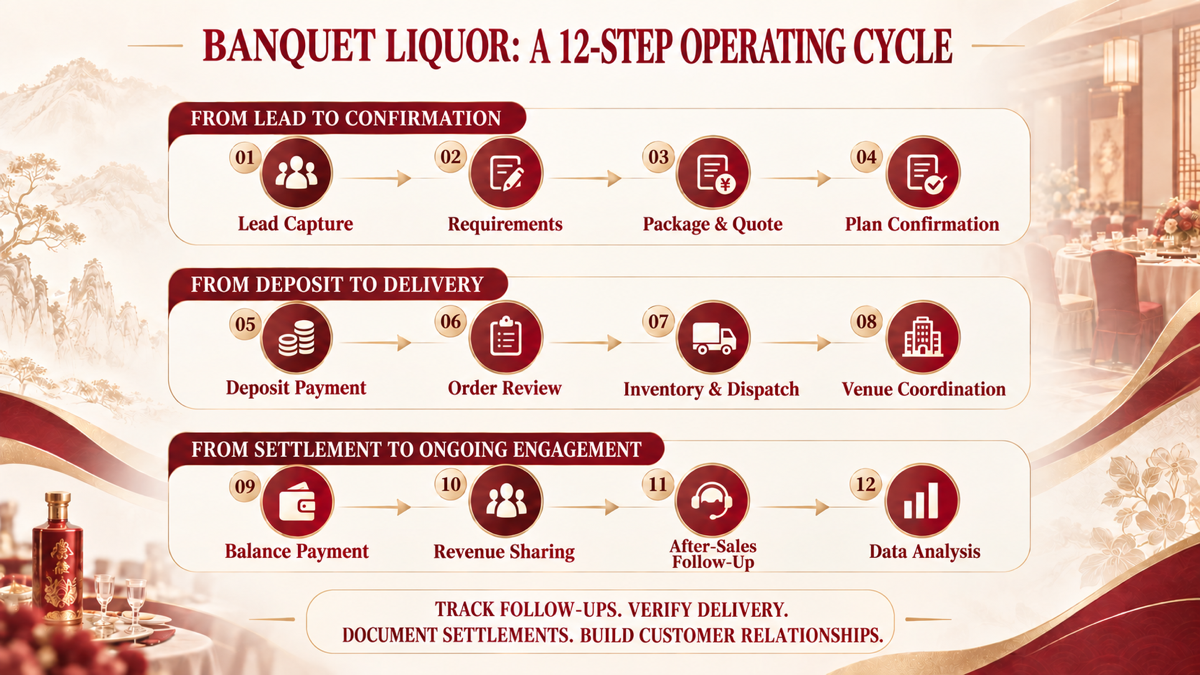
A complete banquet baijiu digitalization solution should be designed around 12 key steps.
Step 1: Customer lead intake.
Customers can come from in-store consultations, hotel partner referrals, salesperson introductions, WeChat Moments links, mini-program QR codes, or community events. The system needs to record basic information: customer name, phone, banquet type, event date, venue, table count, budget range, and whether custom baijiu is needed.
Leads enter the system first so they don't get lost in personal WeChat messages.
Step 2: Banquet demand registration.
Stores or salespeople enter detailed requirements based on the customer's situation. This includes banquet type—wedding, birthday, baby shower, housewarming, graduation, corporate entertaining—estimated baijiu quantity, per-table budget, delivery address, and whether services like custom bottle labels, gift box customization, table card materials, or unopened bottle returns are needed.
The clearer the demand registration, the fewer disputes later on.
Step 3: Package recommendation and quoting.
The system can recommend different baijiu package options based on banquet type, table count, and budget—for example, economy banquet packages, mid-to-high-end wedding packages, custom commemorative baijiu packages, or corporate entertaining packages.
Salespeople can also adjust proposals based on the customer's situation and generate quotes in the system. Quotes have records, discounts have rationale, and the customer confirms before moving forward.
Step 4: Customer confirms the proposal.
The customer confirms the baijiu selection, quantity, price, gifts, delivery method, and customization details. If custom baijiu is involved, they also upload label text, blessing messages, dates, photos, and logos.
The system should generate a customer confirmation form. After confirmation, subsequent modifications leave a trail. This protects both the customer experience and the store and sales staff.
Step 5: Deposit payment.
After the proposal is confirmed, the customer pays a deposit. This can be online payment or offline collection recorded in the system.
The order status is truly locked once the deposit arrives. The system records the payment amount, payment method, arrival time, and handler, providing the basis for subsequent review, stocking, and settlement.
Step 6: Order review.
After the store submits the order, headquarters or the platform reviews it. The review mainly checks whether pricing policies comply, whether gift ratios are reasonable, whether inventory is sufficient, whether customization materials are complete, and whether delivery information is clear.
If approved, the order enters the stocking and shipping phase. If not approved, it's sent back to the store for revision.
Step 7: Inventory and shipping management.
The warehouse locks inventory, arranges stocking, and ships out based on the order. The system records outbound quantity, shipping time, delivery method, logistics information, and sign-off status.
Different enterprises can use different delivery methods: headquarters delivers directly to the hotel, or headquarters ships to the store first, and the store delivers to the customer or hotel.
The key is that every step can be traced.
Step 8: Hotel coordination and on-site service.
Banquet baijiu ultimately lands in the hotel scenario. The hotel needs to cooperate on confirming delivery time, recipient, display location, and on-site service requirements.
On or before the banquet day, the system can record whether the baijiu was delivered, whether the hotel signed for it, whether materials were arranged, the actual quantity used, and whether unopened bottles were returned.
This step may seem trivial, but it directly affects customer satisfaction.
Step 9: Balance payment.
Before or after the banquet ends, the customer pays the balance. The system records the balance amount, arrival time, payment method, and updates the order status.
Managing deposits and balances separately keeps finances clearer and reduces accounting disputes between salespeople and stores.
Step 10: Profit sharing settlement.
After the banquet ends, the system calculates profit sharing based on preset rules—for example, store profit, salesperson commissions, hotel referral fees, platform service fees, or headquarters gross margin.
Sharing rules are configured in advance, and settlement statements are automatically generated after order completion. Who brought the customer, who completed the service, who gets how much—all backed by data.
This step is crucial. Only when incentives are clear can partnerships be stable.
Step 11: After-sales follow-up and customer retention.
The system reminds salespeople to conduct follow-up calls, recording customer satisfaction, how remaining baijiu was handled, whether there's repurchase intent, and whether the customer is willing to refer friends and family.
At the same time, customers are tagged—for example, "wedding customer," "high-budget customer," "corporate entertaining customer," "customization-demand customer," "hotel-referred customer."
These tags are the foundation for subsequent private domain operations and precision marketing.
Step 12: Data analytics.
Management dashboards can view order volume, transaction value, customer sources, store performance, salesperson conversion rates, baijiu sales, inventory consumption, banquet type distribution, repurchase rates, referral results, and profit sharing expenses.
Owners no longer judge the business by gut feeling alone. They can see through data: which channels work, which stores close deals well, which baijiu products suit banquets, and which salespeople have strong follow-up capabilities.
III. Hotel and Store Incentives Must Also Be Reflected in the System
Banquet baijiu digitalization must consider the interests of all partners.
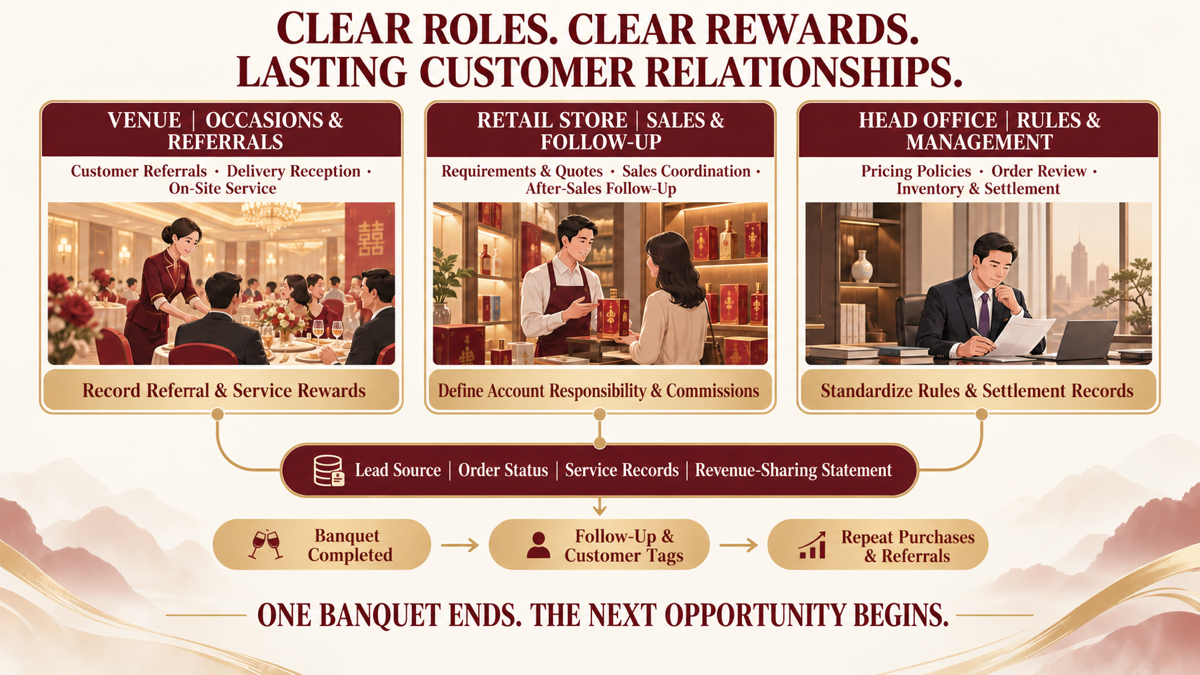
The hotel's value lies in the scenario. It holds banquet customers and can provide venue space, customer referrals, receiving assistance, on-site arrangement, and leftover baijiu feedback. The digital system can record customers referred by hotels, services they participate in, and corresponding revenue, giving partnerships a clear basis.
The tobacco & alcohol shop or store's value lies in sales and service. It handles customer reception, baijiu recommendations, quoting and closing, delivery coordination, and after-sales follow-up. The system must clarify customer ownership, order profit, salesperson commissions, and subsequent repurchase rights, to prevent customer resources from being vaguely allocated.
The value of headquarters or the platform lies in rules and management. Unified pricing policies, order review, inventory management, data tracking, product mix optimization—and coordinating all parties through the system.
Ultimately, digitalization isn't about controlling one party tightly. It's about clarifying responsibilities and benefits for everyone.
When things are clear, the business runs long-term.
IV. What Capabilities Should the Software System Have?
From a system-building perspective, a banquet baijiu digitalization solution should include at least these modules:
customer lead management, banquet demand registration, package and quote management, customization materials management, order review management, deposit and balance payment management, inventory and shipping management, hotel coordination management, on-site service records, unopened bottle returns, profit sharing settlement, after-sales follow-up, customer tagging, and data dashboards.
For business models with multiple stores, multiple salespeople, and multiple hotel partners, additional modules are needed: permission management, regional management, store management, salesperson performance, hotel partner management, and financial settlement management.
In terms of technical architecture, a mini-program can serve as the customer and business entry point, with a web backend for stores, headquarters, and finance. The backend uses a mature, stable business system architecture, with the database capturing order, customer, inventory, financial, and profit-sharing data.
For enterprises, a good system isn't just about pretty pages—it's about whether it can truly integrate into business processes.
Can it reduce missed orders?
Can it control pricing?
Can it provide inventory visibility?
Can it calculate profit sharing accurately?
Can it retain customers?
These are the questions banquet baijiu digitalization must answer.
V. Conclusion
Banquet baijiu is a scenario business, and it's also a relationship business.
A banquet ends, but the customer relationship shouldn't.
Truly valuable digitalization makes every banquet the beginning of the next business opportunity.
If you're looking to upgrade your banquet baijiu business from "manual order tracking" to "digital management," leave a comment with "BANQUET" to get the solution.