
Understanding the Eight Core Capabilities of an Alcohol Instant Retail System
An alcohol instant retail system is, at its core, a digital operating system built around store and dark store fulfillment. This article systematically breaks down eight capabilities—from mini-program order management, platform order unification, store fulfillment, inventory and replenishment, membership and marketing, fund splitting and settlement, data analytics, to enterprise WeChat SCRM—explaining what problem each solves and how it lands, helping alcohol merchants understand the complete capability map of an instant retail system.
I. Mini-Program Order Management
The mini-program is the alcohol merchant's own online store.
When a user opens the mini-program, the system can automatically match the nearest store or dark store based on the user's location. The products, prices, inventory, and delivery ranges the user sees all come from that store's actual data—not a virtual central warehouse.
This is critical for instant retail. Because what consumers care about most when placing an order is: Is there stock nearby? How soon can it arrive? Can I pick it up?
In the mini-program order scenario, the system needs to support online ordering, online payment, member pricing, coupons, gift cards, stored-value balances, and other features. For the alcohol industry, it must also support more complex product specifications, such as single bottles, full cases, gift boxes, cans, and cartons—different purchasing formats.
For example, a case of beer has 24 cans. Users can buy by the can or by the case. A baijiu product can be sold by the bottle or as a gift box. The system must automatically handle inventory conversion to avoid manual calculation errors at the store level.
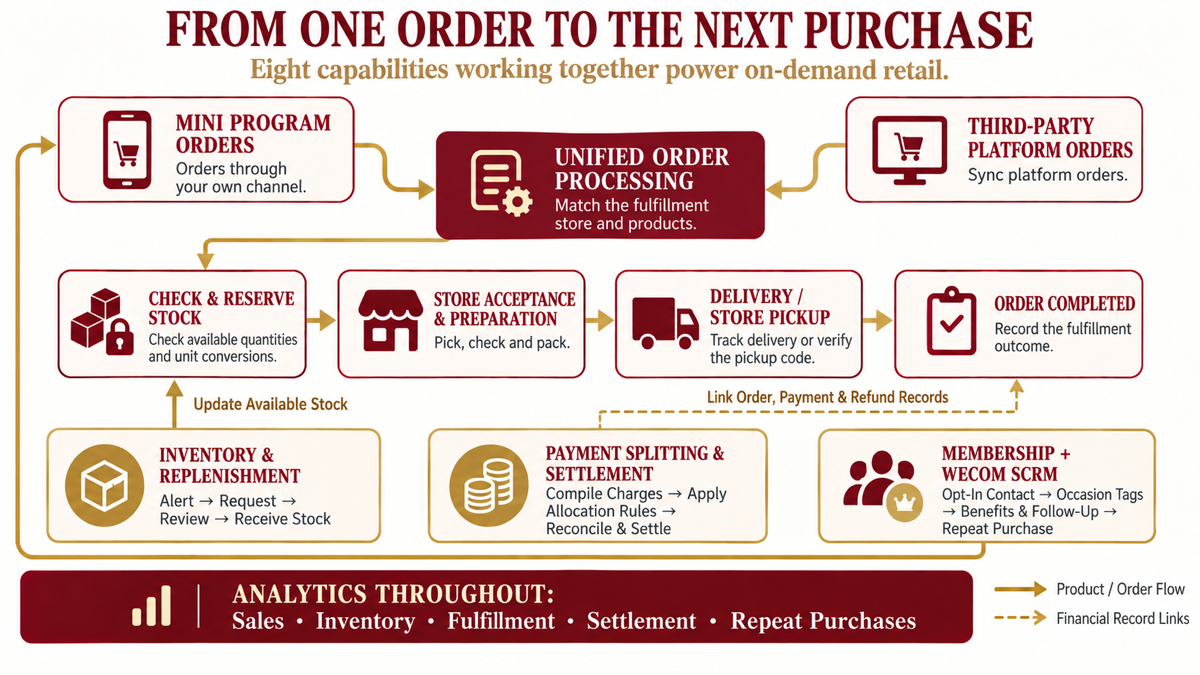
At the same time, mini-program orders must support two fulfillment methods: same-city delivery and in-store pickup. If the user chooses delivery, the system pushes the order to the store for preparation and calls a rider. If the user chooses pickup, they present a verification code at the store, and the store scans it to complete the order.
The mini-program order capability essentially solves the problem of "selling through your own channel."
II. Instant Retail Platform Order Management
Beyond the proprietary mini-program, alcohol stores also connect to third-party instant retail platforms, such as Meituan Shangou, JD Miaosong, and Taobao Instant Commerce.
These platforms bring traffic, but also new management challenges: each platform has its own rules for products, inventory, orders, after-sales, and settlement. If store staff switch between multiple platform backends daily, it's easy to miss orders, make mistakes, or oversell.
The second core capability of an alcohol instant retail system is unifying third-party platform orders into one system.
After users place orders on Meituan, JD, or Taobao Instant Commerce, the orders sync into the system and are then dispatched to the corresponding store or dark store for fulfillment. Store staff don't need to repeatedly log into multiple platform backends—they only need one store management interface to view orders, accept them, prepare goods, and handle delivery.
There's also a critical capability here: product and inventory mapping.
The same bottle of baijiu might be called Product A in your own system, have a different product ID on Meituan, and yet another on JD. The system must establish the correspondence between platform products and local products to ensure that when third-party orders come in, store inventory is accurately deducted.
The instant retail platform order capability solves the problem of "unified multi-platform order management."
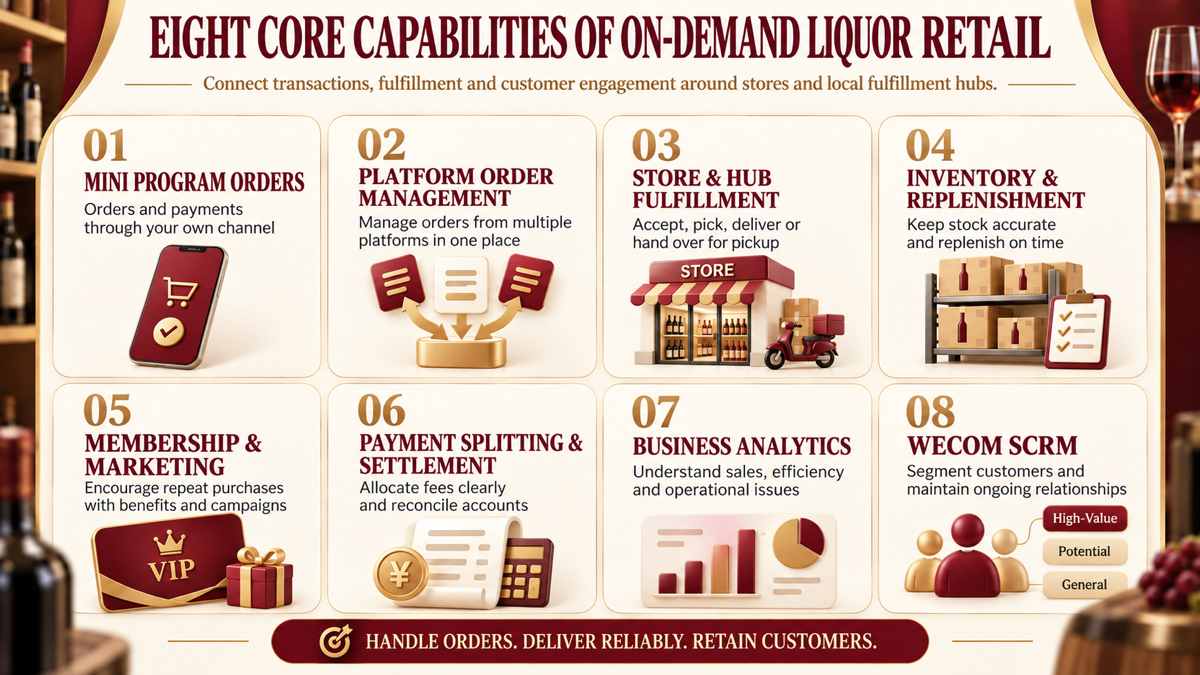
III. Store / Dark Store Fulfillment
The core of instant retail isn't just online ordering—it's fast fulfillment.
After a consumer places an order, the actual service is completed by the store or dark store. The store needs to accept the order, prepare the goods, hand them to a rider, or complete pickup verification. If the fulfillment process isn't smooth, even the best traffic turns into negative reviews and refunds.
So, the alcohol instant retail system must provide stores with a simple, easy-to-use management interface.
Store staff can use their phones to view pending delivery orders, pending pickup orders, pending shipment orders, and after-sales orders. They can also manage product listing and delisting, adjust inventory, submit replenishment requests, and view order settlement details.
For delivery orders, after the store accepts and prepares the goods, the system can connect to same-city rider platforms, such as Meituan Delivery, Hummingbird Delivery, SF Same-City, and Dada Delivery. When the rider arrives at the store to pick up the goods, the order status updates in sync, and both consumers and the platform can see delivery progress.
For pickup orders, the user presents a verification code at the store, and the store scans it to complete the order.
For group-buy vouchers and cash vouchers, the store can also verify, deduct, and record them through the system, forming complete consumption data.
The fulfillment capability solves the problem of "how to efficiently complete orders once they arrive."
IV. Inventory Management and Replenishment
In an alcohol instant retail system, inventory is one of the most important foundational capabilities.
Because instant retail doesn't sell based on "does the central warehouse have stock"—it sells based on "does this store near the user have stock right now."
The system must support inventory management by store and by dark store. Each store has its own actual inventory, sellable inventory, locked inventory, alert-level inventory, and in-transit inventory.
For example, after a user places an order, inventory can't wait until the order is completed to be deducted—it must be locked first, to prevent the same bottle from being sold simultaneously across multiple channels. After an order is cancelled or refunded, inventory must also be released according to rules.
Alcohol products have another special characteristic: complex specifications.
Baijiu may be sold by bottle, box, or case. Beer and beverages may be sold by can, bottle, or case. Conversion relationships exist between different packaging formats. The system must support multi-unit conversion across cases, boxes, bottles, and cans, so stores can manage by actual business needs.
Additionally, stores need replenishment capability.
When inventory drops below the alert threshold, the system can remind the store to submit a replenishment request. After the store submits the request, the platform or central warehouse reviews it, arranges shipment, and inventory automatically updates upon the store's receipt.
The inventory management and replenishment capability solves the problem of "having stock to sell, accurate inventory, and timely replenishment."
V. Membership and Marketing Management
The alcohol business is well-suited for membership operations.
A user who buys beer today might buy again in a few days. A user who buys gift baijiu for Mid-Autumn Festival might also buy for Spring Festival. A corporate client with long-term procurement needs all the more requires ongoing maintenance.
So, the alcohol instant retail system can't just do one-time transactions—it needs membership and marketing capabilities.
The membership center can record user phone numbers, order history, spending amounts, frequently purchased categories, membership tiers, points, balances, gift cards, and coupons.
Marketing tools can support newcomer coupons, spend-and-save coupons, member pricing, top-up bonuses, gift cards, points redemption, flash sales, group buys, and other tactics.
But for alcohol stores, the most important thing isn't making campaigns complex—it's making them genuinely serve repurchase.
For example, users who frequently buy beer can receive late-night-snack-scenario promotions. Users who buy premium baijiu can receive gifting proposals before holidays. Long-inactive regulars can receive exclusive re-engagement coupons.
The membership and marketing capability solves the problem of "making users buy again after their first purchase."
VI. Fund Splitting and Settlement
When the system involves platforms, stores, franchisees, third-party platforms, rider delivery, and marketing campaigns, fund settlement becomes complex.
After a consumer pays, where does the money go first?
How much commission does the platform take?
How much should the store be settled?
Who bears the delivery cost?
Who bears the coupon cost?
How are refunds processed?
When can the store see settlement details?
If these questions are handled by manual reconciliation, errors easily occur, and trust between the platform and stores is affected.
The alcohol instant retail system needs to support unified collection, automatic fund splitting, store settlement, channel reconciliation, and original-path refunds.
For example, after a mini-program order is completed, the system can, according to splitting rules, clearly separate platform service fees, store product payments, and delivery-related costs. The store can view its pending settlement amount, settled amount, and order details.
If an order is refunded, the system must also process it along the original payment path, ensuring clear accounts and traceable processes.
The fund splitting and settlement capability solves the problem of "where the money comes from, who it goes to, and how to reconcile it clearly."
VII. Data Analytics and Business Intelligence
The system doesn't just process orders—it also accumulates data.
For stores, the biggest concerns are: How much did we sell today? Which products are selling well? What inventory is running low? Which orders haven't been processed yet? When will the platform settle?
For the platform, the focus is on global business data, such as total GMV, order count, average order value, repurchase rate, store rankings, product rankings, channel sales share, fulfillment timeliness, inventory turnover, and campaign effectiveness.
The alcohol instant retail system must present this data in clear dashboards.
With data, stores can know which products to stock more of and which are selling slowly. The platform can know which store has high fulfillment efficiency, which channel brings higher-quality orders, and which campaign genuinely drove repurchase.
The data analytics capability solves the problem of "moving from gut-feel management to data-driven management."
VIII. Enterprise WeChat SCRM
Alcohol retail shouldn't stop at platform orders alone.
If users only place orders on third-party platforms every time, it's hard for stores to build long-term customer relationships. Therefore, alcohol enterprises need to gradually capture users into their own private domain system.
Enterprise WeChat SCRM capability helps stores capture and retain customer relationships.
The system can automatically tag users based on purchase behavior, such as baijiu customer, beer customer, wine customer, gifting customer, high-spend customer, corporate procurement customer, or dormant customer.
Store associates can follow up based on tags, such as reminding about gift baijiu purchases before holidays, re-engaging long-inactive regulars, or regularly maintaining corporate clients.
Enterprise WeChat isn't just about adding friends—it must integrate with orders, membership, tags, coupons, and repurchase reminders to form a sustainable private-domain operations capability.
The Enterprise WeChat SCRM capability solves the problem of "turning one-time orders into long-term customer relationships."
An alcohol instant retail system is, at its core, a digital operating system built around store and dark store fulfillment.