
Custom Baijiu System Solution: Making Every Custom Bottle Clearer from the Moment of Order
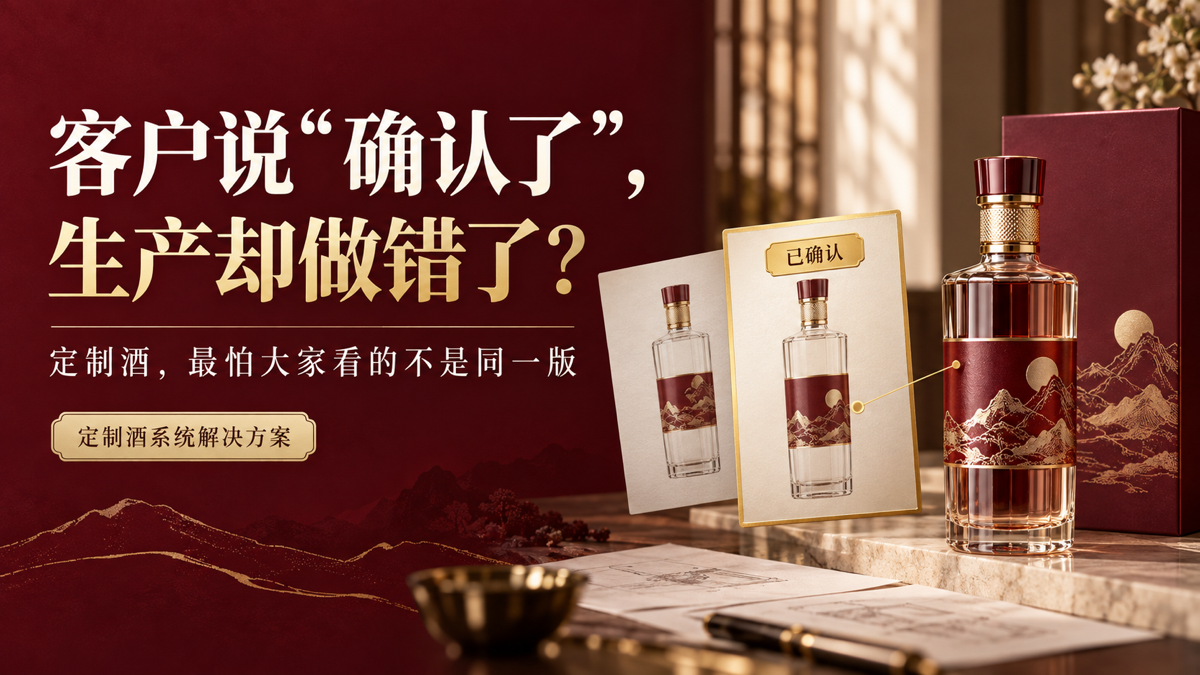
Custom baijiu sells more than alcohol—it sells exclusivity and ceremony. But the more personalized the product, the more complex the process: ordering, review, design confirmation, production tracking, and logistics delivery form a long chain with many roles and much information. This article breaks down how a custom baijiu system digitizes the entire workflow—from requirement submission through design confirmation, review routing, production management to logistics delivery—into a clear, controllable, and trackable closed loop.
Custom baijiu isn't just selling alcohol.
It sells a sense of exclusivity, a sense of ceremony, and a memorable experience. Birthday banquets, wedding banquets, corporate annual meetings, business gifting, family commemorations, old friends reuniting—often, the customer isn't buying a case of ordinary baijiu. They're buying a product "carrying a name, a design, a blessing, and a story."
But the more personalized, the more complex the process becomes.
The person ordering needs to select the baijiu type, specifications, quantity, packaging, label content, and custom graphics. The reviewer needs to confirm whether the information is complete, whether the content is compliant, and whether the proposal is production-ready. The backend needs to track order status, production progress, shipping information, and after-sales communication.
Without a system to support it, the entire process easily devolves into repeated communication, screenshot confirmations, manual data entry, and spreadsheet routing.
It looks doable. But it's inefficient, error-prone, and hard to trace.
So, the value of a custom baijiu system isn't just "online ordering." More importantly, it transforms the entire journey—requirement submission, design confirmation, review routing, production tracking, and logistics delivery—into a clear, controllable, trackable digital workflow.
I. Let the Person Ordering Define Their Own Requirements Clearly
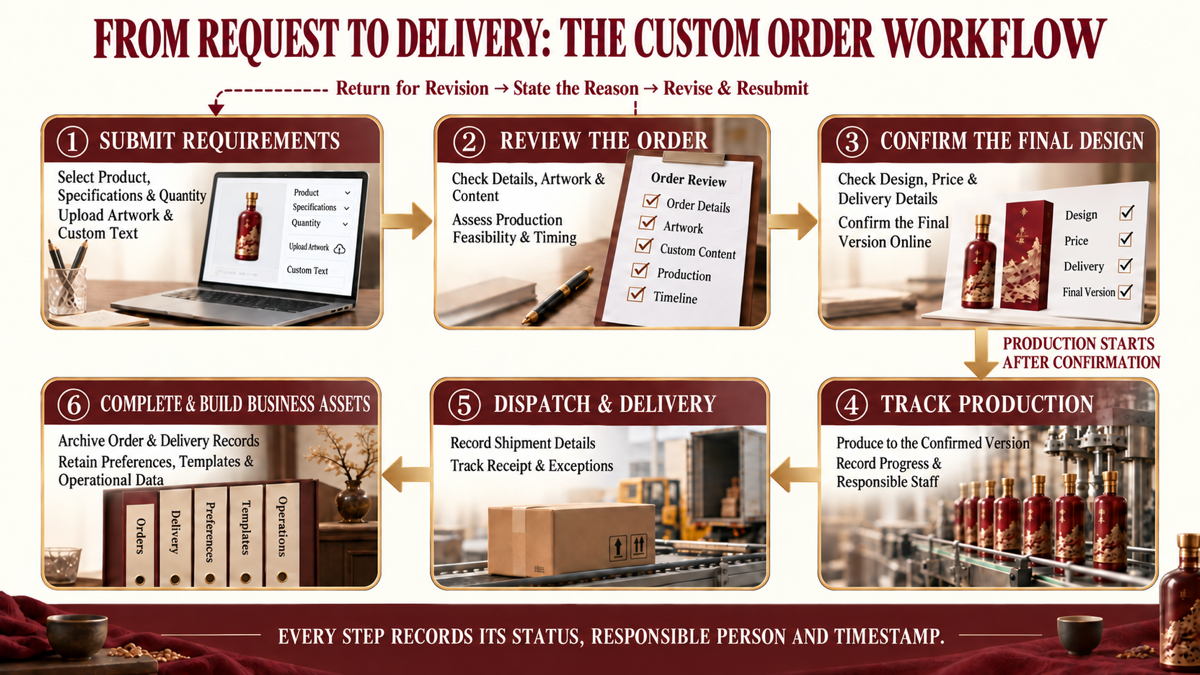
The first step of a custom baijiu system is enabling the person ordering to place orders independently.
This differs from traditional sales communication.
In the past, a client might send a WeChat message: "I want to order a batch of corporate baijiu with our company logo on the bottle." Then, the salesperson would ask repeatedly: What baijiu? How many bottles? What specifications? When do you need it? Do you have the logo file? What should the label text say? Do you need custom packaging? Where's the delivery address?
Questions go back and forth, and things get missed.
Systematized ordering turns these questions into forms and workflows in advance.
After entering the system, the person ordering can follow steps to select the baijiu type, capacity, quantity, packaging type, customization placement, upload images or logos, fill in blessing text or corporate information, and submit the delivery address and contact details.
Every field has clear requirements. What can be selected, let the user select. What must be filled, set as required. Where errors are likely, add prompt instructions.
The benefit is direct: the person ordering knows what to submit, and the reviewer gets relatively complete information in one pass.
When the process is clear, communication costs naturally drop.
II. The Reviewer Guards Quality Instead of Chasing Missing Information
Custom baijiu isn't an ordinary standardized product.
It involves content review, design confirmation, production feasibility assessment, and delivery risk control. So after an order is placed, it can't go straight to production—a reviewer must step in.
This reviewer could be store staff, a salesperson, customer service, operations staff, or even a dedicated order-review team within the company.
The system doesn't need to fixate on their job title—it only needs to define their responsibility: review orders.
The reviewer primarily checks several things.
First, information completeness. For example, whether the baijiu type, quantity, specifications, delivery information, and custom content are all present.
Second, material usability. For example, whether images are clear, whether the logo format meets design requirements, and whether the text contains typos.
Third, content compliance. For example, whether the custom text involves violations, infringement, exaggerated claims, or content unsuitable for printing.
Fourth, production feasibility. For example, whether special packaging, special processes, and delivery timelines can be met.
If the review passes, the order moves to the next step. If not, the system returns it to the person ordering for revision, with the reason noted. This eliminates the need to scroll through WeChat chat histories or rely on memory to determine what was changed and when.
Every return, revision, and approval is recorded in the system.
This is the value of a digital workflow: not making people do less, but making each person do only what they should do.
III. Design Confirmation: The Critical Checkpoint in the Custom Baijiu Process
What's the biggest fear in custom baijiu?
Not that customers have too many demands, but that they don't confirm clearly.
For example, a client says "make the logo bigger," but never confirms the final version. A client says "the text is fine," but after production, a typo is found. A client saw the mock-up but left no clear confirmation record.
These all lead to downstream disputes.
So, the custom baijiu system must include a "design confirmation" step.
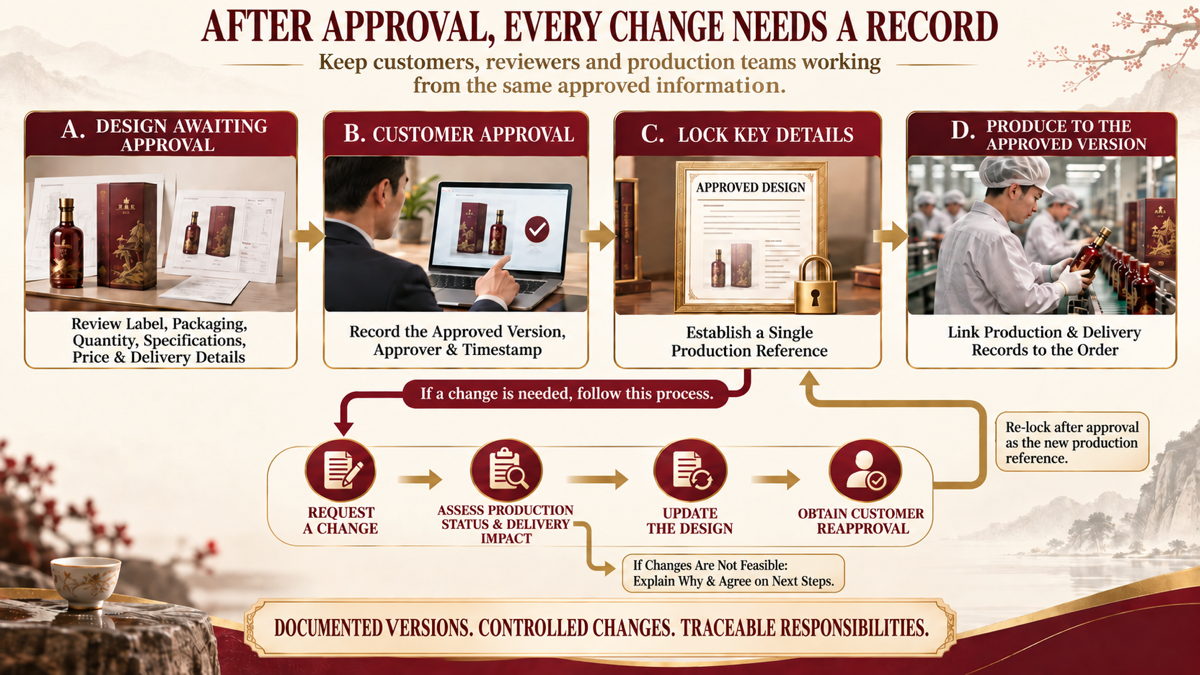
The reviewer generates or uploads the custom design proposal based on the submitted information. The person ordering reviews the proposal online, including bottle appearance, label content, packaging style, quantity, specifications, price, and delivery information.
Once confirmed as correct, the person ordering confirms online.
Upon confirmation, the system locks the key information. If modifications are needed later, they can't be changed casually—they must go through a re-confirmation or change process.
This action seems simple but is critically important. It defines the boundary of responsibility.
The person ordering confirms the final design. The reviewer advances production based on the confirmed proposal. The backend manages delivery based on order status. Everyone works from the same confirmed set of materials.
This dramatically reduces "unclear," "can't find," and "wasn't confirmed" problems.
IV. The Backend Manages the Entire Workflow, Not Just an Order List
Many systems only solve the "can place orders" problem, but don't truly solve the "can manage" problem.
The backend of a custom baijiu system can't just be an order list. It should be the management center for the entire business process.
The backend needs to show orders across different statuses: submitted, pending review, returned for revision, pending confirmation, confirmed, in production, pending shipment, shipped, completed.
Each status must correspond to a clear operator and timestamp.
Who submitted the order?
Who approved it?
When was the design confirmed?
When did it enter production?
Who entered the tracking number?
When did the customer sign for delivery?
If all this information lives in the system, it won't turn into fragmented communication.
The backend can also filter orders by status. For example, view all "pending review" orders to prevent backlog; view all "pending shipment" orders to prompt timely processing; view all "abnormal orders" to focus on resolving issues.
This way, managers track progress through the system, not by asking people.
This is the shift from "people watching people" to "systems managing processes."
V. Logistics and Delivery Must Be Part of the System Loop
Custom baijiu delivery isn't just about shipping goods out.
Because it's a personalized product, sending the wrong item, missing items, or delaying shipment has a bigger impact than with ordinary goods.
So, the logistics step can't stay outside the system.
When an order completes production, the system enters the pending-shipment state. Relevant personnel enter the logistics company, tracking number, and shipping time. The person ordering can check the shipping status, and the backend can follow up in sync.
If there are split shipments, special delivery, or in-store pickup scenarios, the corresponding workflows can also be configured in the system.
The key isn't that the process must be complex—it's that every delivery method must have a record.
When the order was shipped, to where, who handled it, and whether there are exceptions—all should be clear.
The goal of a custom baijiu system is to turn "delivery" into a trackable outcome, not just a statement that "it's been arranged."
VI. The Core of Digitalization Is Reducing Uncertainty
The difficulty of custom baijiu business isn't that any single action is hard—it's that the chain is long, the roles are many, and the information is voluminous.
The person ordering submits requirements. The reviewer checks content. The design proposal needs confirmation. The backend manages order status. Production and logistics need continued tracking.
Any unclear information at any step can affect downstream delivery.
What a digital system solves is exactly these uncertainties.
Uncertain requirements? Collect them with standardized forms.
Uncertain responsibilities? Define them with role-based permissions.
Uncertain progress? Track it with order status workflows.
Uncertain design? Lock it with online confirmation.
Uncertain delivery? Close the loop with logistics information.
When every step is recorded by the system, the business no longer depends on someone's memory or scattered chat history fragments.
For the company, this means improved efficiency. For the customer, this means improved experience. For the manager, this means reduced risk.
VII. A Good Custom Baijiu System Ultimately Accumulates Business Assets
A custom baijiu system doesn't just process orders. The longer it's used, the greater the value it accumulates.
The system can capture customer preferences: which baijiu types are more popular, which packaging options are more frequently chosen, which scenarios drive higher order frequency.
The system can capture operational data: which time periods concentrate orders, how long review takes on average, what the production-to-delivery cycle is, which steps are most prone to returns and revisions.
The system can also capture content assets: commonly used templates, popular blessing texts, corporate custom proposals, festival-themed editions, wedding banquet editions, and business gifting editions.
This data and these templates can feed back into improving conversion efficiency.
For example, after entering the system, the person ordering can directly select scenario templates like "corporate annual meeting baijiu," "wedding favor," "birthday commemoration baijiu," or "business gifting baijiu," then fine-tune from the template baseline.
This makes ordering easier for the customer. And it makes closing deals smoother for the company.
Which step do you think is most prone to problems in a custom baijiu system?
Is it incomplete ordering information, unclear design confirmation, or unmanageable backend progress?
Feel free to leave a comment below, and let's discuss how to make the custom baijiu digital workflow smoother.