
Alcohol Instant Retail: Public-to-Private Domain Growth—Acquire New Customers in Public Domains, Drive Repurchase in Private Domains
Introduction
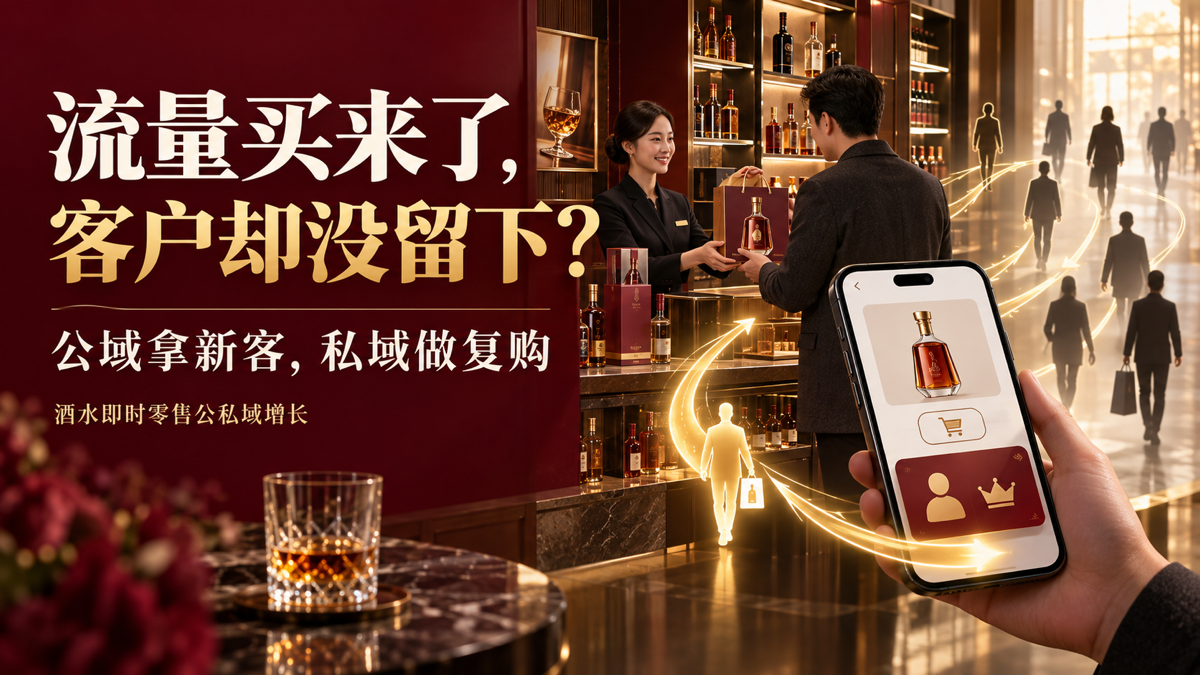
Alcohol sales growth can't rely on waiting for customers to walk in.
In the past, stores sat on the street—regulars came, there was business. Regulars didn't come, you watched the weather, the holidays, your luck. That method worked before, and it's not entirely useless now. But relying on it alone is no longer enough.
Why?
Because users have changed. A gathering runs low—baijiu needs replenishing now. A business banquet needs extra bottles—they must arrive now. A festival gift—users want to order online. Home stocking—someone still needs to deliver. Users aren't stopping their baijiu purchases; their purchase paths have shifted.
Alcohol merchants must adapt by organizing both public and private domains.
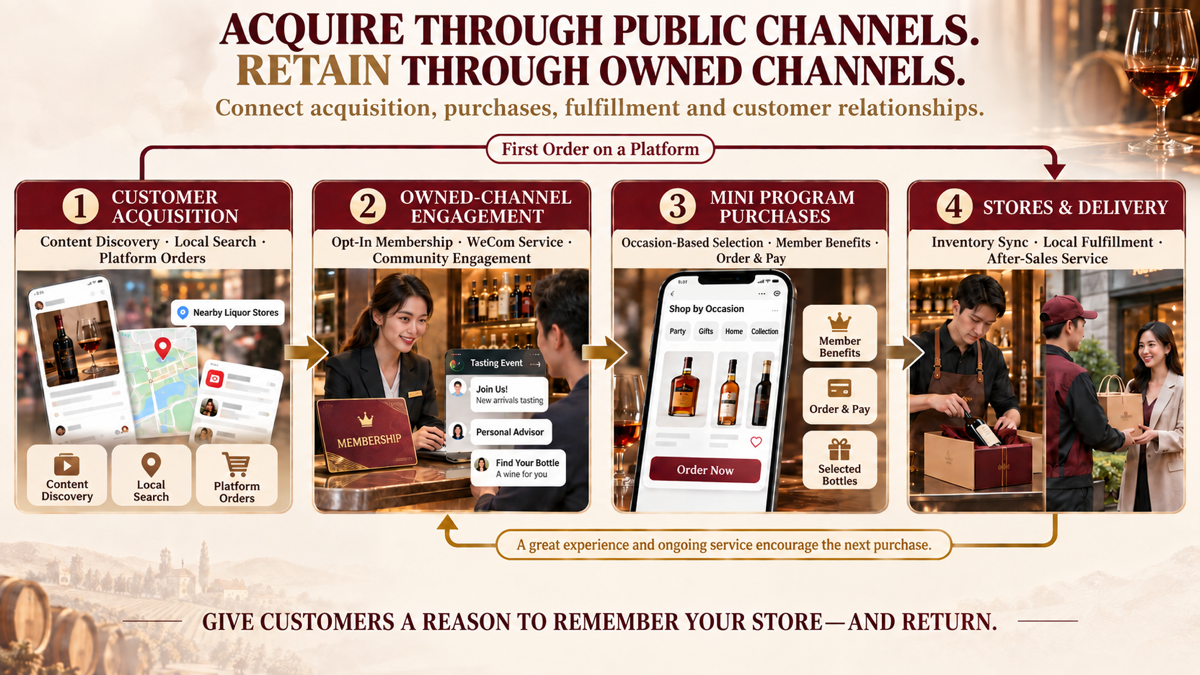
Public domains solve where new customers come from. Private domains solve why users buy again. Mini-programs solve where transactions happen. Stores and delivery solve whether it can reach the customer.
Do these separately, and your efforts scatter. Do them together, and your business has a system.
I. Public Domains Aren't About Buzz—They're Customer Entry Points
What are public domains?
Meituan, Ele.me, JD Miaosong, Douyin, Xiaohongshu, WeChat Channels, map searches, and local life platforms—these are all public domains. Users browse content there, search for stores, find nearby alcohol, compare prices, and place instant orders.
Alcohol stores, alcohol chains, regional distributors, and same-city delivery companies cannot overlook these entry points.
But doing public domains well isn't just about posting ads.
Many alcohol merchants start by posting: "Name-brand specials!" "Storewide discounts!" "Welcome!" This content is too flat—users see it and take no action. Alcohol consumption isn't only about price; it has scenarios.
Content must be built around scenarios.
Friends gathering? Talk about "what to do when the baijiu runs out."
Business banquet? Talk about "how to choose baijiu for clients."
Festival gifting? Talk about "how to choose for elders vs. clients."
Home stocking? Talk about "pairing everyday drinking with guest hosting."
Traveling for work? Talk about "delivering baijiu to your hotel."
Users don't first decide which bottle to buy—they first encounter a problem. Whoever articulates the problem clearly is more likely to win the order.
The first principle of public-domain operations: capture instant demand. Don't sell baijiu generically—appear at the moment the user needs it.
II. Customers from Public Domains Must Not Buy Once and Disappear
Public-domain traffic is expensive, and platform users aren't your users.
Today a user places an order on a platform; tomorrow they might go elsewhere. The reason is simple: they remember the platform, not necessarily your store.
So, when public-domain orders arrive, there must be capture actions.
Delivery orders: include a mini-program card, membership coupon, or repurchase voucher with the order.
In-store visits: guide users to scan and join membership, claiming first-order gifts, birthday gifts, or member pricing.
Livestream sales: guide users to follow the official account, join community groups, and claim next-purchase vouchers.
After delivery completion: guide users to review, join groups, and claim replenishment coupons.
Corporate group-buy clients: use enterprise WeChat to retain them, tagging them with labels like banqueting, gifting, or corporate procurement.
One key point: don't just say "add me on WeChat."
Why should a user add you? Give them a reason.
The reason could be authentic-baijiu guarantees, nearby fast delivery, member pricing, festival reminders, or personalized baijiu recommendations. In short, make the user understand that staying in your private domain benefits them.
Private domain isn't about fencing users in—it's about making sure that next time they want baijiu, they think of you first.
III. Private-Domain Operations Can't Just Broadcast—Segment by Audience and Scenario
Many community groups fail not because users don't buy baijiu, but because operations are too crude.
Posting posters in the group every day—baijiu today, wine tomorrow, beer the day after. Everyone sees the same thing. Over time, users go silent or even leave the group.
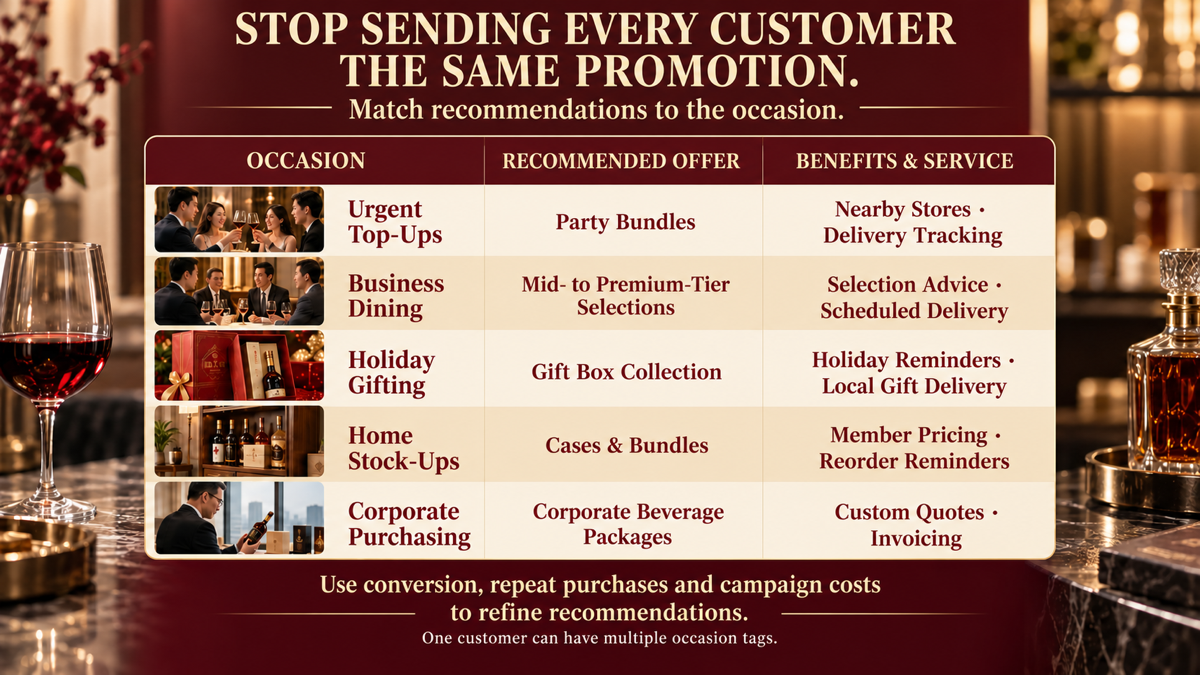
Alcohol private domains need scenario-based segmentation.
Instant-replenishment users: push nearby stores, fast delivery, and party bundles.
Banqueting users: push mid-to-high-end baijiu, wine, and full-case combinations.
Gifting users: push gift boxes, festival zones, and same-city gifting.
Home-stocking users: push member pricing, case pricing, and combo purchases.
Corporate clients: push exclusive quotes, invoicing, long-term procurement, and festival benefits.
The same person may have different scenarios across contexts: casual home drinking on weekdays, festival gifting, annual procurement, and party replenishment. What operations must do is view users within specific scenarios.
Don't treat all users as one user. Don't treat all campaigns as one campaign. Don't sell all baijiu with one script.
This is the foundation of private-domain repurchase.
IV. The Mini-Program Must Be a Transaction Center, Not a Display Page
The official account handles content. Community groups handle reach. Enterprise WeChat handles relationships. The mini-program handles transactions.
This division of labor must be clear.
Many alcohol merchants built mini-programs but merely placed products on display. Users open it and see something no different from an ordinary shelf. No nearby stores, no instant delivery, no membership benefits, no coupons, no repurchase reminders. Such a mini-program can't serve as a transaction center.
An alcohol instant retail mini-program must at minimum solve these problems.
Can users quickly find products?
Can they see nearby stores?
Can they choose delivery or pickup?
Can they pay online?
Is inventory accurate?
Can coupons be applied?
Are member prices visible?
Can order status be tracked?
These questions seem trivial, but each is a transaction step.
Users buying baijiu, especially on impulse, have limited patience. One extra moment of hesitation means one less conversion. The mini-program must be clear, direct, and easy to order from.
Whether private-domain operations ultimately convert to sales depends on whether the mini-program can capture demand.
V. Campaigns Must Serve Four Goals: Acquisition, Conversion, Repurchase, Referral
More campaigns isn't better.
Goal-less campaigns only drain profit. Flash discounts today, flash sales tomorrow, markdowns the day after—it looks lively, but users only remember "cheap," not your store.
Campaigns must serve four purposes.
Acquisition: Use newcomer gift packs, first-order coupons, free tastings, and join-group gifts. Get users to complete that first order. Once the first order is done, repurchase becomes possible.
Conversion: Use flash sales, half-off second bottles, spend-and-save coupons, party bundles, and banquet recommendations. Users already have interest—push them to decide.
Repurchase: Use member days, birthday gifts, festival reminders, monthly stocking coupons, and exclusive regular-customer pricing. Build fixed purchasing habits.
Referral: Use share-to-earn rewards, bring-a-friend coupons, community group buys, and corporate referral incentives. Let old users bring new ones; let personal relationships drive word-of-mouth.
The alcohol industry has one advantage: many consumption scenarios. Gatherings, banquets, gifting, stocking, replenishment, corporate benefits—all can be designed into campaigns. But each campaign must serve one purpose.
Don't do campaigns for campaigns' sake. Do campaigns for orders, repurchase, and user retention.
VI. Stores and Delivery Are the Foundation of Public-Private Domain Operations
No matter how good the public-private domain operations are, if fulfillment fails, everything degrades.
A user orders in a community group, but the store is out of stock. A platform promises fast delivery, but it takes over an hour. A festival gift arrives with poor packaging. No one handles after-sales. These experiences only drive users away.
The alcohol industry depends especially on trust.
The baijiu must be authentic, prices must be transparent, delivery must be reliable, and service must be handled. One bad first experience, and no amount of marketing can make up for it.
So, stores and delivery must keep up.
Stores must sync inventory in real time.
Stock up before holidays.
Monitor bestsellers closely.
Same-city delivery must have trackable routes.
Prepare multiple delivery capacities for peak periods.
Banquet and gifting orders require attention to packaging and timing.
Private domain isn't operated purely online. The real private-domain relationship is formed from the moment of ordering, to the moment the user receives the baijiu, to the next repurchase—the sum of all experiences combined.
VII. Different Businesses Need Different Playbooks
Alcohol stores: Focus on the surrounding 3–5 km radius. Store owners know local users—connect regulars, nearby users, and community-group users. Instant delivery, member pricing, and festival reminders are the priorities.
Alcohol chains: Focus on unified headquarters operations with store-level fulfillment. Headquarters handles products, pricing, campaigns, membership systems, and data analysis; stores handle local customers, community maintenance, order fulfillment, and after-sales service.
Regional distributors: Can't stop at supplying goods. With stock and channels in hand, they must also build consumer-facing operational capabilities. They can integrate partner stores, group-buy clients, and local delivery to transform from supplier to local alcohol service provider.
Same-city alcohol delivery companies: Focus on building a reputation for "fast" and "reliable." Nighttime replenishment, party emergencies, hotel delivery, and temporary business use are all high-frequency scenarios. Speed matters, but so must service quality be controllable.
Different businesses have different conditions, but the direction is the same: organize users, products, stores, delivery, and membership into one system.
VIII. Implementation in Six Steps
Step 1: Build entry points. Set up mini-programs, official accounts, enterprise WeChat, and community groups so users have a place to browse, buy, and stay.
Step 2: Direct traffic. Channel platform orders, store foot traffic, livestream users, group-buy clients, and delivery users into the private domain.
Step 3: Tag and segment. Distinguish user scenarios: instant replenishment, banqueting, gifting, home stocking, corporate procurement.
Step 4: Match campaigns. New customers get acquisition campaigns; regulars get loyalty benefits; high-spend users get premium service.
Step 5: Strengthen fulfillment. Inventory must be accurate, dispatch must be fast, delivery must be stable, and after-sales must be followed up.
Step 6: Watch the data. Track new users, order conversion, repurchase rate, average order value, delivery timeliness, and campaign cost. Whichever step is weak, fix that step.
Growth isn't achieved by shouting—it's built by connecting one link at a time.
Public domains acquire new customers; private domains drive repurchase. Mini-programs handle transactions; stores handle service; same-city delivery handles experience. Succeeding in alcohol instant retail doesn't depend on any single tool—it depends on a set of operating methods that can keep running.
If you're running alcohol stores, alcohol chains, regional distribution, or same-city alcohol delivery, and you're thinking about how to connect public and private domains, feel free to leave a comment below.