
Alcohol Instant Retail Solution: From Mini-Program Ordering to Same-City Delivery, Helping Alcohol Merchants Connect Sales, Fulfillment, and Repurchase Loops
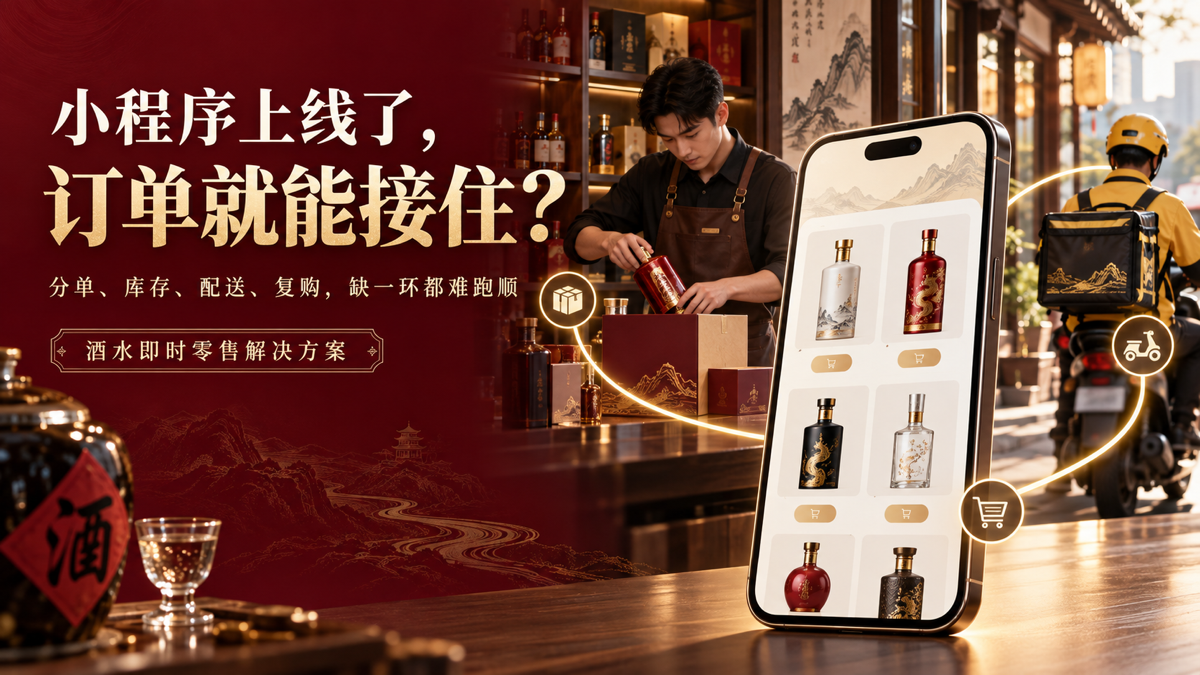
Alcohol instant retail isn't just a delivery problem—it's a system problem spanning online customer acquisition, store fulfillment, inventory coordination, same-city delivery, and member repurchase. This article breaks down six dimensions—entry, order dispatch, inventory, delivery, operations, and scenarios—to show how alcohol merchants can connect sales, fulfillment, and repurchase into a closed loop.
Where is the inventory?
Where are the customers?
Where do orders come from?
Who handles delivery?
After a user buys once, will they buy again?
Until these questions are answered, so-called instant retail remains nothing more than a slogan.
I. The New Demand: Users Don't Just Want "Alcohol for Sale"—They Want It Buyable Now, Delivered Now
Today's consumers aren't who they used to be. In the past, buying baijiu was mostly planned in advance. Not anymore. Friends gather, and the baijiu runs out—it needs replenishing now. A business banquet needs extra bottles—they need to arrive now. A festival gift is time-sensitive—it needs to reach the door. A quiet night at home, no desire to go out—someone still needs to deliver.
This is the new demand.
What users want isn't "alcohol for sale." It's "buyable now, delivered now, trackable in process, reliable in service."
So, alcohol instant retail isn't just a delivery problem. It's a system problem—from online acquisition, to store fulfillment, to inventory coordination, to same-city delivery, to member repurchase.
II. Online Entry: No Entry Point, No Orders
Alcohol merchants used to rely on natural store foot traffic. People walk in, there's business. People don't walk in, the store waits. Waiting for customers is the old method of traditional retail. It's not entirely useless, but it's no longer sufficient.
The first thing instant retail must do is put the store inside the user's phone.
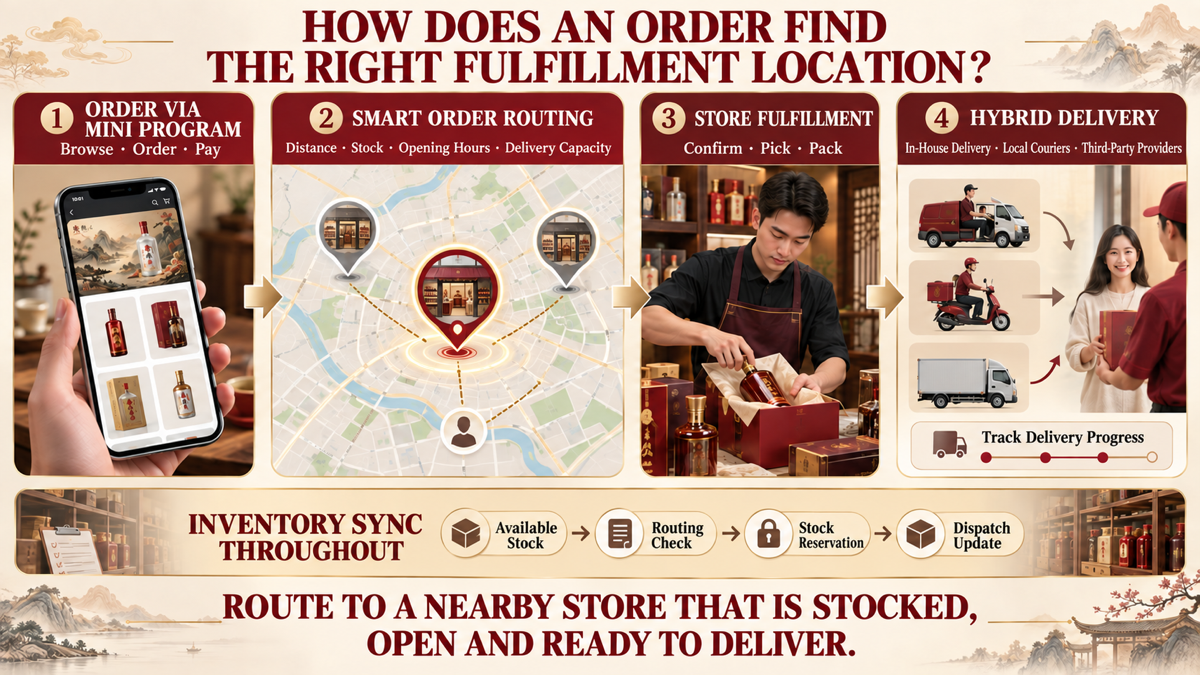
Mini-programs, official accounts, community groups, livestreams, and terminal stores can all serve as user touchpoints. Users see products, browse directly, place orders, and pay. Orders enter the platform, which manages them centrally while stores handle fulfillment.
This solves two problems.
First, the store's service radius expands. In the past, it served only those who walked in nearby. Now it can serve anyone with instant demand in the surrounding area.
Second, users are captured as assets. In the past, users bought and left—the store didn't know who they were. Now, through mini-program orders, user identity, order history, product preferences, and behavior data are all retained.
With an entry point, operations begin. With data, repurchase follows. With a system, growth happens.
III. Smart Order Dispatch: Orders Automatically Find the Right Fulfillment Point
When orders arrive, manual assignment is slow. Slow means users leave.
The key to instant retail is nearest-point fulfillment. Whoever is closest to the user, has stock, and can deliver gets the order.
The system uses LBS (location-based service) positioning to identify the user's location and automatically match the nearest store or dark store. Users can also switch stores themselves, choosing pickup or delivery.
This sounds simple, but it's actually critical.
Without smart dispatch, headquarters must judge, customer service must communicate, and the store must confirm. An order bounces around, and time gets consumed. The worst thing instant retail can do is turn "instant" into "waiting."
Smart order dispatch solves exactly this—letting orders automatically find the right fulfillment point.
Nearest stores get priority.
Stores with stock get priority.
Stores currently open get priority.
Stores with delivery capability get priority.
This way, orders don't bounce around, stores don't fight for orders, and users wait less.
IV. Inventory Coordination: Inventory Must Participate in Sales, Dispatch, and Fulfillment
Alcohol merchants often don't lack stock—they just don't know where it is.
Headquarters has stock, stores have stock, warehouses have stock. But when selling online: is the inventory accurate? After a store accepts an order, is the stock still there? When a hot item sells out, can it be replenished in time? If these problems aren't solved, more orders just mean more trouble.
So, the instant retail system must connect products, inventory, orders, and procurement.
Headquarters can centrally manage products, setting prices, promotions, and delivery ranges. Stores can manage their own inventory, process orders, handle pickup verification, and execute same-city delivery. The platform can also arrange advance stocking and procurement requests based on sales patterns.
Alcohol product structures are complex. There are single bottles and full cases; gift boxes and combo packs; premium baijiu and everyday beer and beverages. Different scenarios call for different selling approaches. Without unified inventory management, online sales easily go wrong.
Inventory isn't a spreadsheet sitting in the backend for reference. Inventory must participate in sales. Inventory must participate in dispatch. Inventory must participate in fulfillment.
Visible to users, manageable by stores, adjustable by headquarters—that's effective inventory.
V. Mixed-Capacity Dispatch: Delivery Can't Rely on Just One Method
Instant retail can't exist without delivery. But delivery can't rely on just one method. Relying only on platform riders means they may not be enough during peak hours. Relying only on store self-delivery means pressure mounts as the area expands. Relying only on third-party logistics means cost and stability become concerns.
Therefore, mixed-capacity dispatch is needed.
The merchant's own delivery team, same-city riders, and third-party delivery companies can all be integrated into the system. When an order arrives, the system selects the appropriate delivery method based on distance, time slot, store capability, and delivery cost.
This solves the delivery stability problem.
During peak hours, avoid order backlog.
During off-peak hours, reduce resource waste.
For long distances, choose appropriate capacity.
For short distances, stores dispatch quickly.
After placing an order, users can track the delivery route, rider location, and estimated arrival time. For users, this means certainty. For stores, this means efficiency. For the platform, this means management capability.
Alcohol delivery can't just be fast—it also needs to be stable. Party replenishment can't be delayed. Business banquets can't be missed. Festival gifting can't be mixed up. Once users get anxious, the experience becomes highly sensitive.
So, delivery capability isn't a supplementary feature—it's a fundamental capability of instant retail.
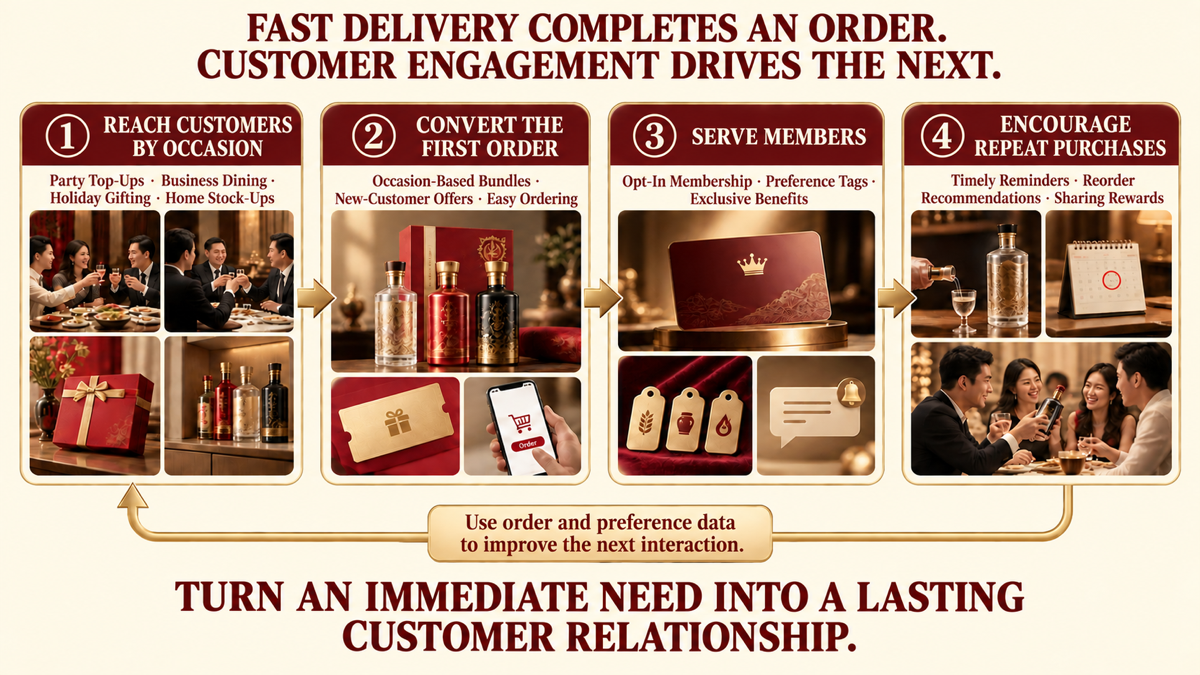
VI. Operations and Repurchase: Fast Delivery Completes One Order; Good Operations Build a Business
Alcohol instant retail needs marketing tools. Newcomer gift packs, first-purchase discounts, flash sales, countdown deals, paid membership, exclusive coupons, free tastings, community-driven referrals, combo purchases, half-off second bottles, share-to-earn rewards—none of these are decoration.
Each tactic solves a specific problem.
New users hesitate to buy? Use newcomer coupons to lower the barrier.
Users are undecided? Use time-limited promotions to push the order.
Old users don't repurchase? Use membership benefits to lock in the relationship.
Want to expand the local customer base? Use community sharing to bring in new users.
Want to increase average order value? Build combo purchases and gift-box bundles.
Operations isn't about making noise. Operations is about guiding users step by step toward transaction and repurchase.
Alcohol is especially suited for scenario-based operations.
Gathering running low? Push a quick replenishment bundle.
Business banquet? Push a mid-to-high-end baijiu combination.
Festival gifting? Push gift boxes and a dedicated gifting section.
Home stocking? Push case pricing and member pricing.
Impulse purchase? Highlight nearby stores and instant delivery.
The system provides tools; operations determine the playbook. Tools without a playbook are just features; a playbook without tools is hard to execute.
VII. Who Is This System For
First, regional alcohol merchants with multiple stores.
The more stores, the more a unified system is needed. Otherwise, orders, inventory, delivery, and settlement easily fragment. The system can turn each store into a fulfillment point, making the offline network truly functional.
Second, liquor and tobacco stores and alcohol chain stores.
These stores have local customer bases and service capability, but often lack online entry points. Through mini-programs and same-city delivery, they can connect regular customers, nearby users, and community-group users all at once.
Third, distributors with supply-chain capability.
Distributors have stock and channels, but limited ability to reach consumers directly. Through an instant retail platform, they can move from supplying goods to providing retail services, connecting supply chain, stores, and users into one line.
Fourth, alcohol enterprises looking to build dark stores and lightning warehouses.
A dark store isn't just about placing stock. It requires an order system, inventory system, delivery system, and operations system to work in concert. Otherwise, the warehouse is just a warehouse—not a sales node.
VIII. System Value: Solving the Organizational Challenge of Moving from Traditional Sales to Local Instant Retail
At its core, this system solves the organizational problem alcohol merchants face when moving from traditional selling to local instant retail.
Acquisition: Solves the problem of few online entry points and stores only waiting for customers.
Transaction: Solves the problem of inconvenient ordering and incomplete product display.
Fulfillment: Solves the problem of slow order dispatch, inaccurate inventory, and unstable delivery.
Operations: Solves the problem of campaigns being hard to execute, members being hard to retain, and repurchase being hard to improve.
Management: Solves the problem of headquarters lacking data visibility and stores operating in isolation.
Users can buy anytime. Stores can deliver nearby. Headquarters can manage centrally. Operations can run continuously.
This is the value of an alcohol instant retail system.
If you're running alcohol stores, alcohol chains, regional distribution, or same-city alcohol delivery, and you're thinking about how to connect online ordering, store fulfillment, same-city delivery, and member repurchase, feel free to leave a comment below.