
New Observations on the Liquor Industry: The Dominant Logic of Alcohol Distribution Is Shifting from Channel Stocking to Terminal Sell-Through and Consumer Operations

I. What's Really Changing Isn't Just the Channel—It's the Growth Logic Itself
The alcohol industry has always been highly channel-dependent.
On one hand, different categories—baijiu, wine, beer, Western spirits—each have long distribution chains and distinct regional characteristics. On the other hand, alcohol is inherently tied to scenario consumption: banquets, gifting, business hosting, family gatherings, casual drinks with friends, and festival stockpiling. These consumption behaviors are uneven and don't depend entirely on shelf display. Alcohol is both a commodity and a social medium—part of emotional expression, relationship building, and atmospheric settings.
Because of this, alcohol distribution was for a long time built on "channel push." Goods were first stocked with distributors, layered into stores, and then sell-through was achieved through display, promotions, rebates, atmosphere building, and holiday campaigns. That model worked, and during the industry's upcycle, it amplified the growth speed of many brands.
The problem is that today's market environment has changed.
Consumers haven't left the market, but their purchasing behavior is more cautious. Terminals haven't lost value, but the store's role is shifting. Distributors are still at the center of the channel, yet they increasingly can't close the business loop just by "distributing goods." The old logic—"once goods reach the channel, the business is mostly done"—no longer holds. Goods reaching a distributor's warehouse only means distribution is complete. Goods reaching a store only means market coverage is achieved. What truly determines business quality is whether the goods keep moving, whether the baijiu is actually opened in real scenarios, and whether consumers leave behind relationships that can be further cultivated.
This is the most important change in alcohol distribution today.
Many companies are still using old methods to solve new problems. On the surface, they're addressing inventory, price stability, and store motivation. In reality, they're facing a systemic challenge brought on by a shift in growth logic. The old logic emphasizes pushing goods out; the new logic emphasizes making consumption happen. The old logic emphasizes periodic remittance; the new logic emphasizes terminal turnover and long-term repurchase. The old logic values channel depth; the new logic values consumer reach and operational depth.
Competition in alcohol distribution is shifting from "who can push goods farther" to "who can make consumption deeper."
II. Why the Old Logic Increasingly Fails: The Marginal Returns of Channel Stocking Are Declining
The tricky part of many industry problems isn't that the old methods have completely failed—it's that they still work, but clearly aren't enough anymore.
Channel stocking in the alcohol industry today is at exactly that stage.
1. Inventory Pressure Has Become a Full-Chain Problem
In the past, high inventory was mostly a channel-internal issue. Manufacturers provided policies, distributors stocked up, terminals slowly sold through, and holiday campaigns cleared stock. There was time to trade space for time.
Today is different. Once inventory backs up, it affects not just warehouse turnover but also price stability, store confidence, and consumer perception.
When distributors have too much stock, terminals become conservative in receiving goods. When terminal turnover slows, price actions easily distort. When prices fluctuate, consumers develop a wait-and-see attitude. When one region cuts prices to clear inventory, it quickly affects the trading expectations of neighboring markets. The alcohol industry is inherently sensitive to price order—especially for mid-to-high-end baijiu and products with strong gifting attributes. Once the market forms a "let's wait and see" sentiment, transactions that should have naturally occurred get postponed.
Inventory used to be a water-level problem within the channel. Now it's more like a fast-conducting pressure pipe.
2. Consumers Are Still Buying, but the Purchasing Logic Has Changed
Many people simplistically attribute the problem to weak consumption. That's too crude and doesn't reflect the alcohol industry accurately.
Demand hasn't disappeared. Banquets, gifting, gatherings, self-consumption, business hosting—these scenarios still exist. The difference is that consumers no longer make purchasing decisions in one fixed way. Previously, strong scenarios could naturally sustain sell-through. Now, users pay more attention to scenario fit, purchase convenience, price perception, and actual use.
Wedding banquets, birthday celebrations, and academic-promotion banquets remain important sources of alcohol sales, but hosts are more careful—scrutinizing brand recognition, price-band combinations, table-level matching, and actual "face" value. Gifting scenarios remain active, but corporate procurement and personal gifting both emphasize budget efficiency, brand reliability, and recipient feedback. Casual gatherings and self-consumption scenarios have become more frequent, but this demand is more fragmented, more spontaneous, and more dependent on stores' and platforms' near-field fulfillment capabilities.
Consumers aren't stopping their baijiu purchases—they're just buying more specifically. Whoever can explain in which scenario, by whom, for what reason, and whether they'll buy again—that's who truly grasps the source of sales.
3. Price Transparency Exposes the Weaknesses of the Traditional Stocking Model
The alcohol industry once had a relatively stable price-management logic, maintained through regional systems, distribution tiers, terminal order, and market policies. Today, the speed and scope of price-information dissemination have changed.
E-commerce platforms, local lifestyle services, instant retail, content seeding, livestream selling, and social sharing have placed alcohol prices in a more open market environment. Stores know what others are charging. Consumers know too. Group-buying clients know even more. The buffer that once relied on hierarchy and information asymmetry has been severely compressed.
What does this mean? It means price stability increasingly depends on real sell-through, on whether terminals are healthy—not just on supply control and policy enforcement. Stocking without real consumption to absorb it easily becomes the starting point of price erosion at some downstream node. Once prices loosen, store motivation is the first to suffer. Once stores hesitate, channel confidence follows.
Many companies think the problem lies in difficulty controlling the market. Look one step further, and the problem actually lies in weak sell-through. When sell-through can't hold up, price stability has no foundation.
4. The Center of Gravity in Manufacturer-Distributor Relations Is Quietly Shifting
In the past, the focus of manufacturer-distributor relations was on quotas, rebates, franchise recruitment, remittance, display, market spending, and regional order. These still matter, but a clearer dividing line has emerged: who can better support terminal sell-through, who can better connect with consumers, and who can better build long-term value.
Distributors will still need capital capacity, warehousing capacity, and distribution capacity in the future, but these three capabilities alone no longer constitute a full competitive edge. Today's stronger distributors typically also possess store-tier management capability, banquet development capability, group-buying client maintenance capability, event execution capability, private-domain operational capability, and digitalization compatibility. They can help a brand sell a bottle of baijiu—and they can also help a brand retain a category of people.
This is a very important shift.
The future focus of manufacturer-distributor collaboration won't stop at "how much goods were shipped and how much was remitted." It will go deeper into "how are sales going, who's buying, why are they buying, and will they repurchase?" The channel hasn't disappeared, but it's being redefined.
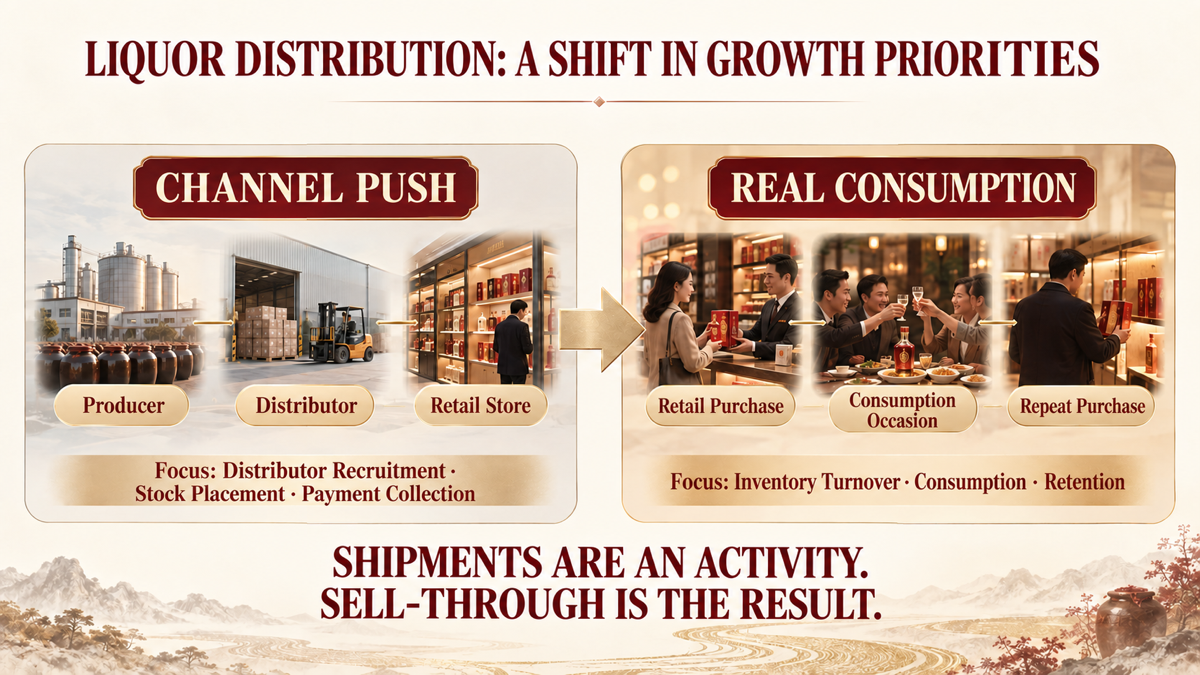
III. What Is the New Dominant Logic: From Distribution-Capability Competition to Sell-Through Capability, Scenario Capability, and Consumer-Asset Capability Competition
When the marginal returns of the old logic decline, the new logic surfaces.
The new dominant logic in alcohol distribution today can be summarized in three layers: sell-through capability, scenario capability, and consumer-asset capability.
Sell-Through Capability Determines Channel Health
Many companies still treat shipments as the core metric. Shipments matter, but they're more like a snapshot result—they can't independently explain channel health.
What truly determines channel quality is whether stores keep selling, whether restocking happens naturally, whether shelves continue to give you space, and whether terminals actively recommend your product. Behind sell-through lies the terminal's confidence in the brand, the single-store turnover efficiency, and the real temperature of the regional market.
Going forward, the more meaningful metrics will increasingly align with retail and real consumption: per-store sell-through, turnover days, open-bottle rate, banquet penetration rate, attach rate, repurchase rate, and terminal activity rate. Whoever can sustain terminal sell-through is the one who truly holds the channel.
In the alcohol industry, shipping is the action. Sell-through is the result. Looking only at actions leads to optimism. Watching results reveals the real market.
Scenario Capability Determines Whether Consumption Happens
Alcohol isn't a pure shelf product. For many categories, the final purchasing decision happens at the channel terminal. For baijiu, that final step often happens in the scenario itself.
Banquet scenarios are a composite of table-level consumption, face consumption, and relationship consumption. Whether you can enter banquets depends not just on brand power, but also on the channel's local resources, the store's recommendation capability, the product's on-table performance, the price-band fit, and the post-banquet follow-up and referrals.
Gifting scenarios test trust and reliability. What the user wants to buy isn't a bottle of baijiu per se, but a sense of propriety and a judgment that won't go wrong. How products are organized for seasonal peaks, how corporate clients are segmented and maintained, and how customization needs are handled—all affect the conversion efficiency of gift-type sales.
Gathering and self-consumption scenarios are about instant gratification and light decision-making. Consumers may buy after work, when friends show up unexpectedly, before late-night snacks, or on weekends watching a game. This demand is highly sensitive to store proximity, delivery speed, product fit, and reach efficiency.
Community scenarios test repurchase more. If community stores, baijiu shops, and convenience terminals can cultivate regular-customer relationships—building node reminders, loyal-customer benefits, baijiu pairings, and near-field services—the repurchase frequency of alcohol retail will be much higher than most people imagine.
The operational depth of the baijiu industry going forward depends largely on the depth of understanding of these scenarios. Whoever can articulate scenarios clearly, execute them meticulously, and capture the people involved—that's who gets closer to real transactions.
Consumer-Asset Capability Determines Whether Growth Is Sustainable
In the past, what many alcohol companies valued most was agency rights, channel coverage, store count, and annual remittance. These matter, but what's increasingly valuable today is whether you have a body of consumers that can be sustainably cultivated.
What kind of people count as consumer assets in the alcohol industry?
Not someone who scanned a code once. Not someone who grabbed a red envelope once. Not someone who bought a promotional bottle once. Truly valuable consumer assets are people who can be identified, categorized, reached, and prompted to repurchase.
For example, a banquet host is often connected to family celebrations, friend referrals, and other drinking scenarios. A corporate procurement client is connected to festival benefits, business gifting, and hospitality baijiu. A high-frequency regular at a liquor and tobacco store is connected to self-consumption, friend gatherings, and instant restocking. A core group-buying client in a region is connected to stable, repeatable purchasing relationships.
What's truly valuable in the future isn't how much baijiu was sold, but how many sustainably cultivable people you hold. Once consumer-asset capability is established, a brand's resilience to channel volatility, its buffer against price fluctuations, and its control over future growth all strengthen significantly.
Terminal sell-through solves for today. Scenario operations determine the present moment. Consumer assets secure tomorrow. Together, these three form the real growth foundation for alcohol distribution in the new cycle.
IV. Three Major Restructurings Underway: Terminal Restructuring, Distributor Restructuring, and Distillery Restructuring
When the logic changes, the roles in the industry follow. The most noteworthy changes in alcohol distribution right now aren't just sales-volume structure and price fluctuations—they're the simultaneous restructuring of three types of roles: terminals, distributors, and distilleries.
Terminal Restructuring: Stores Are Evolving from Sales Points to Operational Nodes
When people talk about terminals, they still habitually use traditional vocabulary like distribution, display, promotion, and stock rotation. Going forward, the value of terminals will be more complex and multidimensional.
For the alcohol industry, a store isn't just a place to sell goods. It's an entry point where consumer perception forms, purchasing decisions happen, scenario demand is captured, and relationships are built. Liquor and tobacco stores, community stores, alcohol chains, and instant-retail nodes may all appear to be selling baijiu, but they actually serve different functions.
Some stores are better suited for brand image, carrying brand display and perception reinforcement. Some are suited for sell-through, using high-frequency turnover to carry regional sales volume. Some excel at banquet development, with hotel, catering, wedding-industry, and host resources. Some have prime locations, suited for instant delivery and nighttime consumption. And some naturally carry familiar-customer relationships, making them better for member retention and high-frequency repurchase.
If distilleries and distributors continue to manage all stores as the same type of terminal, resources will become increasingly inefficient. A store's value is no longer just shelf space and purchase volume—it also includes what kind of people it connects, what scenarios it captures, and what conversion capability it possesses.
The transformation of stores from sales points to operational nodes is a critical link in the overall transformation of alcohol distribution.
Distributor Restructuring: From Wholesaler to Regional Operator
Distributors are the role most in need of upgrading in this round of change.
In the past, the core capabilities of distributors centered on agency rights, distribution networks, capital turnover, warehousing and delivery, and terminal coverage. These remain foundational, but more competitive distributors will gradually shift into regional operator roles.
What is a regional operator?
It's someone who doesn't just deliver goods to stores, but is responsible for making consumption happen continuously in the region. They understand the differences between terminal tiers—knowing which stores are suited for volume, which for brand image, which for banquets, and which for private-domain cultivation. They can maintain corporate and group-buying clients, organize festival events and tasting scenarios, collaborate with catering, wedding, and community resources, and help brands achieve consumer reach and data return.
Looking deeper, the core value of a regional operator lies in "deepening the local market." They don't just complete a single distribution—they organize the brand's local touchpoints, terminals, events, users, and repurchase rhythm into a coherent whole.
Going forward, the distributors who thrive will most likely have this capability. Those who rely solely on tier-based price spreads and brand dividends will find it increasingly difficult. Those who push deeper into regional consumer operations will find their business more stable.
Distillery Restructuring: From Managing Channels to Managing Consumption
Distilleries are changing too, and this shift will become increasingly visible.
In the past, the market work of many distilleries focused on managing regions, setting policies, maintaining prices, organizing franchise recruitment, and market coverage. Now, more companies are shifting their gaze forward—toward terminals and consumers.
This doesn't mean distilleries will bypass channels to do everything themselves. It means they must more directly understand consumption, define scenarios, organize reach, and build digital connections. Future brand competition won't be limited to advertising volume and distribution systems. It will also be reflected in who can more quickly learn what scenarios consumers buy in, why they buy, whether they repurchase, whether stores sell smoothly, and whether market spending is efficient.
This is why more distilleries are prioritizing scan-code systems, membership systems, private-domain touchpoints, digitalized terminal management, new-retail synergy, and instant-scenario capture. On the surface, these actions are scattered across marketing, channel, e-commerce, and IT departments. In reality, they all point to one thing: pushing the brand from a position "far from consumption" to one "close to consumption."
The capability distilleries truly need to build isn't just managing channels—it's managing the entire process of consumption happening.
V. Terminal Sell-Through and Consumer Operations Aren't Slogans—They're a New Operating System
After understanding the industry trends, what truly separates winners is still execution.
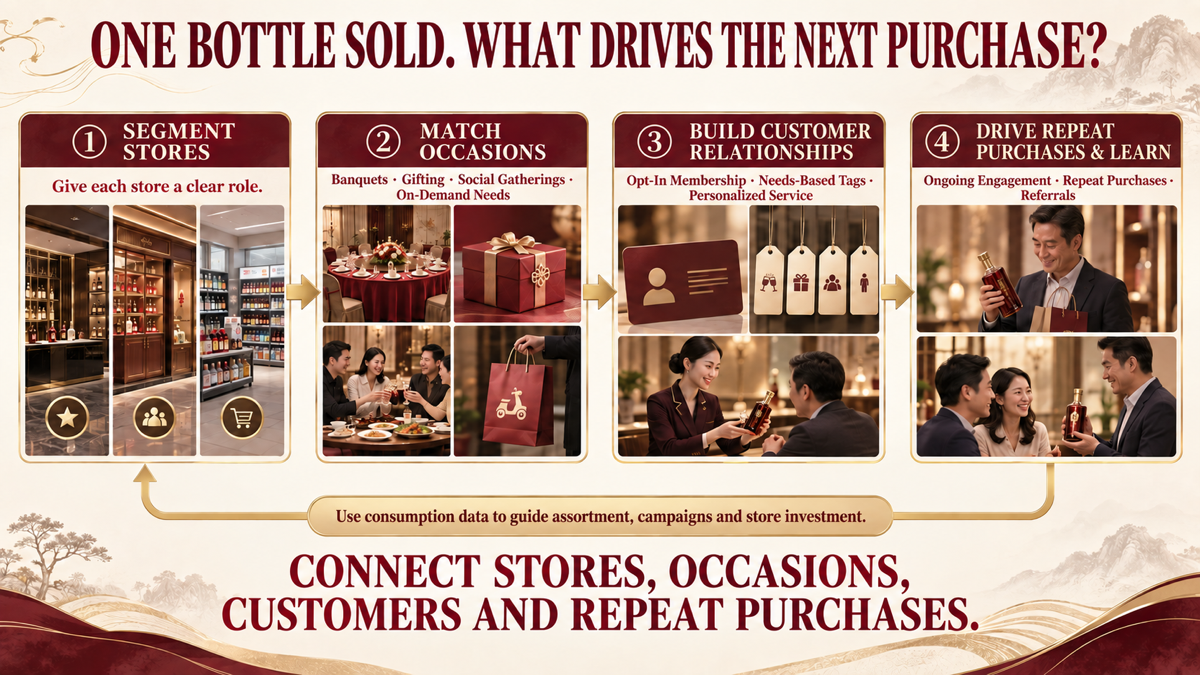
Terminal sell-through and consumer operations—many companies talk about them, but doing them well requires not isolated tactics but a complete operating system. The value of a system lies in its ability to truly connect stores, scenarios, users, and repurchase.
First, Tier Your Terminals for Effective Resource Allocation
The problem for many distilleries and distributors isn't insufficient resources—it's that resources are spread too evenly.
One display policy covers all stores. One promotion covers all stores. One set of targets is pressed on all stores. The result: no focus, diluted spending, terminals feeling nothing, and sell-through never truly lifted.
The alcohol industry is better suited for terminal tiering.
Image stores: brand display and price anchoring.
Sell-through stores: regional sales volume and high-frequency turnover.
Banquet stores: table-by-table penetration and host-relationship cultivation.
Community stores: regular-customer repurchase and near-field service.
Instant-retail stores: impulse consumption and nighttime scenario capture.
Group-buying stores: corporate clients, business hosting, and gifting demand.
Once terminal tiers are clearly defined, policies become more precise. What product range for which stores, what activities for which stores, what targets for which stores—all become clearer. The benefit isn't just improved resource efficiency; more importantly, it lets stores understand their role in the regional system.
Organize Products and Activities Around Scenarios—That's How Baijiu Actually Sells
All high-quality sales in the alcohol industry ultimately return to scenarios.
Banquet scenarios: the key isn't just getting baijiu into weddings, birthday celebrations, or house-warming banquets. It's about deepening reach and conversion around each table of guests. Why did the host choose you? What was the on-table feedback? Did guests make subsequent purchases? Did the banquet scene become the entry point for the brand's first relationship with new users? These determine the real value of banquets.
Gifting scenarios: the key lies in seasonal peaks and client management. Selling a wave of goods before a festival has limited value. When corporate client lists, interaction frequency, procurement preferences, and price-band needs are systematically captured, value becomes sustainable. Gift-type sales may look like node-based business, but they actually test client-management capability.
Gathering scenarios: the core is immediacy and atmosphere. Much of this consumption isn't planned in advance—it's triggered in an instant: a spontaneous get-together, friends dropping by, a game-watching party, a late-night continuation. Whoever is closer to the user, whoever can deliver faster, whoever can offer a better product combination—that's who closes the sale.
Community and self-consumption scenarios: better suited for high-frequency repurchase. The per-transaction AOV may not be high, but once a regular-customer system is established, repurchase stability is strong. The store owner's understanding of regulars, enterprise-WeChat reach frequency, holiday reminders, pairing suggestions, and home-delivery service all become drivers of consumption.
Baijiu sells well not because of a one-time promotion, but because the scenario was captured.
Use Digital Tools to Genuinely Retain People
Many companies talk about consumer operations, but it still comes down to running a scan-to-win lottery, sending red envelopes, or pulling people into a campaign group chat. Short-term buzz, zero long-term accumulation.
Truly valuable digital actions have one core purpose: retaining people, not making noise.
Scanning a code should connect on the front end to product, channel, and campaign, and on the back end to membership identity, consumption records, benefits, and subsequent reach. When a consumer scans, the system should know which region they're from, what product they bought, in which scenario they purchased, and whether they belong to a key segment. Only when identification happens can subsequent reach, tiering, benefits, and repurchase reminders become meaningful.
Membership systems shouldn't stop at points accumulation. In the alcohol industry, membership is better tied to scenarios, tied to benefits, tied to relationship maintenance. Some members are suited for banquet services, some for seasonal gifting reminders, some for new-product tastings, some for high-frequency regular-customer perks. Static membership has no operational value. Tiered membership does.
The same goes for enterprise WeChat and community groups. Pulling customers into a group doesn't equal building a relationship. Truly effective reach means delivering the right content at key nodes: pre-festival purchase reminders, banquet baijiu recommendations, regular-customer exclusive benefits, friend-gathering recommendations, in-store event invitations, and seasonal themed content. When reach has value, relationships stabilize.
Once the chain from scanning to membership, from enterprise WeChat to repurchase is connected, consumer operations transform from concept to operational capability.
Use Instant Retail to Capture Impulse Demand and Incremental Consumption
A portion of the alcohol industry's next increment is clearly identifiable—it comes from instant demand.
In the past, much alcohol consumption depended on planned procurement. Now, more and more demand is spontaneous: friends suddenly visiting, wanting a drink in the evening, running out of baijiu mid-party, last-minute festival gifting, nighttime restocking. These scenarios demand speed and convenience.
Whoever can connect store inventory, online entry points, delivery capability, and nearby users has the opportunity to capture this demand. The value of instant retail isn't just a few extra orders—more importantly, it transforms random demand that would otherwise be lost into a sustainably cultivable user entry point.
Many stores used to look only at natural walk-in foot traffic. Going forward, they'll increasingly pay attention to "what do nearby users need right now." Instant retail isn't a supplementary channel—it's already a standard practice in many alcohol consumption scenarios.
Use Real Consumption Data to Reverse-Engineer Channel Policies and Market Investment
In the future, companies doing market work can no longer just look at shipments and remittances. Looking at those alone leads to overestimating the effect of short-term actions and underestimating real terminal problems.
A more effective approach is to let resources follow real consumption.
Which stores have stronger sell-through? Which stores bring high-value users? Which campaigns actually drive repurchase? Which regions have higher banquet penetration? Which group-buying clients have more growth potential? Which users are suitable for being cultivated through enterprise WeChat? This data should all become a key basis for resource allocation.
Market spending should no longer just be a tool for driving a one-time sales spike. It should become a lever for driving long-term operations. When policies are directed at terminals and channels that can truly drive sell-through, cultivate consumers, and generate repurchase, the system becomes healthier.
The value of consumer operations was never about "adding another set of tools." It's about changing the logic of resource allocation—shifting the business from pushing shipment after shipment toward long-term cultivation.
VI. Who Will Break Through First: The Next Round of Alcohol Growth Belongs to Companies Closer to Real Consumption
After understanding this round of changes, looking back at the future differentiation of the alcohol industry, the logic becomes clear.
The companies that break through first will likely share several common traits.
They have real users, not just inventory. They understand scenarios—knowing how to manage banquets, gifting, gatherings, self-consumption, and instant demand separately. They treat stores as operational nodes, not just distribution tasks. They use digital systems to connect products, terminals, and consumers, turning one-time purchases into long-term relationships. They don't just care about remittance—they genuinely care about sell-through, open-bottle rates, repurchase, and consumer retention.
These capabilities may appear scattered, but they all point to one thing: being closer to real consumption.
The alcohol industry will continue to have brand competition, category competition, price-band competition, and channel competition. But the fundamental dividing line will become increasingly clear. Whoever can understand consumers, capture them, and retain them will have a better chance of stabilizing prices, holding terminals, amplifying repurchase, and weathering cyclical volatility.
Competition will continue to happen within channels, but the key to victory increasingly rests in the hands of consumers.
We Empower the Next Round of Competition in Alcohol Distribution
We provide long-term service for the digital operational upgrading of alcohol industry enterprises. Our capabilities span scan-code engagement, sealed-cask customization, banquet lucky draws, instant retail, membership systems, tagging systems, public-domain matrices, enterprise WeChat reception, points-based campaign planning, terminal sell-through management, consumer operations, and repurchase conversion—helping companies connect products, stores, terminals, and users into a true operational loop. What the alcohol industry will compete on in the next phase isn't just the ability to sell goods—it's the ability to cultivate consumers sustainably.
If you're thinking about how to shift alcohol distribution from a stocking mindset to a sell-through mindset, or how to move from channel management toward consumer operations—this is a topic worth taking a serious step forward on.