
Pang Dong Lai's 1-Billion-Yuan Baijiu Myth Shattered in Six Months: Whose Trend Is Retail-Giant Custom Baijiu Really?
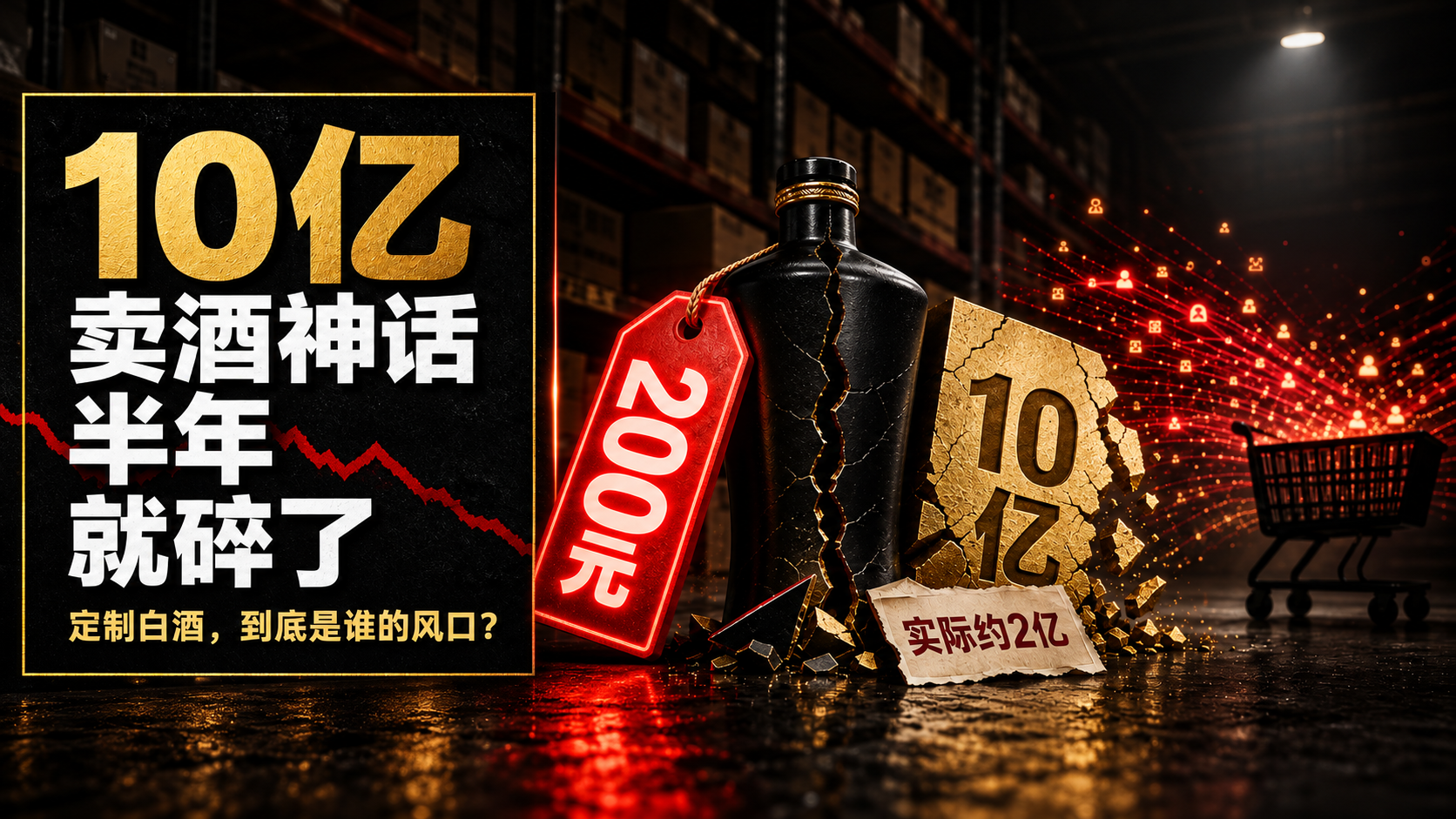
Last July, Pang Dong Lai's founder Yu Donglai posted a video saying the "Freedom Love" single SKU could reach 1 billion yuan in 2025 sales. That day, Jiugui Liquor's stock hit the daily limit, and the next day it climbed nearly 6% more. Moments feeds were flooded. Everyone thought the trend had arrived.
Then the 2025 annual report came out.
Pang Dong Lai's channel contributed roughly 200 million yuan to Jiugui Liquor for the full year. Of the 1-billion target, less than 20% was delivered.
More painfully, Jiugui Liquor's 2025 revenue was 1.108 billion yuan, down 22.2% year-over-year. Net profit attributable to shareholders showed a loss of 33.95 million yuan—the first loss in a decade. Inventory rose from 1.75 billion to 1.9 billion yuan, with capacity utilization below 30%. The more they sold, the heavier inventory pressed down.
A 1-billion-yuan pie was drawn. A 200-million-yuan slice was eaten. Where did the remaining 800 million go?
Eaten by traffic.
I've been turning this over in my head for a long time. Retail-giant custom baijiu—whose trend is it really?
The Phenomenon
Let's start with what's happening. Pang Dong Lai, Sam's Club, Hema, Walmart, ALDI—this year, they're all doing the same thing: finding distilleries to make custom baijiu.
Pang Dong Lai was the first to break out. Back in 2022, they partnered with Baofeng Liquor to launch "Freedom Love 1995," priced at 70 yuan a bottle, selling 100,000 cases a month, and moving roughly 600 million yuan in 2024. This July, they teamed up with Jiugui Liquor to release "Jiugui · Freedom Love," priced at 200 yuan. It sold out on Douyin the day it launched. Pang Dong Lai stores tightened purchase limits from 5 cases to 2. After it hit Changsha's Bubugao shelves, daily sales exceeded 600,000 yuan, moving 3,000 cases a day.
At Sam's Club, the "Jiangjun Ting" fenjiu in 950ml bottles sells for 115.9 yuan. The Sam's app shows monthly sales exceeding 10,000 units, sitting firmly at #1 on the baijiu popularity chart. Insiders estimate that across Sam's and Costco, sales will approach 1 billion yuan this year. The 99.9-yuan 1-liter Green Neck Xifeng is also selling strongly. Non-standard-format name brands like the 750ml Yuan Xijiu and 1-liter Luzhou Laojiao Touqu are all hot sellers.
Hema is steadier. Last year they partnered with Fenyang Wang to launch "Qingxiang No. 1" light-bottle baijiu, selling 20 million yuan in six months. This year's growth is nearly 80% year-over-year, and a second product, "Qingxiang No. 1 20," is about to launch, priced under 200 yuan. Hema's white and yellow liquor buyer told me that OEM baijiu will account for over 10% of Hema's baijiu product lineup this year, with 6–7 new SKUs before the Mid-Autumn Festival, covering strong-aroma, light-aroma, and sauce-aroma categories.
Walmart partnered with Guizhou Wuxing Liquor to create the "Huiyi Maotai Town Sauce-Aroma Baijiu" at 99.9 yuan, targeting the staple-drink sauce-aroma segment. ALDI went even more aggressive: 9.9 yuan for 52% ABV pure-grain strong-aroma baijiu, 19.9 yuan for light-aroma, and 32.9 yuan for a 3-liter barrel of strong-aroma—prices pushed to the floor. Yonghui partnered with Bobo Sauce Liquor for the "Yongyuehui Xiaozhuo" light-bottle sauce-aroma baijiu, selling over 3,000 cases a month. Henan regional supermarket "Taoxiaopang" also launched a custom light-aroma light-bottle baijiu, with solid sales.
You might wonder: why are all these retail giants suddenly fixated on baijiu?
Two Reasons
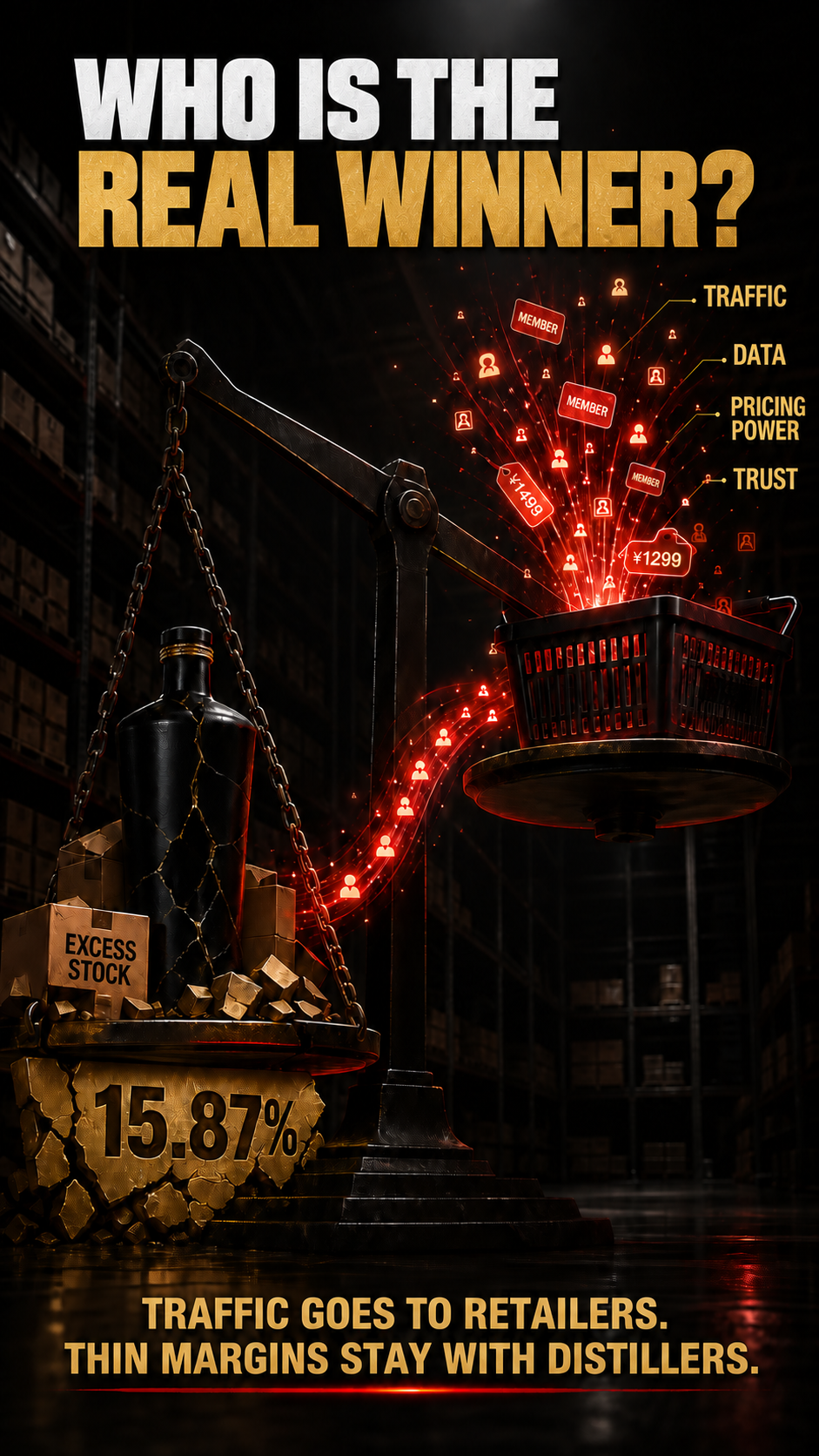
Two reasons. First, business banqueting and gifting scenarios are shrinking, while self-consumption and casual gatherings are rising. Demand is strongest for staple baijiu under 300 yuan. Retailers deal with consumers every single day—their data is sharper than the distilleries'. They know exactly which price band, which aroma type, which bottle size sells best. Hema locked onto the "hundred-yuan light-aroma" pain point through data analysis before approaching Fenyang Wang with a custom requirement: the baijiu body had to reach 80% of the quality of Qinghua Fen 20, with price kept under 168 yuan.
The second reason is more practical. Private-label profits dwarf name-brand margins. Name-brand baijiu prices are transparent—retailers barely make anything. With private label, pricing power is in their hands, and the profit margin is whatever they decide.
Retail giants don't lack baijiu to sell. What they lack is baijiu that tells a story.
The Most Interesting Part
The most fascinating thing about this story is that Pang Dong Lai did something no one in the industry dared: they published the costs.
Jiugui · Freedom Love is priced at 200 yuan a bottle. Pang Dong Lai laid out every cost line: comprehensive cost 168.26 yuan, supply price 115.3 yuan, taxes 39.7 yuan, development cost 13.3 yuan. Gross profit: 31.74 yuan. Gross margin: 15.87%.
Do you see the problem?
Jiugui Liquor's overall gross margin in 2025 was 65%. The Neican series: 87%. The Jiugui series: 67.4%. The version sold to Pang Dong Lai: 15.87%.
Roughly a 50-percentage-point gap.
What did Jiugui Liquor gain by selling to Pang Dong Lai at 15.87% margin? On the surface, 200 million in incremental revenue. But strip out the Pang Dong Lai channel and look again: Jiugui series revenue shrank from 830 million to 460 million—nearly cut in half. The 200 million Pang Dong Lai brought in can't fill the 400-million hole left by other channels.
Let's run another set of numbers. What did Pang Dong Lai gain? Reputation, traffic, consumer trust. "Freedom Love" generated enormous buzz for Pang Dong Lai. That buzz converts into foot traffic, converts into other category sales—far beyond the 15.87% margin on the baijiu itself. Pang Dong Lai doesn't need the profit from the baijiu. It needs the traffic and trust the baijiu brings.
What did consumers gain? Value for money. Two hundred yuan buys baijiu claimed to be worth 600 yuan. Industry insiders say the baijiu body for Jiugui · Freedom Love benchmarks against Jiugui Liquor's 600–700 yuan tier products. Even if it doesn't quite reach that level, 200 yuan for this quality is genuinely a good deal.
What did the distillery gain?
Honestly, you have to look at this closely. Short-term, there's incremental volume—no argument there. 200 million in revenue for a company doing 1.1 billion total is nearly 20%, not insignificant. But long-term, brand value is being diluted. Consumers remember "Pang Dong Lai's baijiu," not "Jiugui Liquor." The Freedom Love brand is led by Pang Dong Lai; Jiugui Liquor is just the supplier behind it. Channel dependency is also forming: if Pang Dong Lai sells well, you must keep supplying at low margins. Once the partnership stops, the 200 million in incremental revenue vanishes overnight—but you've already been pushed out of other channels, and going back isn't easy.
Retailer custom baijiu, at its core, is trading your brand for their traffic. The traffic belongs to the retailer. The brand belongs to you, the distillery.
The Distributor Bypass
Traditional baijiu distribution has three tiers: manufacturer, distributor, and retail terminal. The distributor is the throat in the middle, profiting from information asymmetry and channel spreads.
Now retailers are going straight to distilleries for custom products. Distributors are being bypassed entirely.
The crueler cut is Pang Dong Lai's cost transparency. In traditional channels, markups cascade from distillery to consumer, typically adding 40%–60%. Pang Dong Lai compressed the markup to under 20% and then published every cost line. It amounts to telling everyone: all that money the traditional baijiu channel adds is pure padding.
I have a friend in the baijiu business, a regional distributor in Henan for over a decade. Last year he told me the hardest part now is not knowing what to sell. If something doesn't move, you can find a workaround. But if you pick the wrong category, everything falls apart. Name-brand prices are inverted—sell a bottle, lose money on a bottle. Retailer private labels are pulling consumers away. His network of terminal retail points used to be an asset; now it increasingly feels like a liability.
The distributor's predicament, how to put it... If they don't go with the retailers, they watch consumers get siphoned away. If they do, they go from channel partner to delivery service, margins pressed to the floor, with zero pricing power.
This is exactly what happened in the home appliance industry. When Gome and Suning rose, appliance distributors were bypassed too. Brands supplied channels directly, and distributors went from partners to redundant links. In the end, the channel players took pricing power, and brand profits were squeezed lower and lower. Baijiu is walking the same path.
Distributors used to be the throat of baijiu distribution. Now retailers have performed a bypass—going straight past the throat, directly to the heart.
So Whose Trend Is It?
Back to the opening question: retail-giant custom baijiu—whose trend is it really?
This can't be answered with a single stroke. Let me break it apart.
Retailers are the real winners. They hold three leverage points: traffic, data, and pricing power. Pang Dong Lai used "Freedom Love" to win buzz; Sam's Club used "Jiangjun Ting" to win member stickiness; Hema used "Qingxiang No. 1" to win category differentiation. They don't need baijiu profits—they need the traffic and trust the baijiu brings. Baijiu is just a hook to pull consumers into stores, onto apps, and into memberships.
Small and mid-sized distilleries have an opportunity to get on board, but the cost is significant. Baofeng Liquor leveraged "Freedom Love" to climb from a regional brand into the second tier of light-aroma baijiu—the growth is real. But the cultivation period is long. Freedom Love launched in late 2022 and only broke out this year—that's three to four years in between. In the early days, it was only doing 10–20 million in volume. Many distilleries wouldn't have given it a second look. Jia Fuchun, who does marketing consulting in the industry, put it bluntly: if a manufacturer can lower its posture and embrace quality retail, this is a sound strategy for surviving the cycle—but you have to accept low margins, long cycles, and brand dilution happening simultaneously.
The staple-drink price band is genuine demand. Under 300 yuan, quality benchmarking against 600 yuan—consumers are indeed buying baijiu more rationally. This demand isn't fabricated.
But top-tier distilleries can't take this path. Moutai and Wuliangye won't do OEM for retailers—their brand assets are too valuable. A 15% margin can't cover their operating costs and brand-maintenance investment either.
For distributors, I'll say it directly: this is an alarm. You must find value that retailers can't replace. Service, scenarios, private-domain communities—these three things retailers can't do, but your decade-plus of local resources can. Do them well, and you can still live decently. Do them poorly, and you're the next link to be bypassed.
The Wind Never Deceives
The wind never lies. What deceives is the person standing in it, thinking they're the pig. *[1]
Retail-giant custom baijiu has brought this business into the spotlight. But what custom demands of the distillery itself is higher than anyone imagines.
A single Pang Dong Lai order starts at the million-level. Sam's Club's Jiangjun Ting required Fenyang Wang to restructure production plans. To handle orders like these, relying on WeChat groups to send images and Excel for scheduling, with production progress tracked manually—none of it scales. Wrong order, wrong packaging, late delivery—and the retailer's trust evaporates in a second.
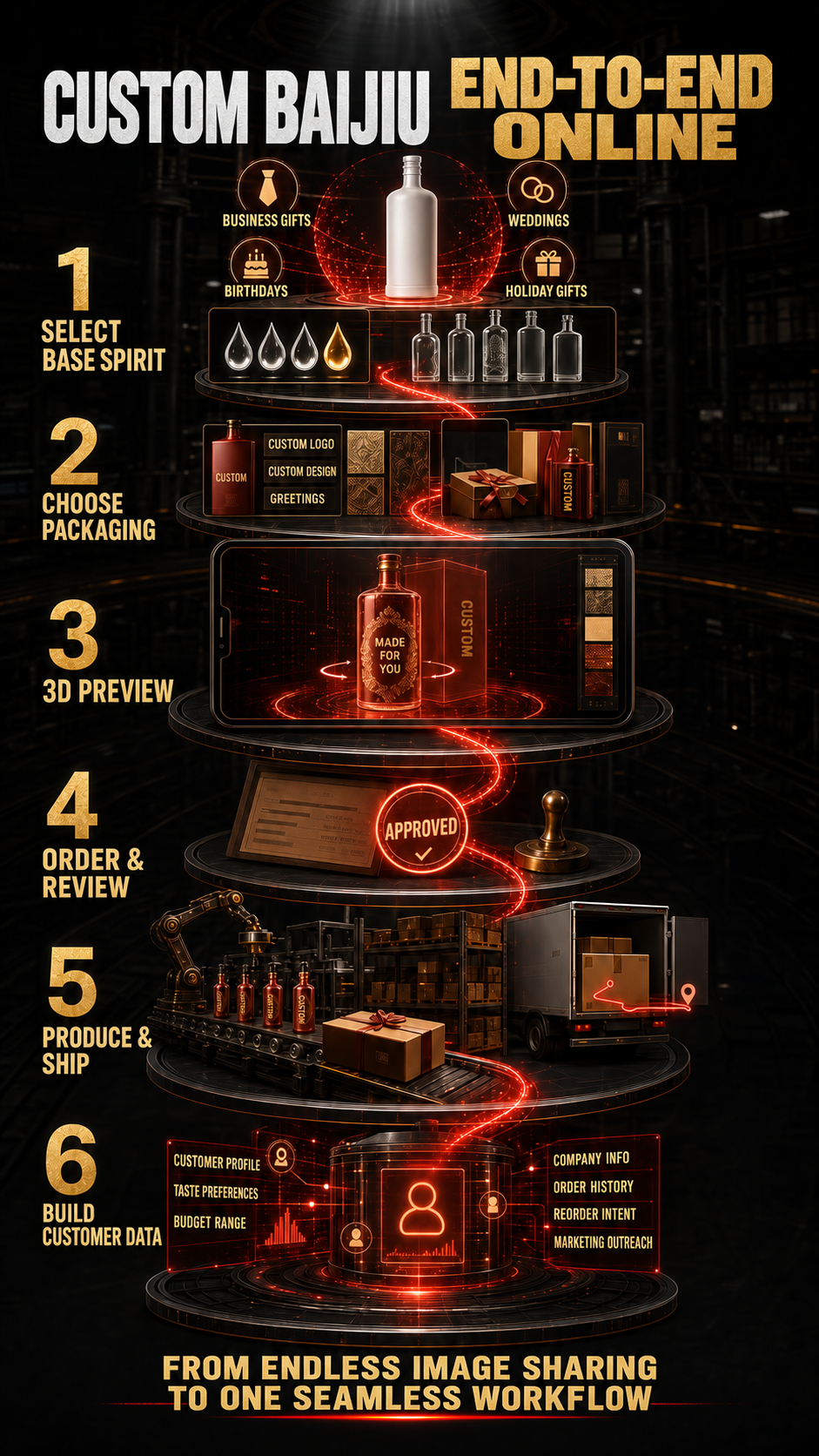
It's even harder when distilleries try to run consumer customization themselves. Wedding banquets, corporate gifts, birthday commemorations—every client wants something different. Which baijiu body, which bottle type, what text on the label, how to configure the gift box—the traditional approach means sending images back and forth for confirmation. Designers are exhausted, clients are frustrated.
This can't be carried by people. It needs a system to bring the entire customization workflow online.
The custom baijiu system we built does exactly this—helping distilleries and distributors move the whole process online. Consumers select the baijiu body, capacity, bottle type, and packaging material in WeChat, upload images, write a personalized message, and preview the finished product in real-time 3D. Once confirmed, they place the order and pay. The backend runs the full pipeline: requirement submission, proposal confirmation, payment, approval, production scheduling, inventory, logistics, and progress tracking—all in one line, no more reconciling across five or six group chats.
For distilleries, the most valuable thing is data accumulation. Who ordered wedding-banquet baijiu, who's a corporate client, who sends festival gifts every year, who's a high-value spender—the system remembers. Next festival campaign, banquet supply, member repurchase—you pull the list and target precisely, no more starting from scratch to find customers.
Retail giants have already proven with their traffic that the demand for custom baijiu is real. The remaining question is how distilleries can take on this business, retain it, and deepen it.
If you're thinking about how to bring your custom baijiu business online, or want to see how peers are using systems to boost customization efficiency, leave a comment below. No rush to buy—first map out your business scenarios and see whether a system can actually support them.
In the next decade, the baijiu industry will compete on one thing: how close you are to the consumer.
[1] A reference to the Chinese saying "even a pig can fly if it stands at the mouth of the wind" (站在风口上,猪都能飞), popularized by Lei Jun, founder of Xiaomi. It means a rising trend lifts everyone—but also implies those lifted may mistake the trend for their own ability.